Qwen-Image-2.1 in PIC STUDIO — benchmark v2 against its predecessors
Text-to-image, infographics, prompt-format precision, brand campaigns with real assets, and editing — Qwen-Image-2.1 (generator + editor) vs Qwen-Image-2512 Lightning, Z-Image-Turbo and Qwen-Image-Edit-2511. Every image: one generation, seed 3407, no cherry-picking. Scores by the vision judge on GPU 0; measured values where possible.
1 · Text-to-image: general prompts
Eight requests covering portrait, product, spatial layout, exact signage, landscape, flat illustration, action and interior. The same rewritten prompt goes to every model; Qwen-Image-2.1 renders at native 2K, the predecessors at their native area. The second column, when present, is Qwen-Image-2.1 with CFG 3.0 and the configured negative prompt (twice the render time): it won 15 of 16 pairwise verdicts against cfg 1.0 and is now the tab's default (PIC_STUDIO_QI21_CFG=3.0).
| Series | Value |
|---|---|
| QI-2.1 | 9.34 |
| QI-2.1 cfg3 | 9.47 |
| QI-2512 L | 9.38 |
| Z-Turbo | 9.38 |
| Series | Value |
|---|---|
| QI-2.1 · adherence | 9.62 |
| QI-2.1 · realism | 8.88 |
| QI-2.1 · aesthetics | 8.88 |
| QI-2.1 · text | 10 |
| QI-2.1 cfg3 · adherence | 9.88 |
| QI-2.1 cfg3 · realism | 9 |
| QI-2.1 cfg3 · aesthetics | 9 |
| QI-2.1 cfg3 · text | 10 |
| QI-2512 L · adherence | 9.50 |
| QI-2512 L · realism | 8.88 |
| QI-2512 L · aesthetics | 9.12 |
| QI-2512 L · text | 10 |
| Z-Turbo · adherence | 9.62 |
| Z-Turbo · realism | 8.88 |
| Z-Turbo · aesthetics | 9 |
| Z-Turbo · text | 10 |
Pairwise verdicts
| Pair (both A/B orders judged) | 2.1 wins | predecessor wins | ties | 2.1 win rate | verdicts |
|---|---|---|---|---|---|
| Qwen-Image-2.1 vs Qwen-Image-2512 Lightning (FP4) | 5 | 11 | 0 | 31 % | 16 |
| Qwen-Image-2.1 vs Z-Image-Turbo | 4 | 12 | 0 | 25 % | 16 |
| Qwen-Image-2.1 · cfg 3.0 + negative prompt vs Qwen-Image-2512 Lightning (FP4) | 8 | 8 | 0 | 50 % | 16 |
| Qwen-Image-2.1 · cfg 3.0 + negative prompt vs Z-Image-Turbo | 7 | 9 | 0 | 44 % | 16 |
| Qwen-Image-2.1 · cfg 3.0 + negative prompt vs Qwen-Image-2.1 | 15 | 1 | 0 | 94 % | 16 |
close-up portrait of a middle-aged woman with short grey hair and green eyes, wearing a navy blazer, soft window light, neutral grey background
rewritten prompt sent to every model (176 words, aspect 3:4)
A close-up portrait of a middle-aged woman with short, neatly styled grey hair and striking green eyes. She wears a structured navy blue blazer over a simple white blouse, the fabric showing subtle texture and fine stitching. Her expression is calm and composed, with a slight, knowing smile, and her gaze is directed straight into the lens. Soft, diffused window light illuminates her face from the left, creating gentle highlights on her cheekbones and casting soft shadows that define her features. The background is a smooth, neutral grey, providing a clean and unobtrusive backdrop that keeps the focus entirely on the subject. The lighting is natural and even, enhancing the realistic skin texture and the depth of her eyes. The camera uses a medium telephoto lens with a shallow depth of field, blurring the background slightly to isolate the subject. The overall mood is professional and serene, with a muted color palette dominated by greys, navy, and soft skin tones. The image is a high-resolution photograph with sharp focus on the eyes and natural color rendering.

- The skin texture on the neck shows slight smearing and loss of fine detail compared to the face.
- The lighting on the left side of the face is slightly flat, reducing the three-dimensional depth of the features.

- The lighting on the left side of the face is slightly flat, reducing the three-dimensional depth of the features.
- The texture of the navy blazer appears somewhat uniform and lacks the subtle variation of a real fabric weave.
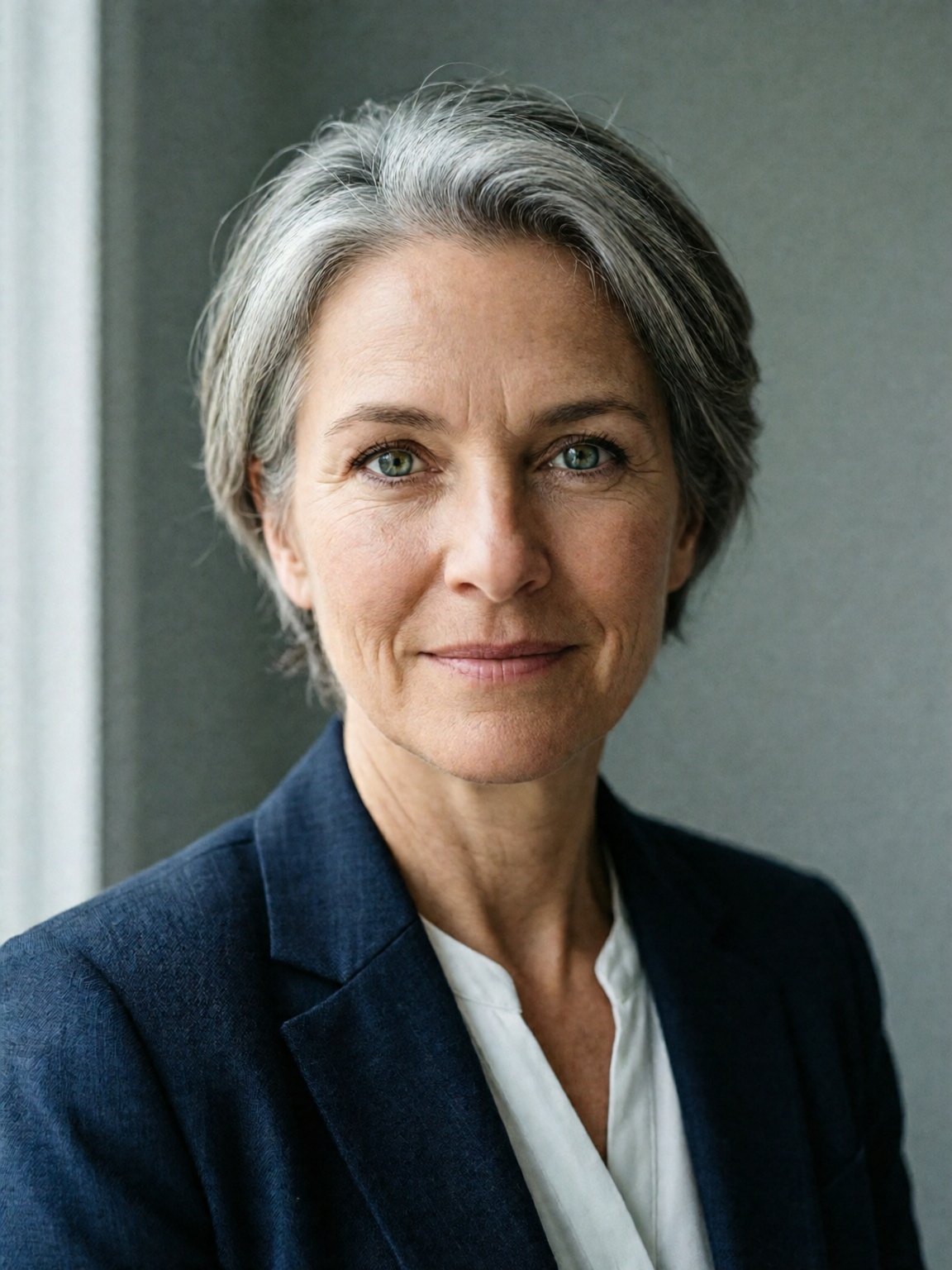
- The lighting is slightly flat, lacking the distinct directional quality of strong window light.
- The background is a uniform grey without the subtle depth or texture often found in professional portraits.

- Slight softness in the hair texture that borders on smearing rather than distinct strands.
- The background is a flat grey which, while requested, lacks the subtle depth or gradient often seen in professional portraits.
a matte black wireless headphone on a walnut desk next to a white ceramic mug, morning light from the left, shallow depth of field
rewritten prompt sent to every model (167 words, aspect 4:3)
A matte black wireless headphone rests on a polished walnut desk, its sleek over-ear cups and padded headband catching the soft glow of the morning. Beside the headphone, a simple white ceramic mug sits empty, its smooth surface reflecting the ambient light. The scene is bathed in warm, directional morning light streaming from the left, casting long, gentle shadows across the wood grain. The background is a soft, indistinct blur of neutral tones, emphasizing the shallow depth of field that isolates the objects in sharp focus. The texture of the matte plastic contrasts with the glossy finish of the ceramic and the natural sheen of the walnut. The color palette is muted and earthy, dominated by deep blacks, warm browns, and clean whites, creating a calm and minimalist atmosphere. The camera captures the scene from a slightly elevated angle, using a prime lens to achieve the creamy bokeh effect. The image is a high-resolution photograph with realistic lighting and material rendering, devoid of any lettering or text.
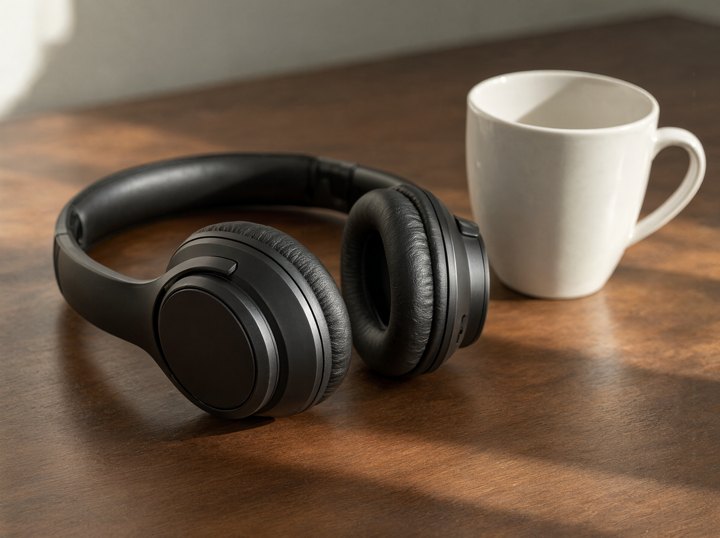
- The shadow cast by the mug on the right side is slightly inconsistent with the strong directional light coming from the left.
- The texture on the headphone earcups appears slightly too uniform and synthetic, lacking the micro-scratches of real matte plastic.
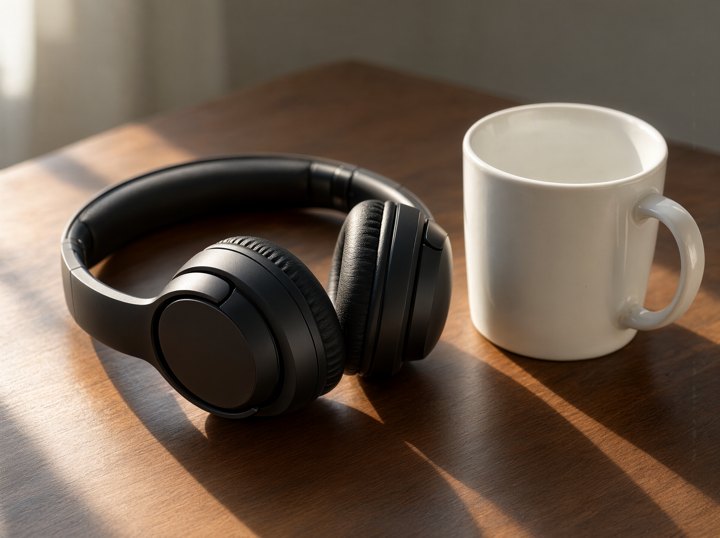
- The shadow cast by the mug on the right appears slightly disconnected from the object's base.
- The texture on the headphone earcups is somewhat uniform and lacks the subtle imperfections of real matte materials.
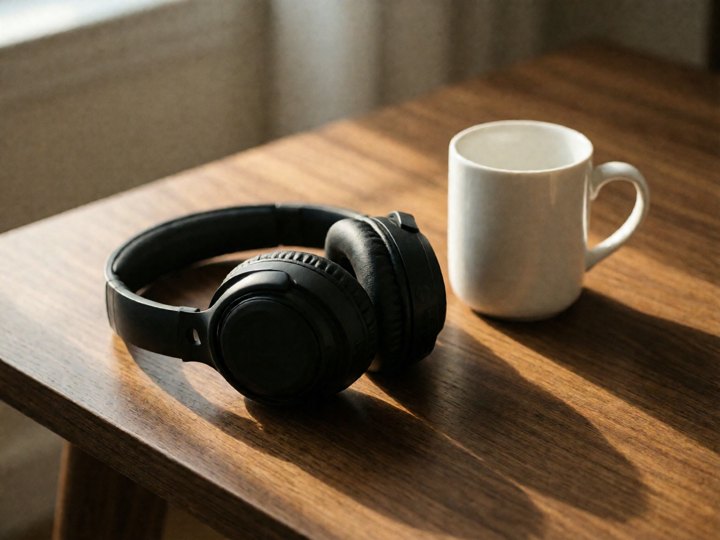
- The shadow cast by the mug appears slightly detached from its base, creating a minor physics inconsistency.
- The texture on the headphone earcups is slightly smeared and lacks fine definition in the shadowed areas.
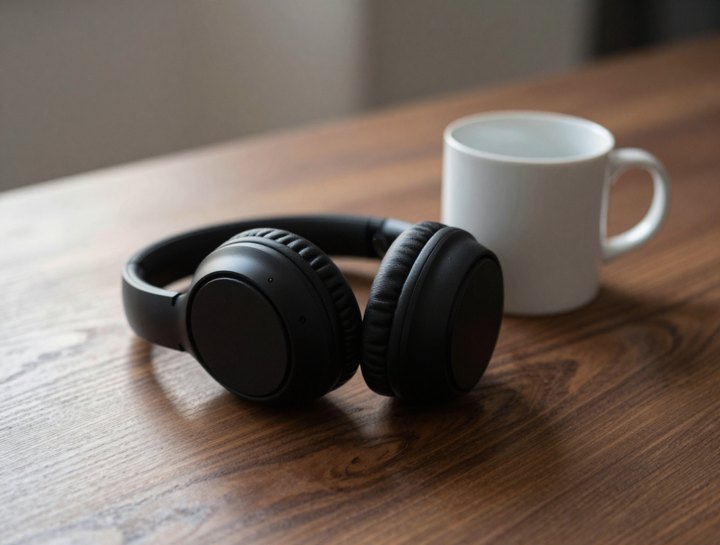
- The headphone headband appears slightly flattened where it meets the table, lacking the natural curvature of a resting object.
- The lighting is soft and diffuse, which does not strongly convey the specific 'morning light' quality requested.
a red cube on the left, a blue sphere in the middle and a yellow pyramid on the right, standing on a white table, studio lighting
rewritten prompt sent to every model (197 words, aspect 16:9)
A minimalist still life composition features three distinct geometric shapes arranged in a horizontal row on a pristine white table surface. On the far left, a matte red cube sits with sharp, defined edges, its flat faces reflecting the ambient light subtly. In the center, a smooth blue sphere rests, its curved surface creating a soft gradient of highlights and shadows that emphasize its perfect roundness. To the right, a yellow pyramid stands with a solid base, its triangular facets catching the light to reveal a faceted texture. The objects are evenly spaced, creating a balanced and symmetrical arrangement. The background is a seamless white void, eliminating any distractions and focusing attention entirely on the primary subjects. Studio lighting illuminates the scene from the front and slightly above, casting soft, diffuse shadows beneath each shape that ground them on the table. The lighting is even and controlled, typical of a professional product photography setup, ensuring that the vibrant primary colors of the red, blue, and yellow objects pop against the neutral white environment. The image is a high-resolution digital render or photograph, characterized by clean lines, precise geometry, and a lack of any lettering or additional text.
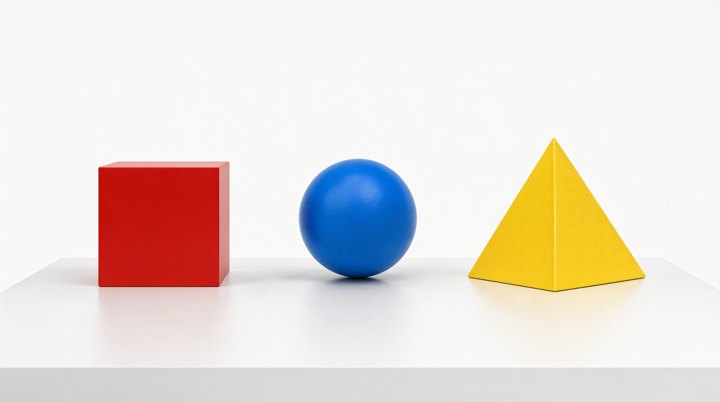
- The blue sphere has a slightly soft, matte texture that lacks the crisp specular highlight expected of a perfect studio render.
- The shadows cast by the objects are very faint and diffuse, which slightly reduces the sense of depth and grounding on the table.
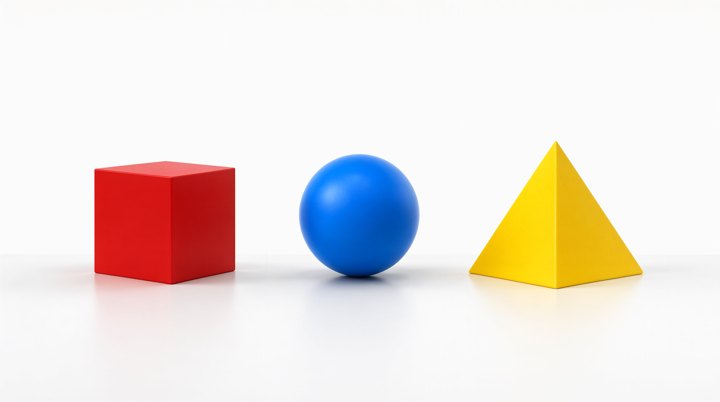
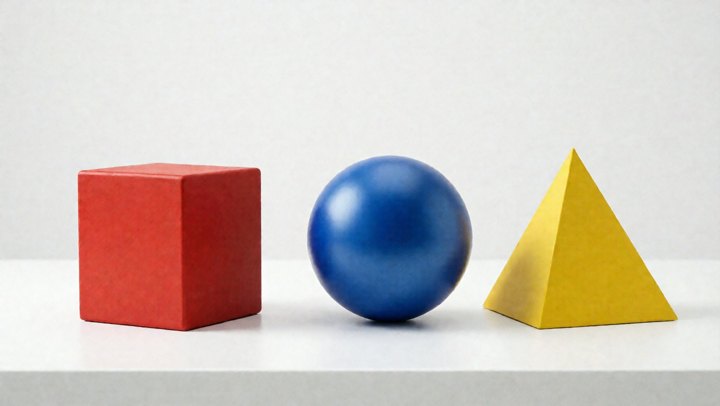
- The blue sphere has a slightly glossy, plastic-like finish that contrasts with the matte texture of the other objects, which may be intentional but breaks uniformity.
- The shadows are very soft and diffuse, which is consistent with studio lighting but lacks the sharpness often seen in high-end product photography.
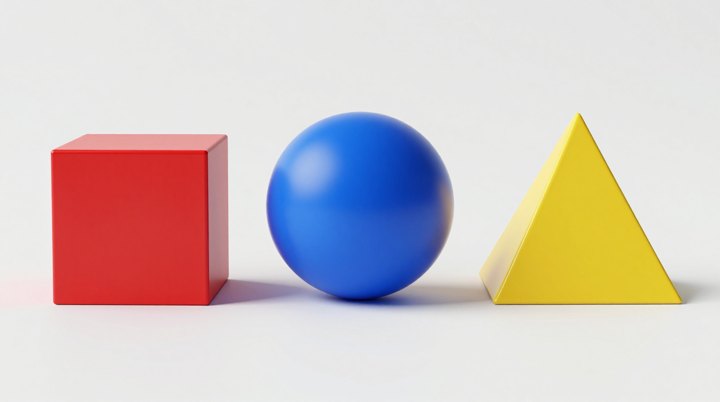
- The yellow pyramid's left face is slightly darker, which is consistent with lighting but could be seen as a minor shading inconsistency.
- The shadows are very soft and diffuse, which is typical for studio lighting but lacks some crispness for a high-end professional look.
a vintage bakery storefront with the sign "Golden Crust" above the door and two round tables outside
rewritten prompt sent to every model (170 words, aspect 3:2)
A charming vintage bakery storefront features a weathered wooden facade with peeling cream paint and exposed brick accents. Above the glass-paneled double doors, a hand-painted wooden sign displays the text "Golden Crust" in elegant, cursive gold lettering. Two round wooden tables with wrought-iron legs sit on the cobblestone sidewalk outside, each accompanied by two mismatched vintage chairs. The tables hold small ceramic vases with dried wildflowers. Warm, golden light spills from the large display windows, revealing shelves stacked with loaves of sourdough and pastries. The scene is set in the late afternoon, with long shadows stretching across the pavement. The camera captures the scene from a straight-on, eye-level perspective using a 35mm lens, creating a balanced composition with a shallow depth of field that keeps the storefront sharp while softly blurring the background street. The color palette is warm and nostalgic, dominated by amber, brown, and muted green tones. The image is a high-resolution photograph with realistic textures, capturing the grain of the wood and the dust on the glass.
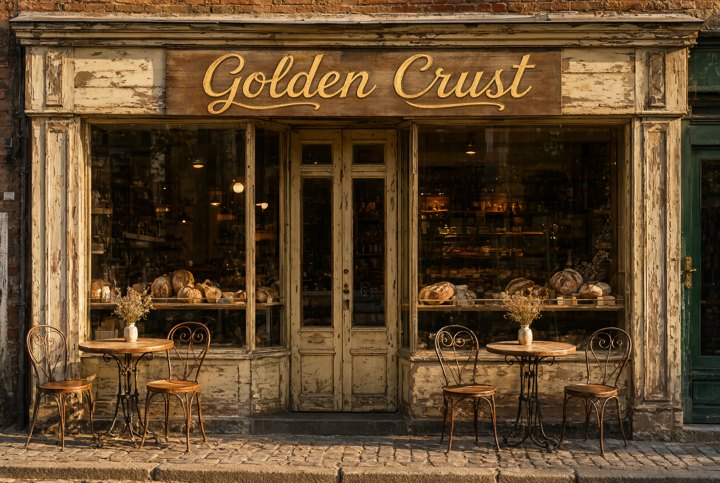
- The wooden sign above the door appears to float slightly without visible mounting hardware.
- The bread loaves in the window display have a slightly artificial, repetitive texture.
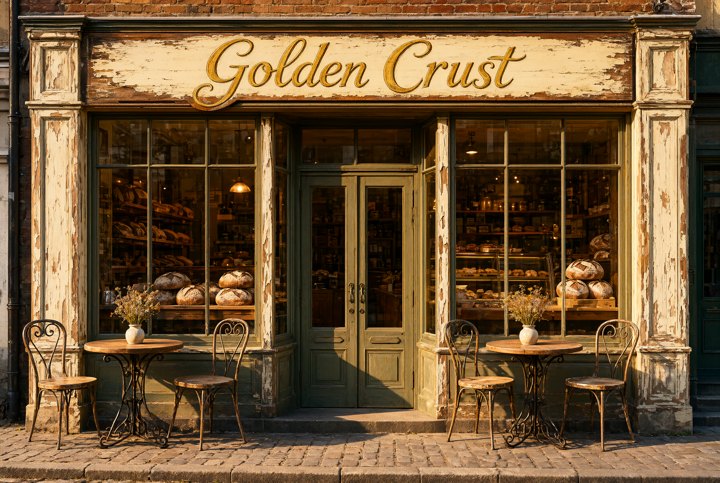
- The weathered paint texture on the pillars is slightly repetitive and looks like a digital pattern rather than natural decay.
- The shadows cast by the chairs and tables are very sharp and uniform, suggesting a single light source that might not match the ambient environment perfectly.
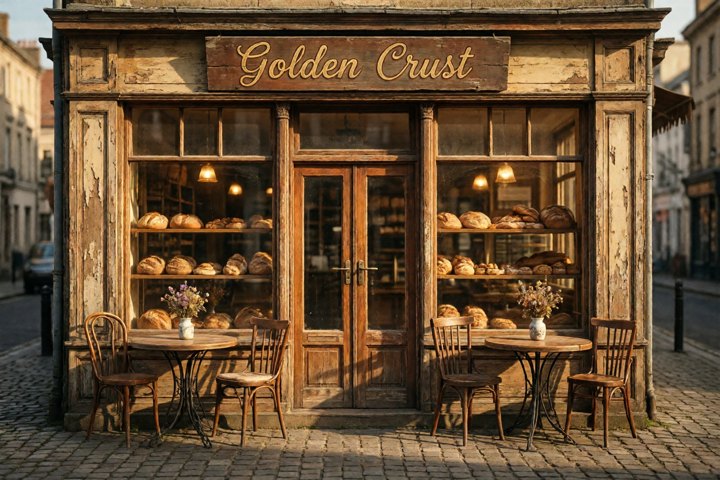
- The wooden sign above the door has slightly uneven edges that look artificially generated.
- The shadows cast by the chairs and tables are somewhat soft and lack sharp definition.
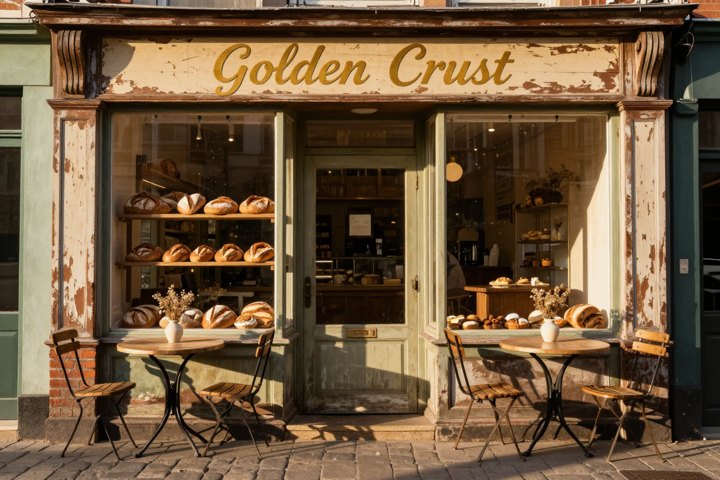
- The wooden slats on the chair seats appear slightly warped and uneven in thickness.
- The reflection in the right window shows a person that is somewhat indistinct and blends into the background.
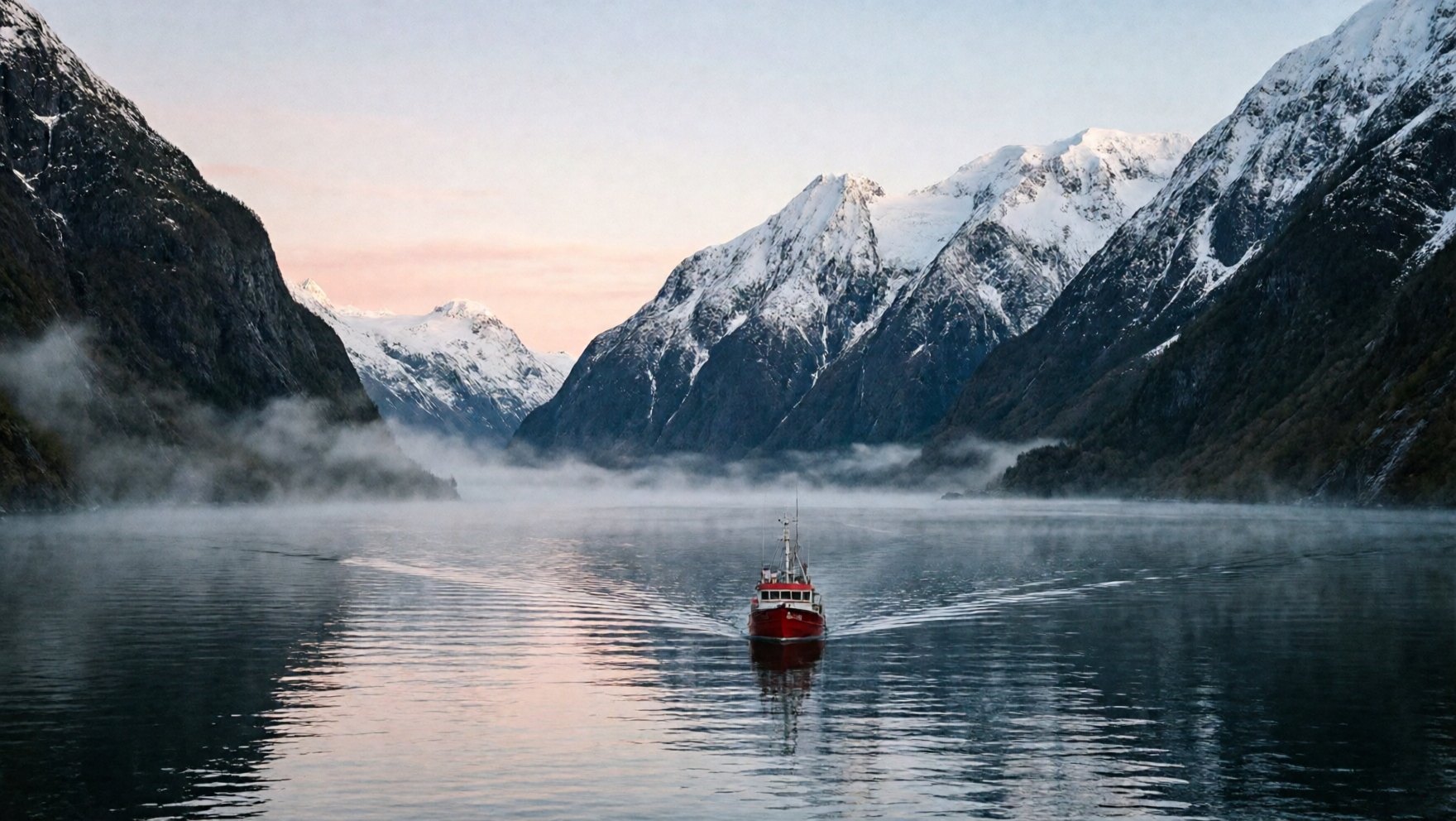
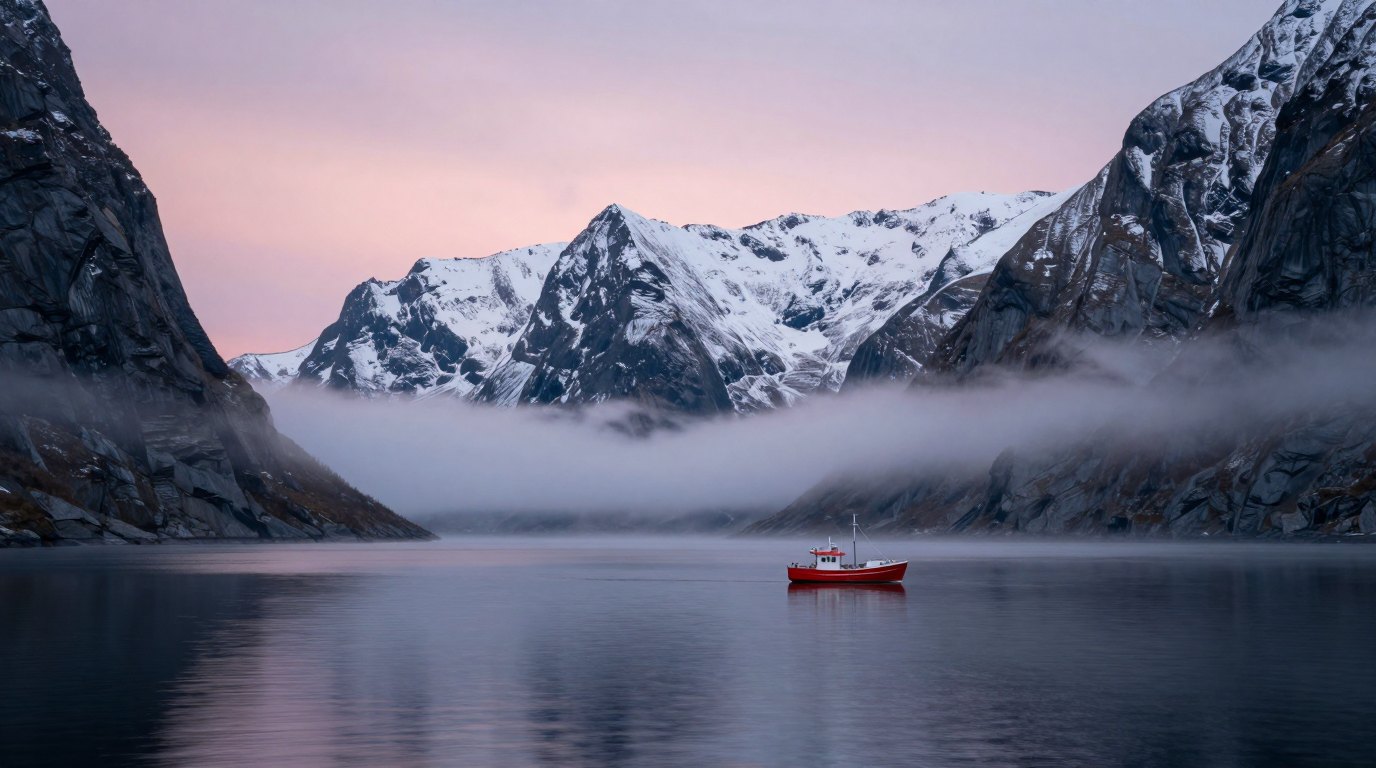
a fjord at dawn with a small red fishing boat, mist over the water, snow on the peaks
rewritten prompt sent to every model (173 words, aspect 16:9)
A serene fjord landscape at dawn, featuring a small red fishing boat floating gently on the calm, dark water. Thick white mist drifts low across the surface, partially obscuring the base of the steep, rugged cliffs that rise sharply from the water. The towering mountain peaks in the background are capped with pristine white snow, contrasting with the dark, rocky faces below. The sky is a soft gradient of pale pink and light blue, indicating the early morning light. The lighting is diffuse and soft, creating a tranquil and cold atmosphere. The camera captures a wide-angle view from a slightly elevated position, offering a broad perspective of the fjord's depth and scale. The water reflects the muted colors of the sky and the red hull of the boat. The scene is rendered in a realistic photographic style with high detail, emphasizing the textures of the mist, snow, and water. The color palette is dominated by cool blues, whites, and greys, punctuated by the vibrant red of the boat. The image contains no lettering.
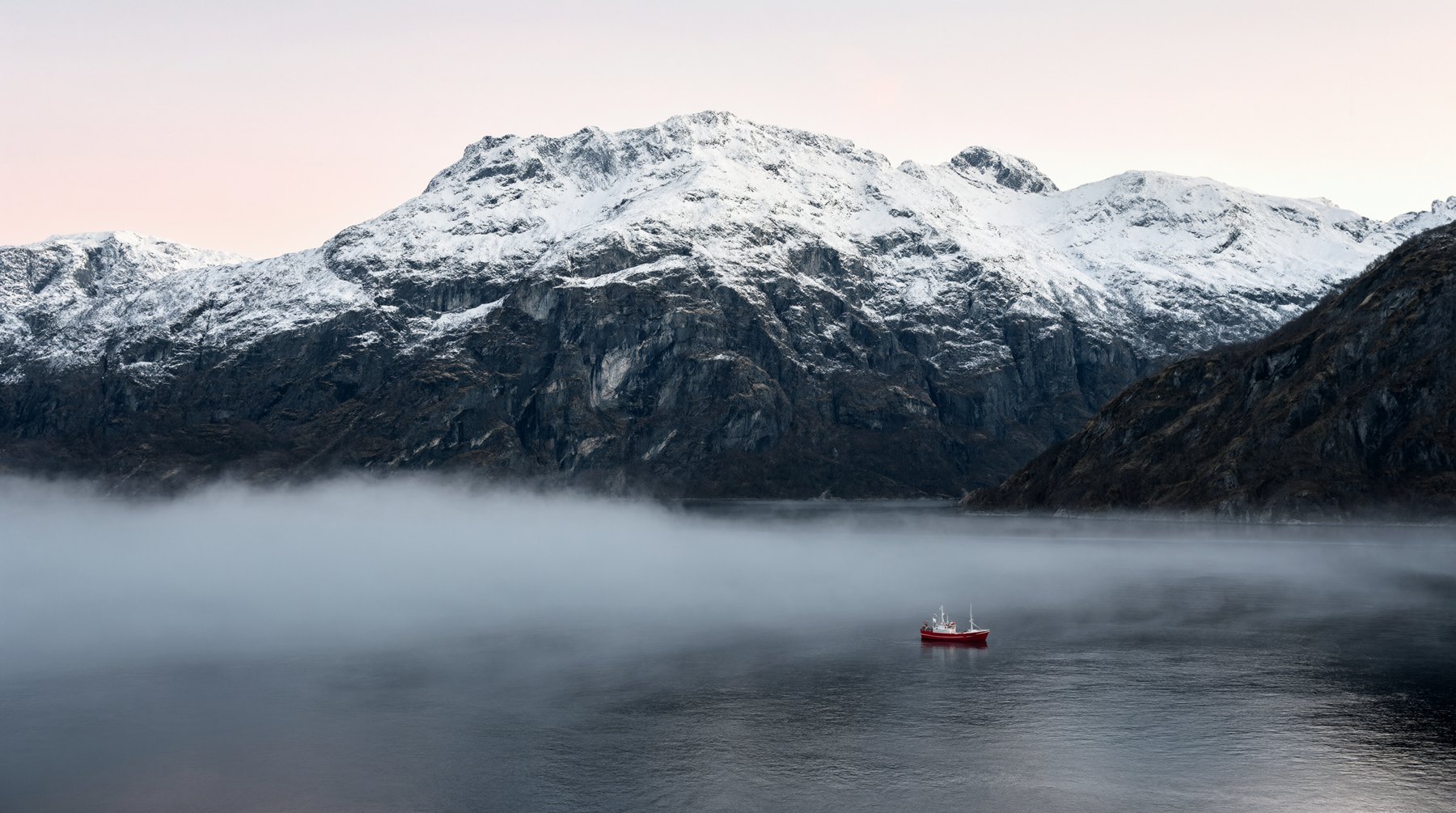
- The water surface is extremely smooth, appearing almost like glass rather than a natural body of water with subtle ripples.
- The mist layer is very uniform and flat, lacking the natural variation in density one might expect in a real fjord.
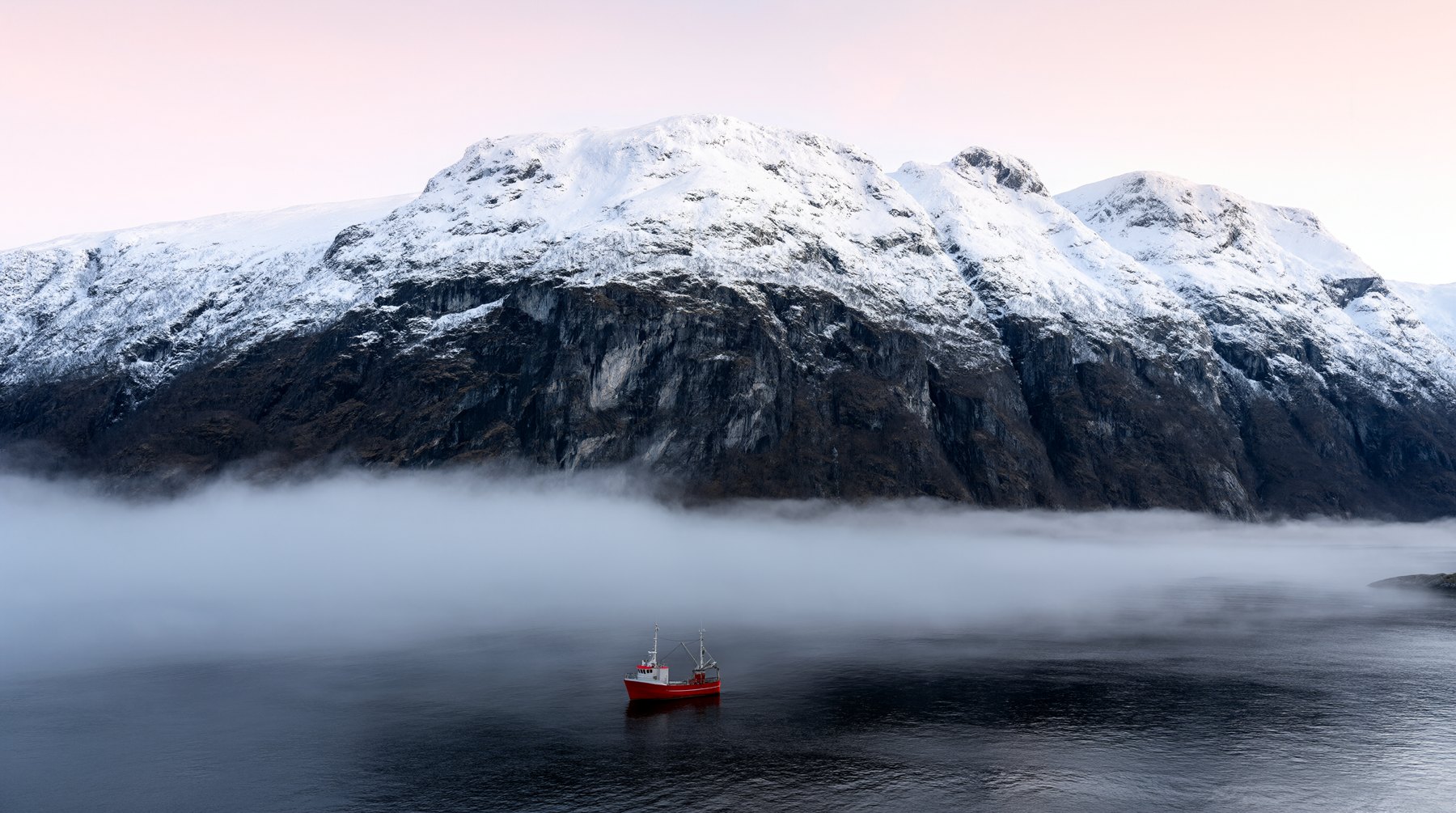
- The water surface is extremely smooth, resembling a long-exposure photograph rather than a natural state, which may be considered a stylistic choice but slightly reduces immediate realism.
- The mist layer is very uniform and flat, lacking the subtle variations in density that would be typical of natural fog.
flat vector illustration of a rocket launching from a laptop screen, pastel colours, minimal
rewritten prompt sent to every model (184 words, aspect 1:1)
A flat vector illustration depicts a sleek, modern laptop resting on a plain surface, its screen glowing with a soft, luminous white light. From the center of the display, a stylized rocket ship launches upward, breaking through the digital boundary as if bursting into the surrounding space. The rocket features a simple, aerodynamic design with a rounded nose cone and small fins, rendered in smooth, solid shapes without complex shading. The color palette consists exclusively of soft pastel tones, including pale pink, mint green, lavender, and cream, creating a gentle and harmonious visual effect. The background is a uniform, untextured field of light beige, ensuring the focus remains entirely on the central action. The composition is balanced and centered, with the laptop positioned horizontally at the bottom third of the frame and the rocket ascending vertically through the middle. The style is strictly minimal, utilizing clean lines, geometric forms, and a lack of intricate details to convey a sense of simplicity and modernity. The image contains no lettering, text, or additional decorative elements, maintaining a pure and uncluttered aesthetic typical of contemporary digital design.

- The rocket's exhaust flame is cut off abruptly by the bottom edge of the laptop screen rather than appearing to launch from it.
- The laptop keyboard and trackpad are rendered as simple flat shapes with minimal detail, reducing the sense of a real device.


- The laptop is rendered with photorealistic detail, which slightly conflicts with the 'flat vector illustration' style request.
- The rocket's exhaust flame appears to originate from within the screen rather than clearly launching out of it, creating a slight depth ambiguity.

- The rocket's exhaust flame is a very pale, low-contrast mint green that blends slightly with the white screen, reducing visual impact.
- The rocket's central fin is a simple vertical line that lacks the depth or shape of the side fins, appearing somewhat flat.
three friends playing beach volleyball at sunset, one of them jumping to spike the ball, long shadows
rewritten prompt sent to every model (172 words, aspect 16:9)
Three friends play beach volleyball on a wide sandy court as the sun dips low on the horizon. One player leaps high into the air, body arched and arm extended, preparing to spike a white and yellow volleyball. The other two friends stand on the sand, one ready to receive and the other watching the play, both wearing athletic swimwear. The setting sun casts extremely long, dramatic shadows that stretch across the textured sand toward the viewer. The sky glows with warm gradients of orange, pink, and purple, creating a vibrant sunset atmosphere. The lighting is golden and soft, highlighting the contours of the players and the ripples in the sand. The camera captures the scene from a low angle, emphasizing the height of the jump and the length of the shadows. The image is a realistic photograph with sharp focus on the players and a slightly softer background where the ocean meets the sky. The color palette is dominated by warm earth tones and sunset hues. The image contains no lettering.
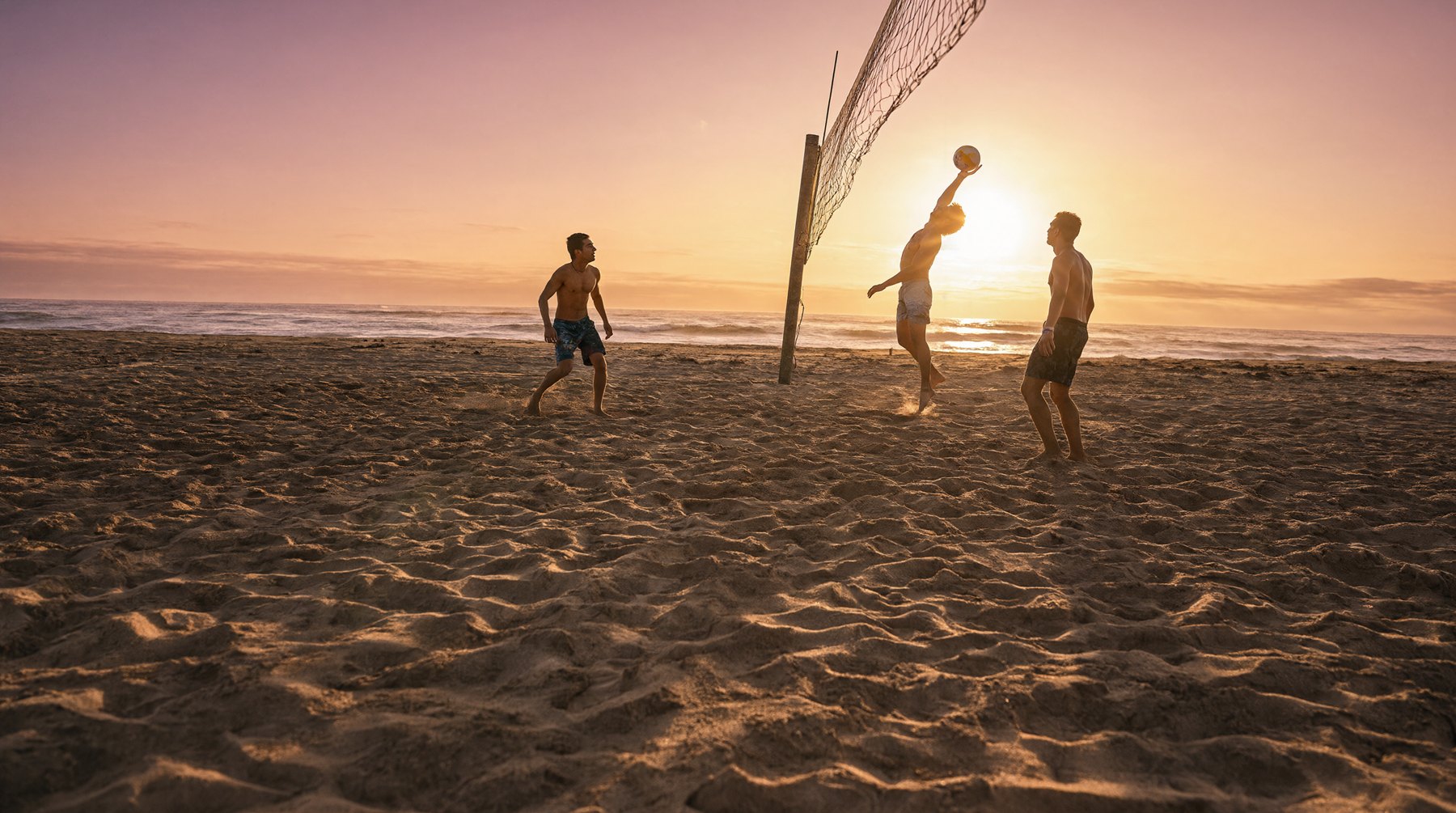
- The volleyball net appears to float without a visible second post or anchor on the right side.
- The jumping player's feet are slightly obscured by the sand, making the takeoff point ambiguous.
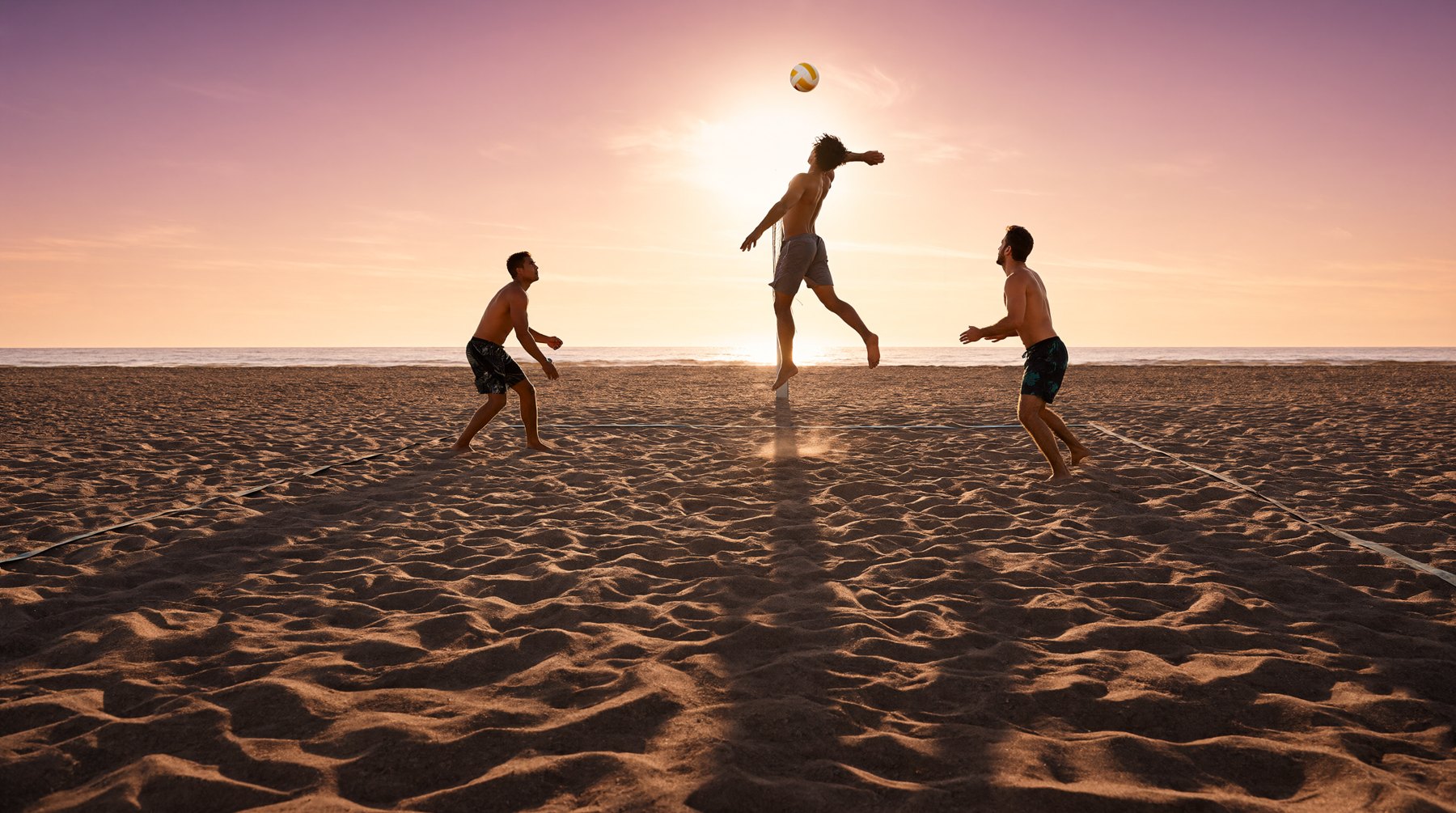
- The shadow of the jumping player is unnaturally sharp and dark for the soft, diffused light of a sunset.
- The net posts and netting appear to be floating or embedded in the sand without clear structural support.
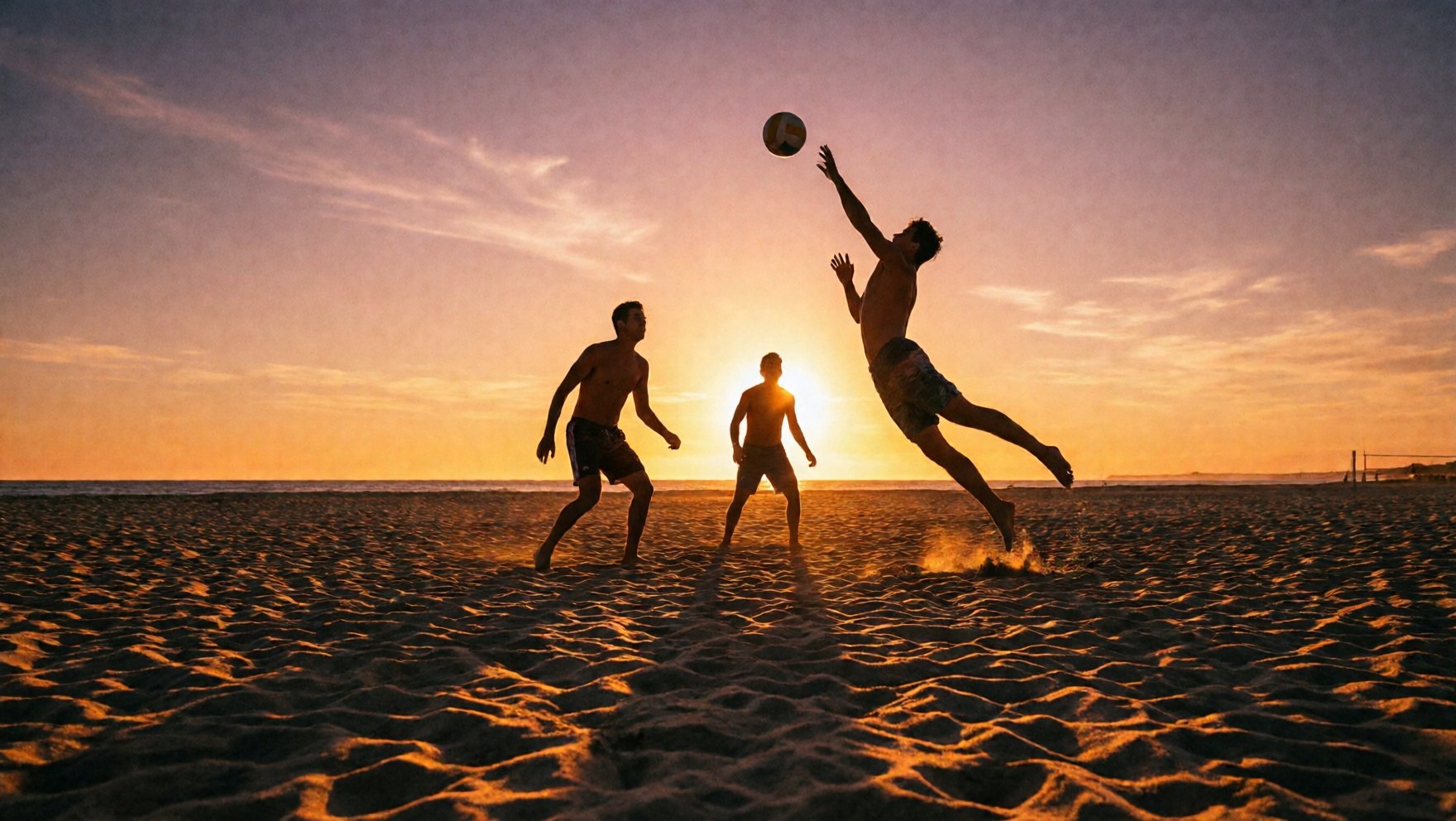
- The ball appears to be a soccer ball rather than a standard volleyball.
- The jumping figure's anatomy is slightly distorted, particularly the angle of the legs and feet.
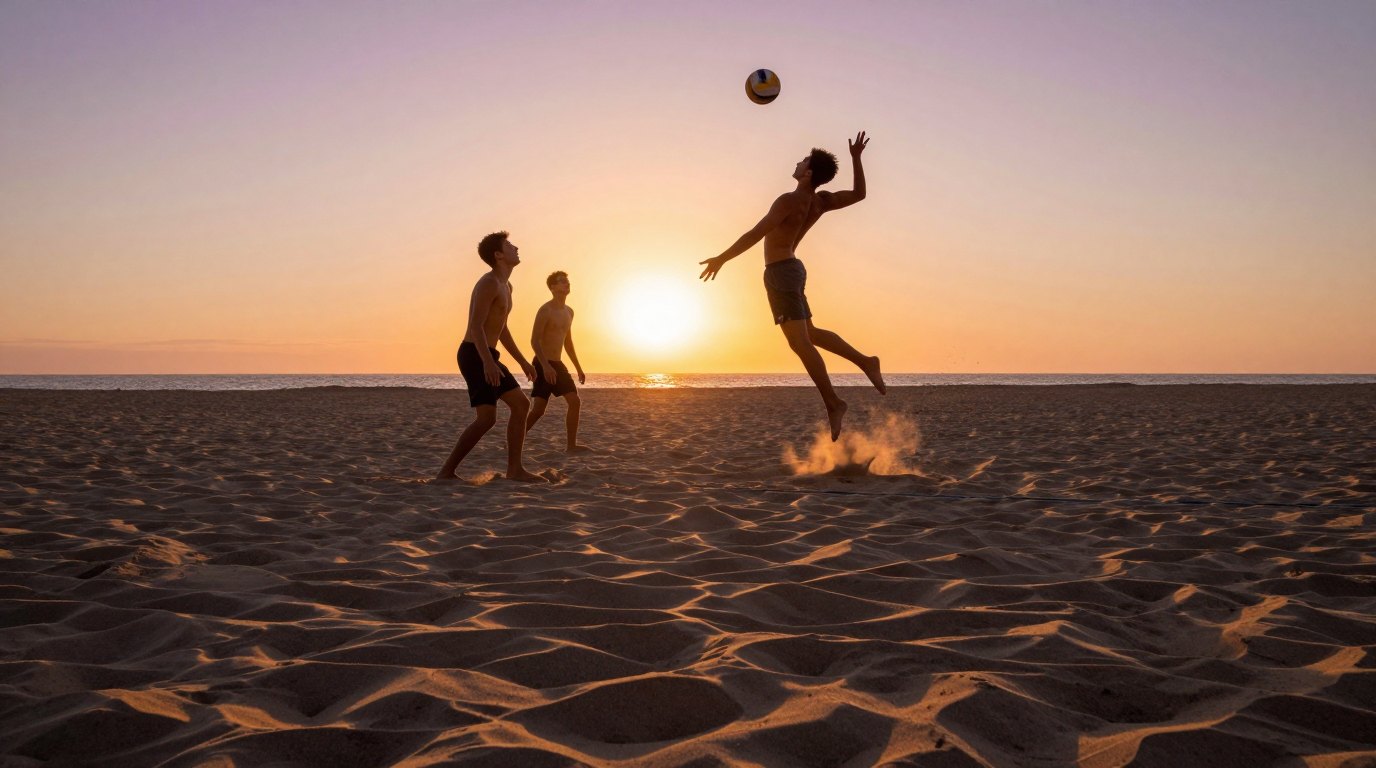
- The sand kicked up by the jumping player's feet appears slightly unnatural and disconnected from the ground.
- The shadows cast by the figures are somewhat soft and lack the sharp definition expected from the low sun angle.
a scandinavian living room with a light oak floor, a green velvet sofa, a large window and a monstera plant
rewritten prompt sent to every model (168 words, aspect 4:3)
A bright, airy Scandinavian living room features a polished light oak floor with visible wood grain. A plush green velvet sofa sits centrally, its deep emerald fabric contrasting with the pale wood. Behind the sofa, a large floor-to-ceiling window floods the space with soft, diffused natural daylight, suggesting a calm afternoon. To the right, a tall monstera plant with broad, glossy green leaves stands in a simple white ceramic pot, adding organic texture. The walls are painted a crisp matte white, maintaining the minimalist aesthetic. A small, round wooden side table holds a single white ceramic vase. The lighting is even and gentle, casting soft shadows that emphasize the room's depth. The camera captures the scene from a slightly elevated eye-level perspective, using a wide-angle lens to encompass the entire layout. The color palette is dominated by neutral whites, warm oak tones, and the rich green of the velvet and foliage. The overall mood is serene, clean, and inviting, embodying modern hygge principles. The image contains no lettering.
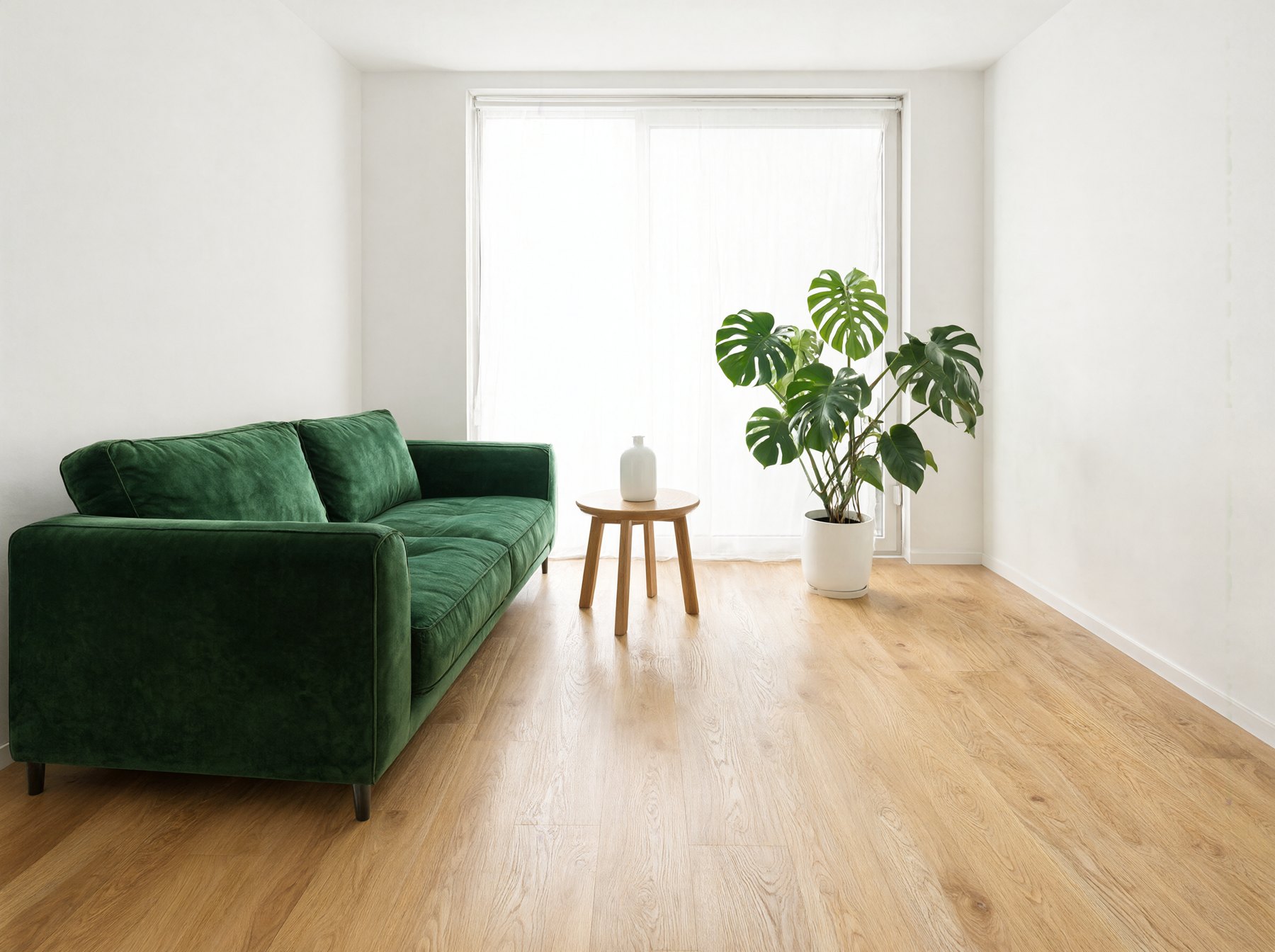
- The wooden side table legs appear slightly uneven in height and perspective.
- The window frame and curtain details are somewhat generic and lack fine texture.
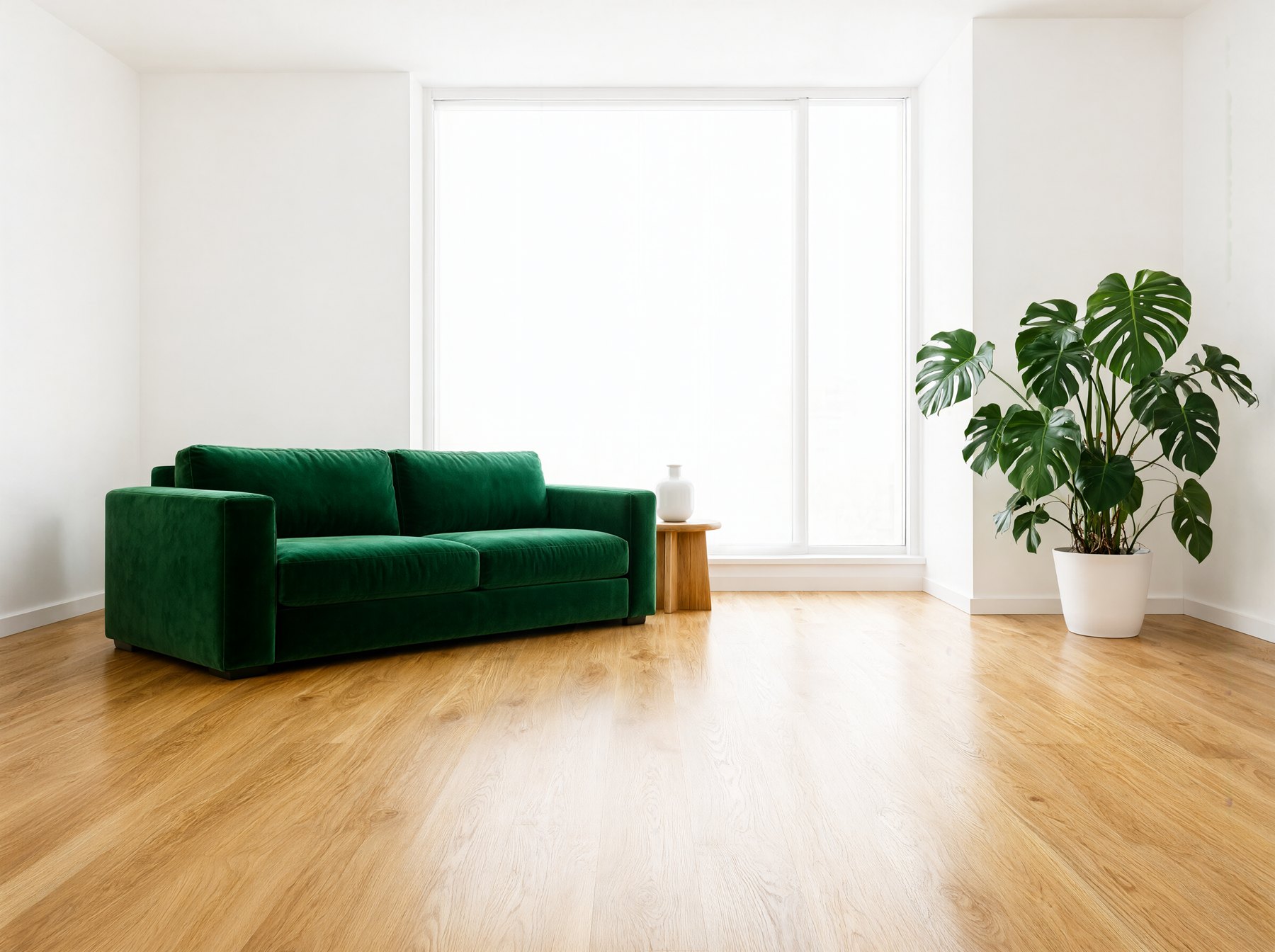
- The window is completely blown out to white, lacking any visible view or detail outside.
- The lighting is extremely flat and uniform, resulting in a lack of depth and shadow definition.
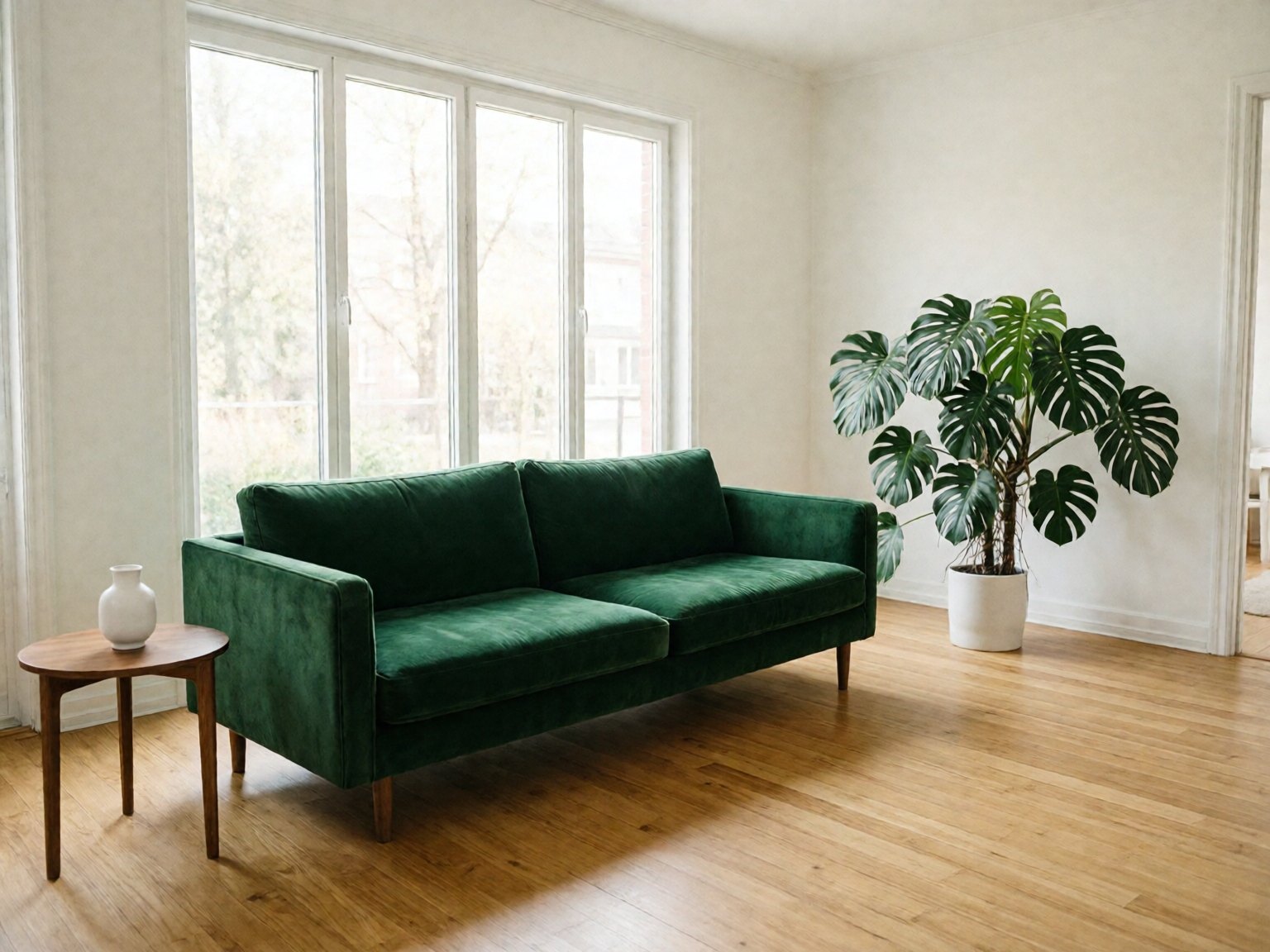
- The window view outside is slightly overexposed, making details of the exterior hard to discern.
- The shadow cast by the side table is very soft and lacks the sharpness expected from the bright directional light coming through the window.
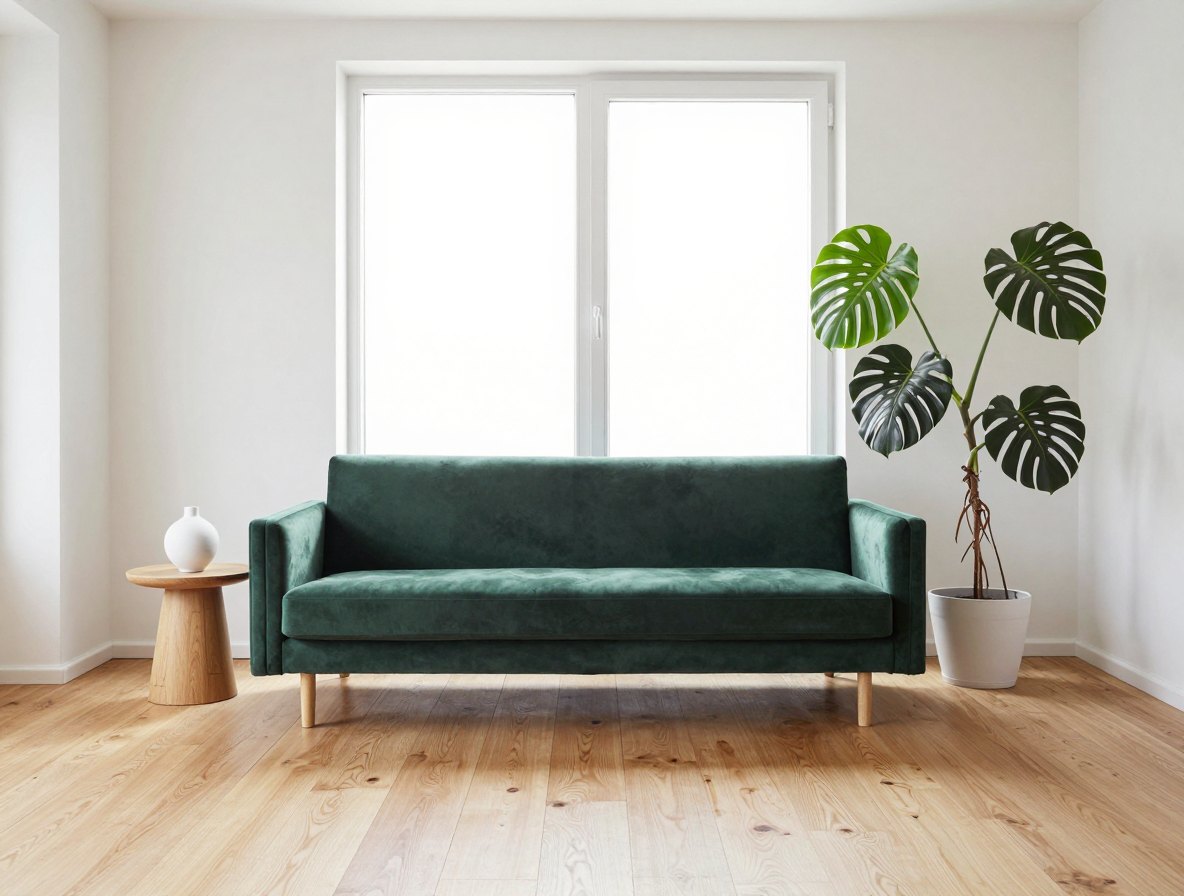
- The window is completely blown out to white, lacking any visible outdoor detail or depth.
- The monstera plant's stems appear somewhat thin and sparse relative to the large leaf size.
2 · Infographics, charts and schematics
Six diagram requests with exact labels and numbers: process steps, bar chart, donut chart, flowchart with a decision node, exploded-view schematic and a timeline. Text accuracy is the criterion that separates usable diagrams from decoration.
| Series | Value |
|---|---|
| QI-2.1 | 9.42 |
| QI-2512 L | 8.29 |
| Z-Turbo | 8.96 |
| Series | Value |
|---|---|
| QI-2.1 · adherence | 9.67 |
| QI-2.1 · realism | 9.17 |
| QI-2.1 · aesthetics | 8.83 |
| QI-2.1 · text | 10 |
| QI-2512 L · adherence | 8 |
| QI-2512 L · realism | 8.33 |
| QI-2512 L · aesthetics | 8.17 |
| QI-2512 L · text | 8.67 |
| Z-Turbo · adherence | 8.83 |
| Z-Turbo · realism | 9.17 |
| Z-Turbo · aesthetics | 8.50 |
| Z-Turbo · text | 9.33 |
Pairwise verdicts
| Pair (both A/B orders judged) | 2.1 wins | predecessor wins | ties | 2.1 win rate | verdicts |
|---|---|---|---|---|---|
| Qwen-Image-2.1 vs Qwen-Image-2512 Lightning (FP4) | 8 | 4 | 0 | 67 % | 12 |
| Qwen-Image-2.1 vs Z-Image-Turbo | 6 | 6 | 0 | 50 % | 12 |
a clean four-step process infographic titled "From data to decision" with numbered steps 1 Collect, 2 Clean, 3 Train, 4 Deploy, connected by arrows from left to right, dark background, red and gold accents, white text
rewritten prompt sent to every model (199 words, aspect 16:9)
A clean, modern four-step process infographic displayed on a deep charcoal dark background. The layout features four distinct rectangular nodes arranged horizontally from left to right, connected by sleek, directional arrows that flow seamlessly between them. Each node contains a large, bold white number followed by a specific label in crisp white sans-serif typography. The first node on the far left displays the text "1 Collect", the second shows "2 Clean", the third reads "3 Train", and the final node on the right states "4 Deploy". The design utilizes striking red and gold accents, with the arrows and subtle border highlights rendered in a metallic gold gradient, while the numbers feature a vibrant red glow to create visual hierarchy. Above the central sequence, the title "From data to decision" is written in elegant white lettering, centered at the top of the composition. The overall aesthetic is professional and high-contrast, utilizing flat vector graphics with smooth gradients and sharp edges. The lighting is uniform and digital, emphasizing the clarity of the white text against the dark surface. The image contains no other lettering or decorative elements, maintaining a minimalist and focused presentation suitable for a business presentation or technical documentation.
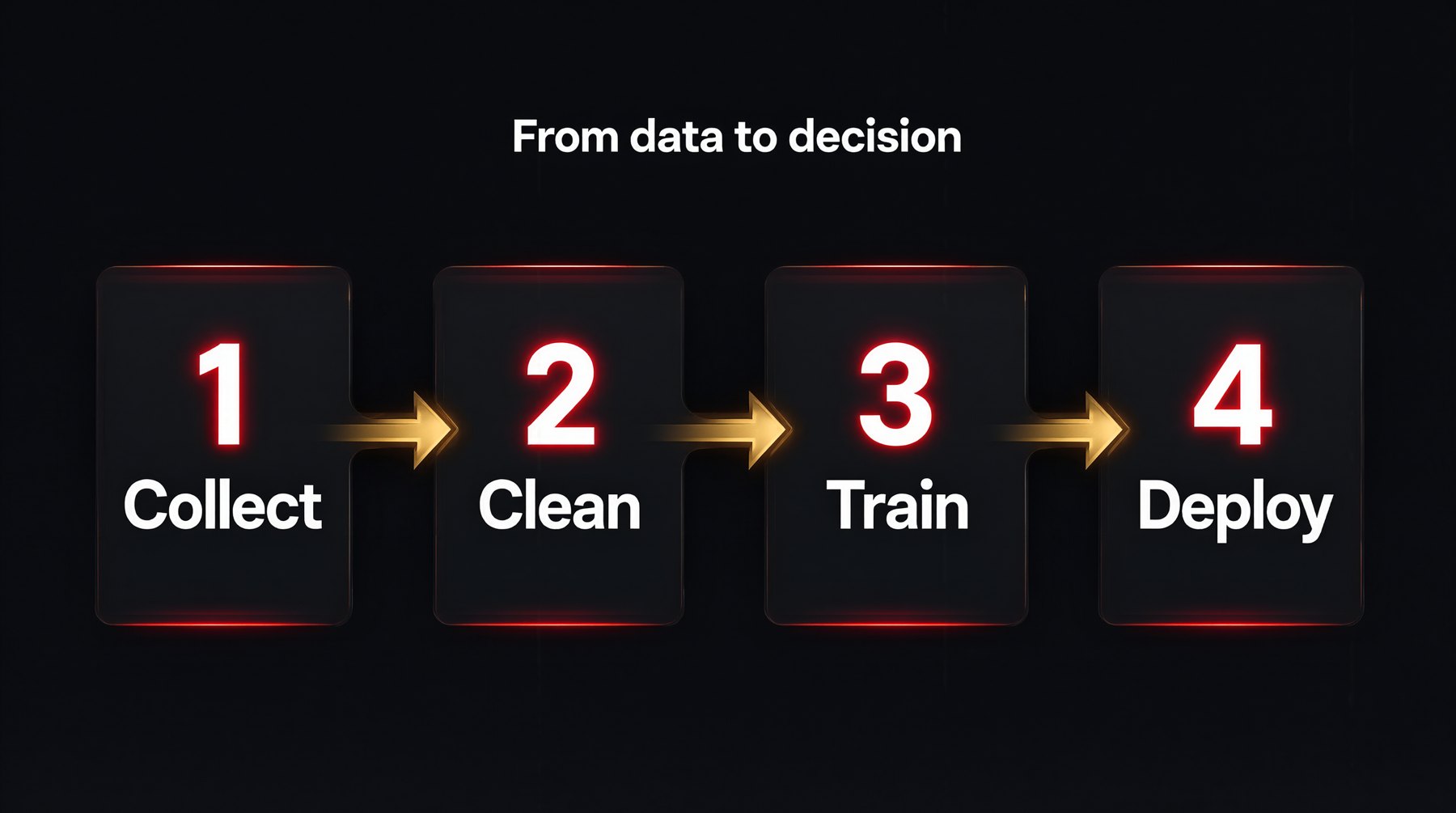
- The red glow on the numbers creates a slight visual noise that could be reduced for a cleaner look.
- The arrows are somewhat thick and could be more refined to match the sleekness of the boxes.
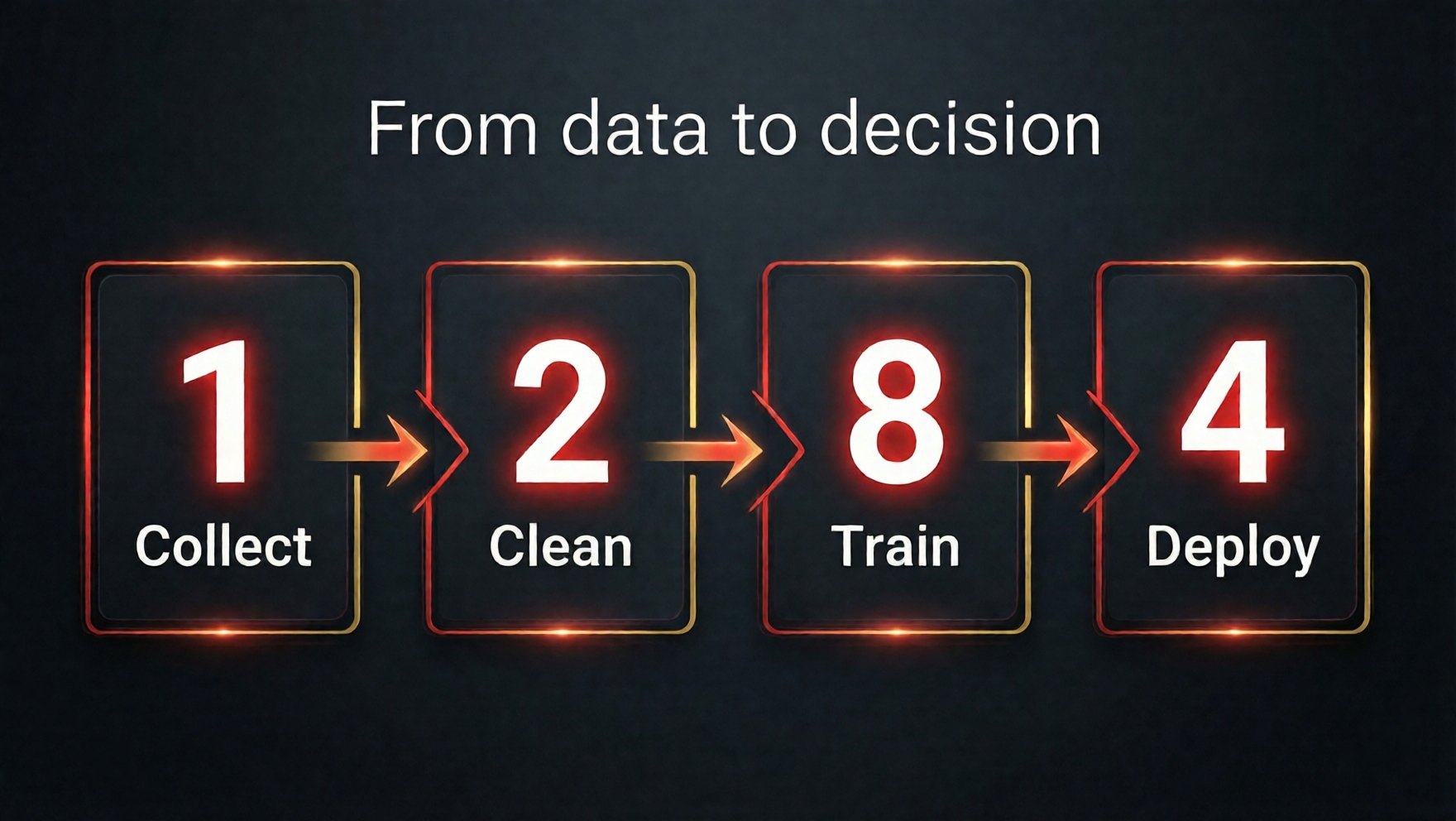
- The number for the third step is '8' instead of the requested '3'.
- The title text is present but the specific step number '3' is missing, replaced by an incorrect digit.

- The arrows connecting the steps are partially obscured by the cards, making the connection less clear.
- The glow effect on the numbers is quite intense, which might be slightly distracting.
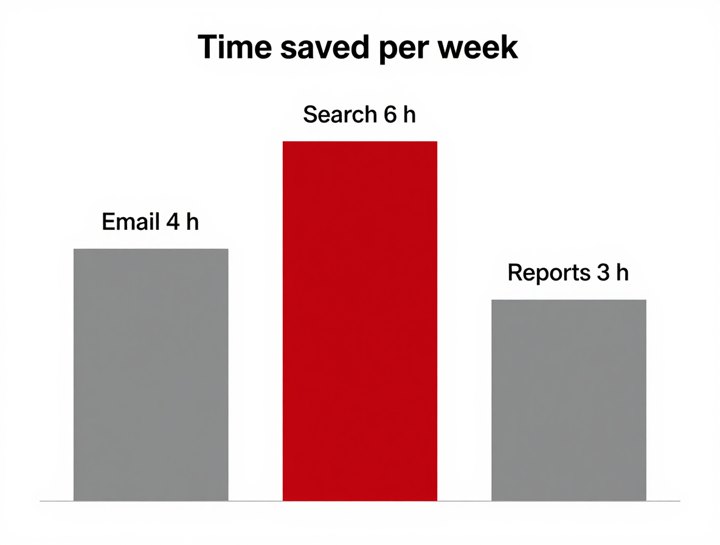
a bar chart titled "Time saved per week" with three bars labelled Email 4 h, Search 6 h, Reports 3 h, the tallest bar in red, values printed above the bars, white background, minimal style
rewritten prompt sent to every model (159 words, aspect 4:3)
A minimalist bar chart displayed on a pure white background, featuring three vertical rectangular bars of varying heights. The text "Time saved per week" is written at the top center in a clean, black sans-serif font. The leftmost bar is medium height, colored in a neutral grey, with the text "Email 4 h" printed directly above it in small black letters. The middle bar is the tallest, rendered in a vibrant solid red, with the text "Search 6 h" printed above it in black. The rightmost bar is the shortest, colored in the same neutral grey as the first, with the text "Reports 3 h" printed above it in black. The bars are evenly spaced with no gridlines, axes, or additional decorative elements, creating a flat, two-dimensional vector graphic appearance. The lighting is uniform and shadowless, emphasizing the flat design and high contrast between the colored shapes and the white space. The image contains no other lettering or textures.
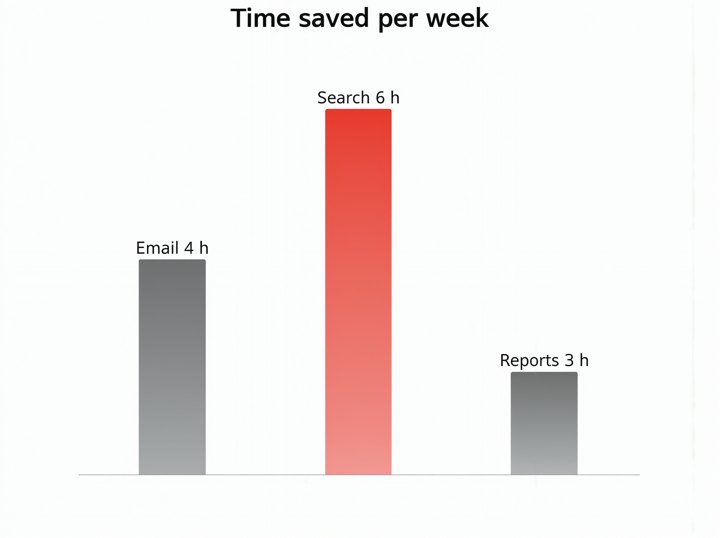
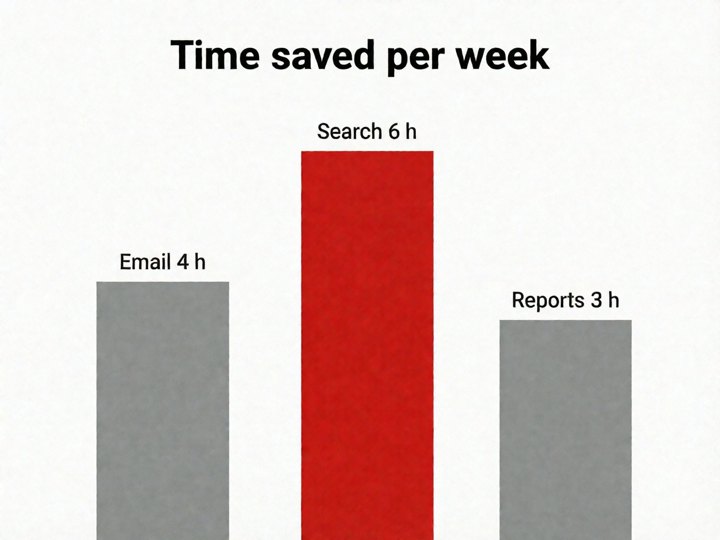
- The bars are cut off at the bottom, lacking a visible baseline or axis.
- The red bar is slightly wider than the grey bars, creating a minor inconsistency in bar width.
a donut chart with three segments labelled 60% Local, 30% Cloud, 10% API, legend on the right, the title "Where inference runs" above, flat design, light grey background
rewritten prompt sent to every model (144 words, aspect 4:3)
A flat design data visualization featuring a donut chart centered on a light grey background. The chart consists of three distinct segments: a large segment occupying sixty percent of the ring, a medium segment occupying thirty percent, and a small segment occupying ten percent. The segments are rendered in solid, contrasting colors typical of modern dashboard aesthetics. To the right of the donut, a vertical legend lists the categories with corresponding color swatches. The text "60% Local" is written next to the first swatch, "30% Cloud" next to the second, and "10% API" next to the third, all in a clean sans-serif font. Above the chart, the title "Where inference runs" is written in a bold, dark grey sans-serif typeface. The composition is balanced and minimal, with no shadows or gradients, emphasizing clarity and readability. The image contains no other lettering or decorative elements.
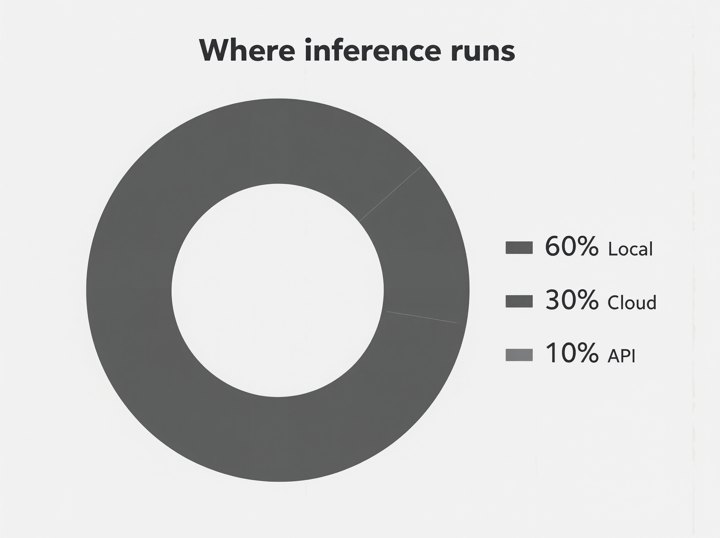
- The color palette is extremely low-contrast, making the 30% and 10% segments nearly indistinguishable from the 60% segment in the chart itself.
- The legend swatches for 'Local' and 'Cloud' appear to be the same dark grey, failing to visually differentiate the categories as intended.
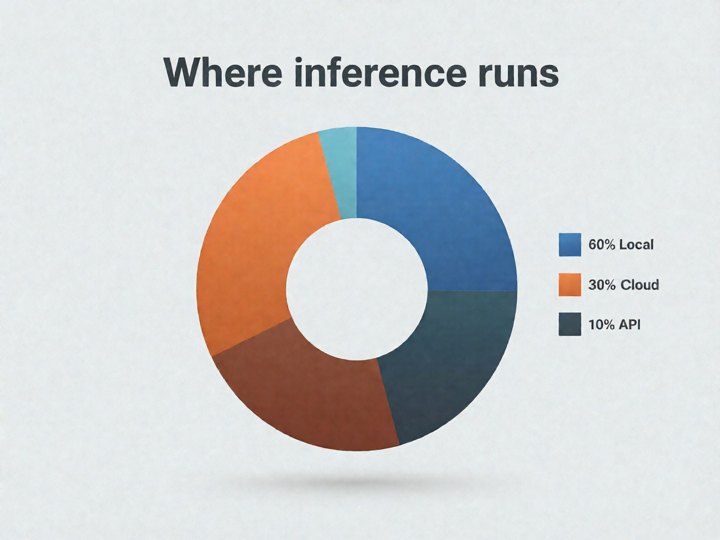
- The donut chart has five visible segments instead of the requested three.
- The segment proportions do not match the 60/30/10 percentages stated in the legend.
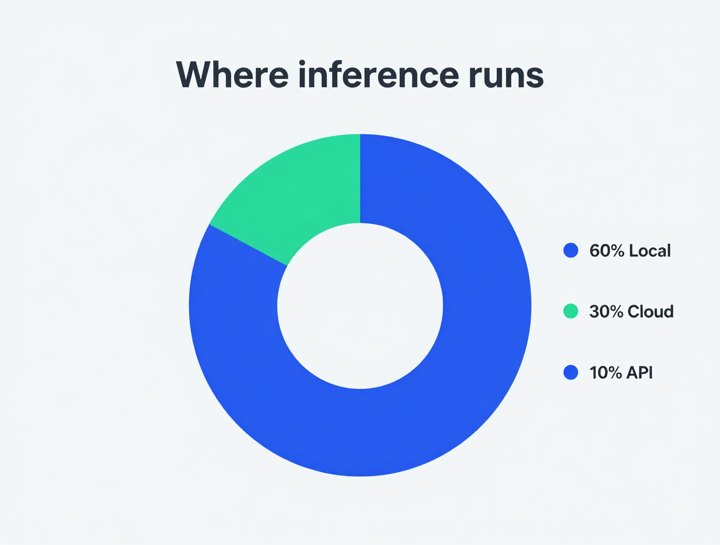
- The 10% API segment is the same blue as the 60% Local segment, making it visually indistinguishable from the larger segment.
- The legend uses the same blue dot for both '60% Local' and '10% API', which is confusing and fails to differentiate the two categories.
a horizontal flowchart with five rounded boxes labelled Request, Check, Approve, Sign, Archive, connected by arrows, a diamond decision node after Check with branches Yes and No, blue outlines on white
rewritten prompt sent to every model (170 words, aspect 16:9)
A horizontal flowchart diagram rendered in a clean, minimalist vector style on a pure white background. Five rounded rectangular boxes are arranged in a linear sequence from left to right, each featuring a thin blue outline and a white fill. The first box contains the text "Request" in a simple black sans-serif font. An arrow points right to the second box, labelled "Check". Following this, a diamond-shaped decision node with a blue outline appears, connected by an arrow from the Check box. The diamond branches into two paths: an upper arrow labelled "Yes" and a lower arrow labelled "No". The Yes path leads to the third rounded box, labelled "Approve", which connects via an arrow to the fourth box, labelled "Sign", and finally to the fifth box, labelled "Archive". The No path loops back or terminates, maintaining the blue outline aesthetic. All text is black, legible, and centered within its respective shape. The image contains no other lettering or decorative elements, focusing entirely on the structural logic of the process.
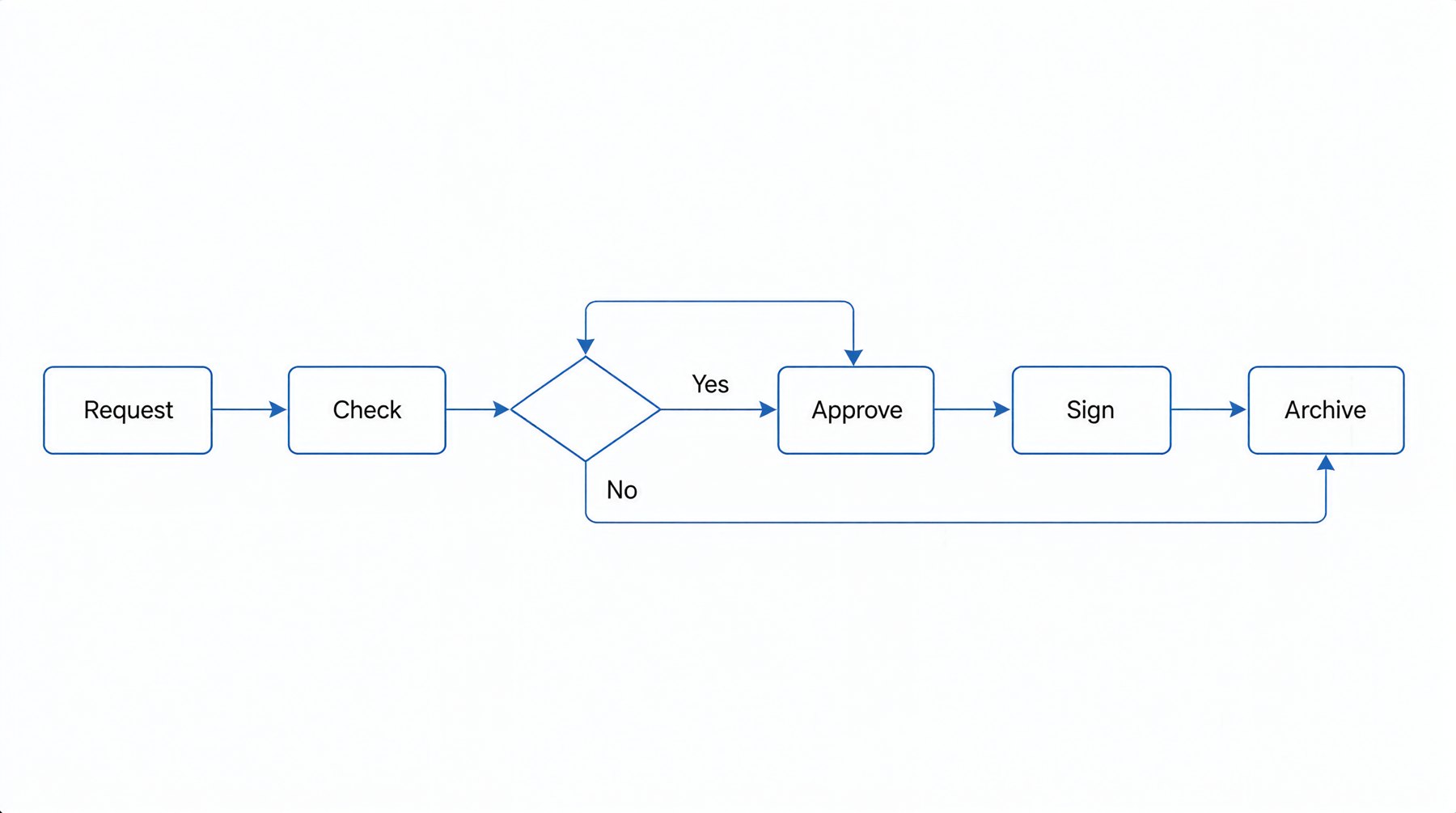
- The 'No' branch from the decision diamond bypasses the 'Sign' step, which may be logically inconsistent for a standard approval flow.
- The loop-back arrow from 'Approve' to the decision diamond is visually cluttered and could be misinterpreted as a re-check rather than a re-approval.
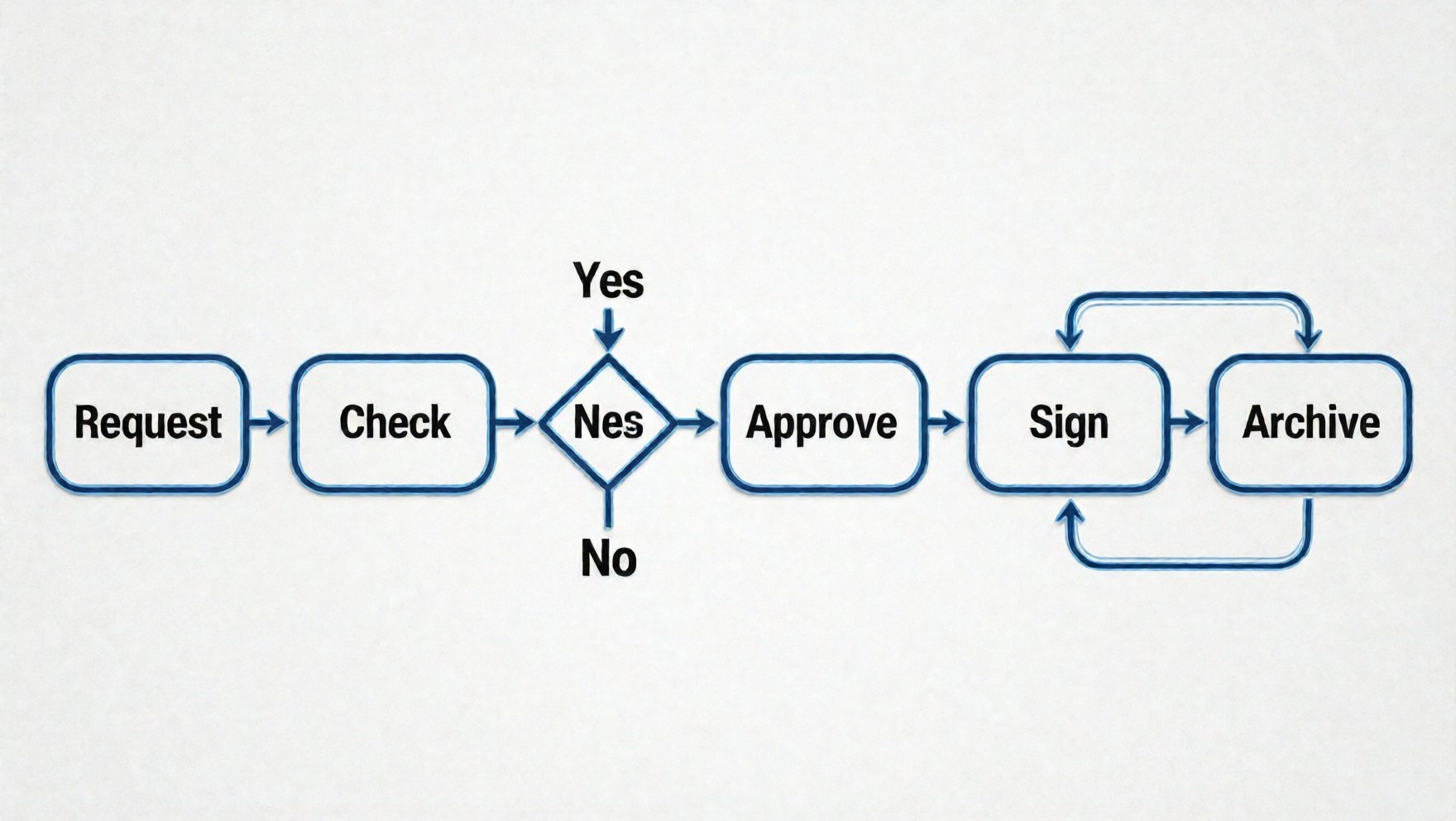
- The text inside the diamond decision node is 'Nes' instead of a clear label or 'Yes/No'.
- The 'Yes' branch arrow points into the top of the diamond, which is unconventional for a decision node output.
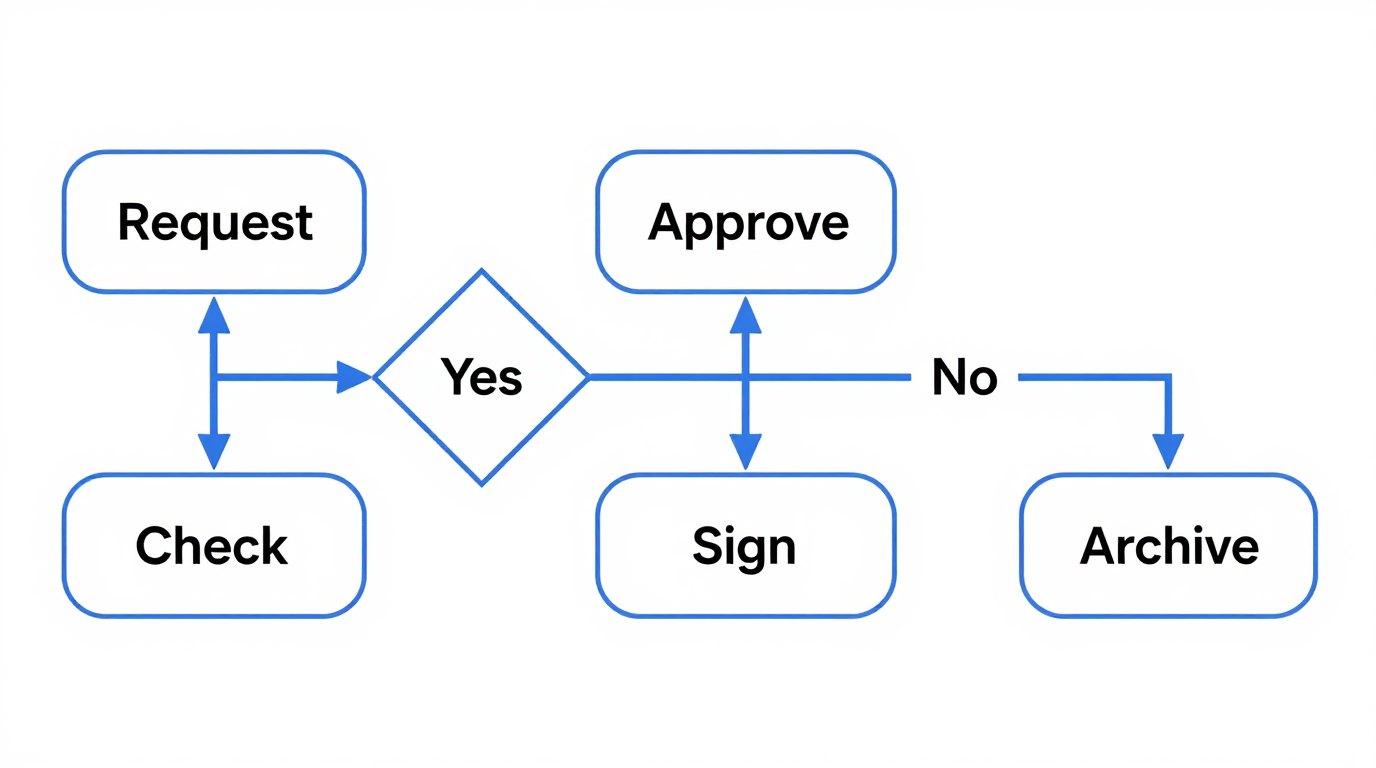
- The layout is not strictly horizontal; the boxes are arranged in two rows rather than a single line.
- The decision node is placed after the Request/Check cluster, not immediately after Check as specified.
an exploded-view technical schematic of a wireless earbud with four labelled parts: shell, battery, driver, antenna, thin leader lines to each label, isometric view, white background, engineering drawing style
rewritten prompt sent to every model (208 words, aspect 1:1)
An isometric exploded-view technical schematic of a single wireless earbud, rendered in a precise engineering drawing style on a pure white background. The device is disassembled into four distinct components, floating in a vertical stack with clear separation. The top component is the smooth, matte white outer shell, shaped like a teardrop. Below it hovers the compact, rectangular lithium-ion battery, depicted in a light grey tone. The third layer is the circular acoustic driver, showing its metallic diaphragm and copper voice coil. The bottom element is the thin, flexible antenna, coiled in a spiral shape. Thin, black leader lines extend from each component to specific labels. The text "shell" is written next to the top part, in a clean, sans-serif font. The text "battery" is written next to the second part, in a clean, sans-serif font. The text "driver" is written next to the third part, in a clean, sans-serif font. The text "antenna" is written next to the bottom part, in a clean, sans-serif font. The lighting is flat and even, eliminating shadows to emphasize the technical clarity. The lines are sharp and uniform, typical of CAD software output. The overall mood is clinical, precise, and informative, focusing entirely on the internal architecture of the audio device.
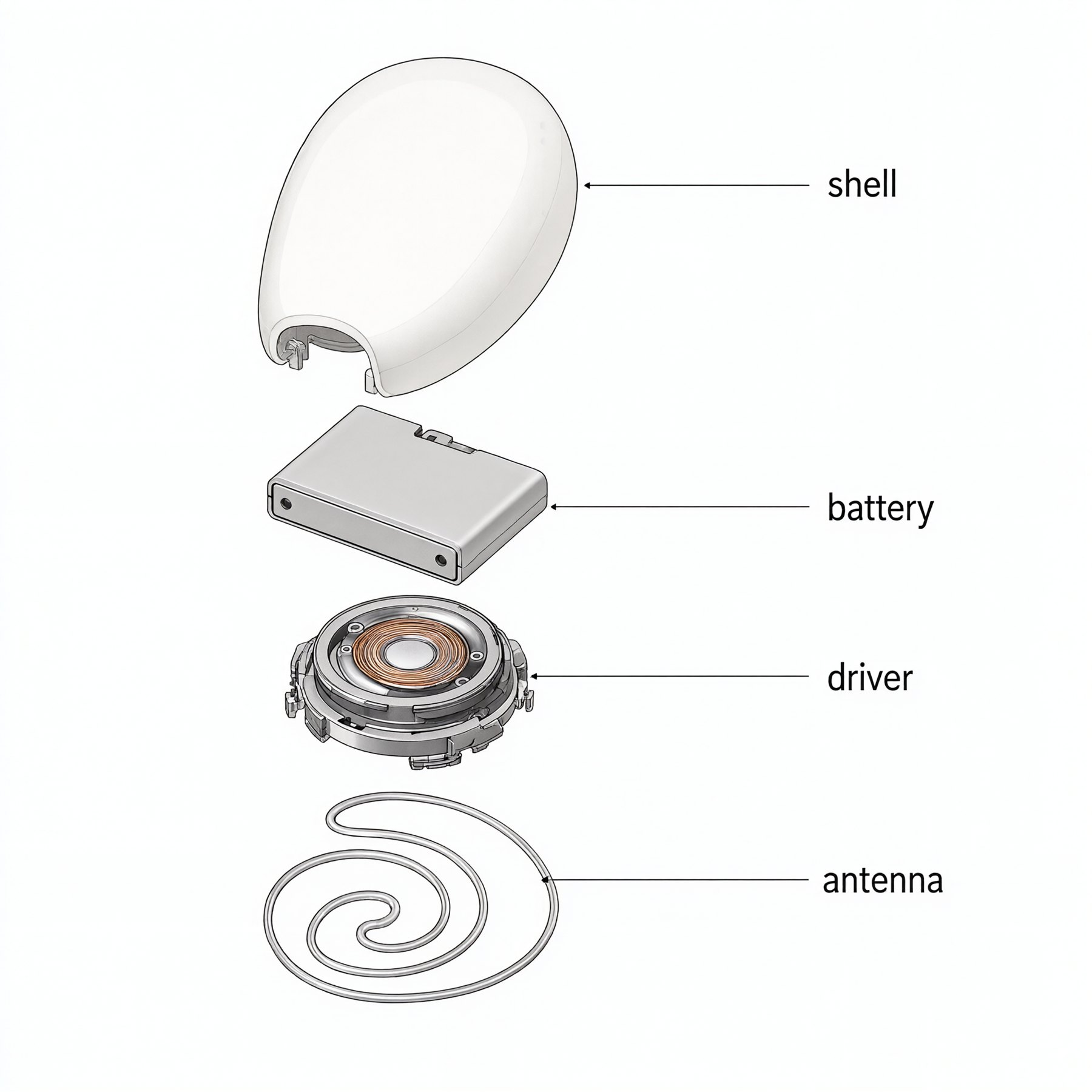
- The antenna is depicted as a flat spiral wire rather than a typical PCB trace or coil, which is a slight simplification.
- The driver component shows a copper coil that is more characteristic of a speaker voice coil than a typical earbud driver assembly, though acceptable for a schematic.
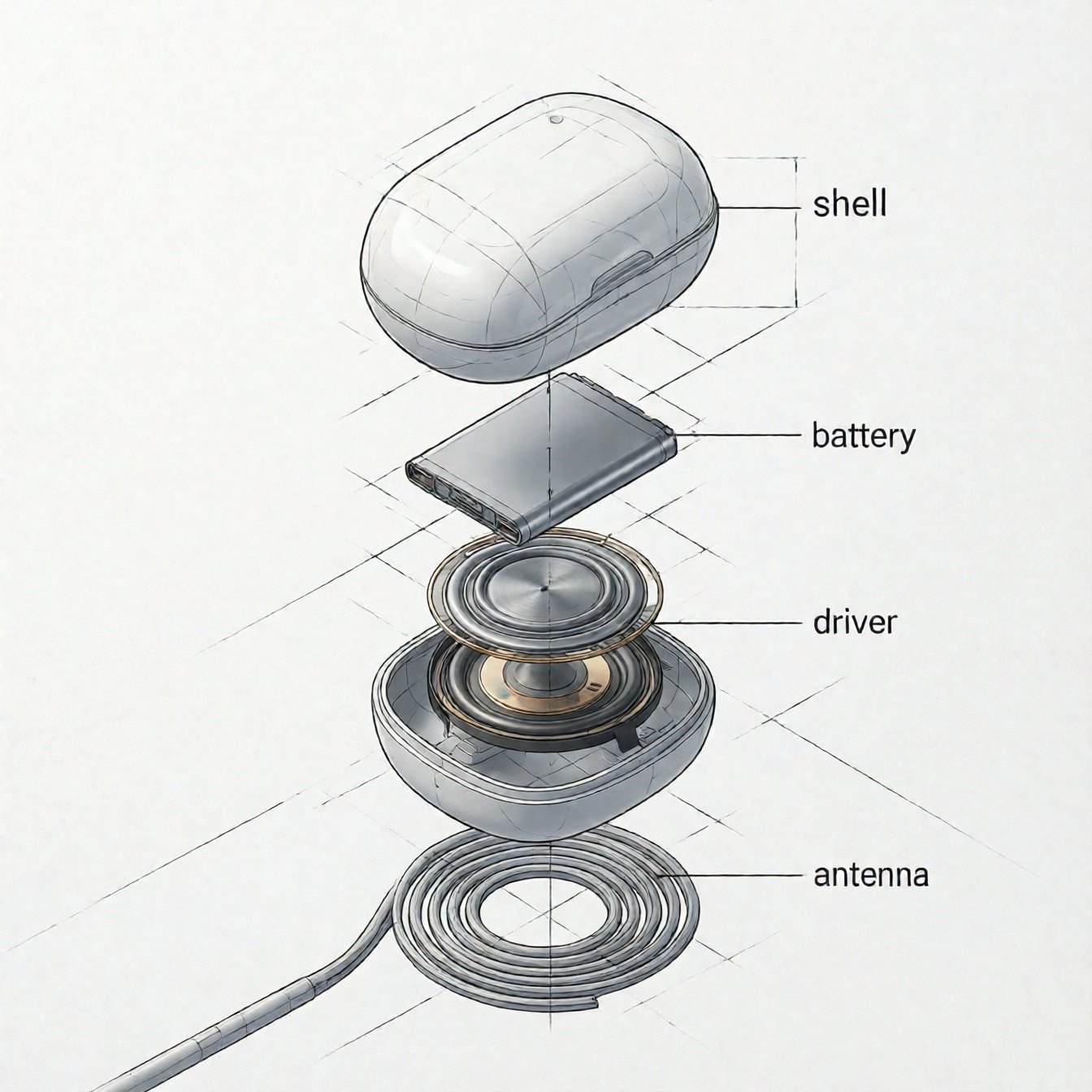
- The exploded view is slightly ambiguous as it appears to show a charging case shell rather than a single earbud shell.
- The antenna is depicted as a coiled wire with a long tail, which is less typical for a modern earbud schematic than a printed circuit trace.
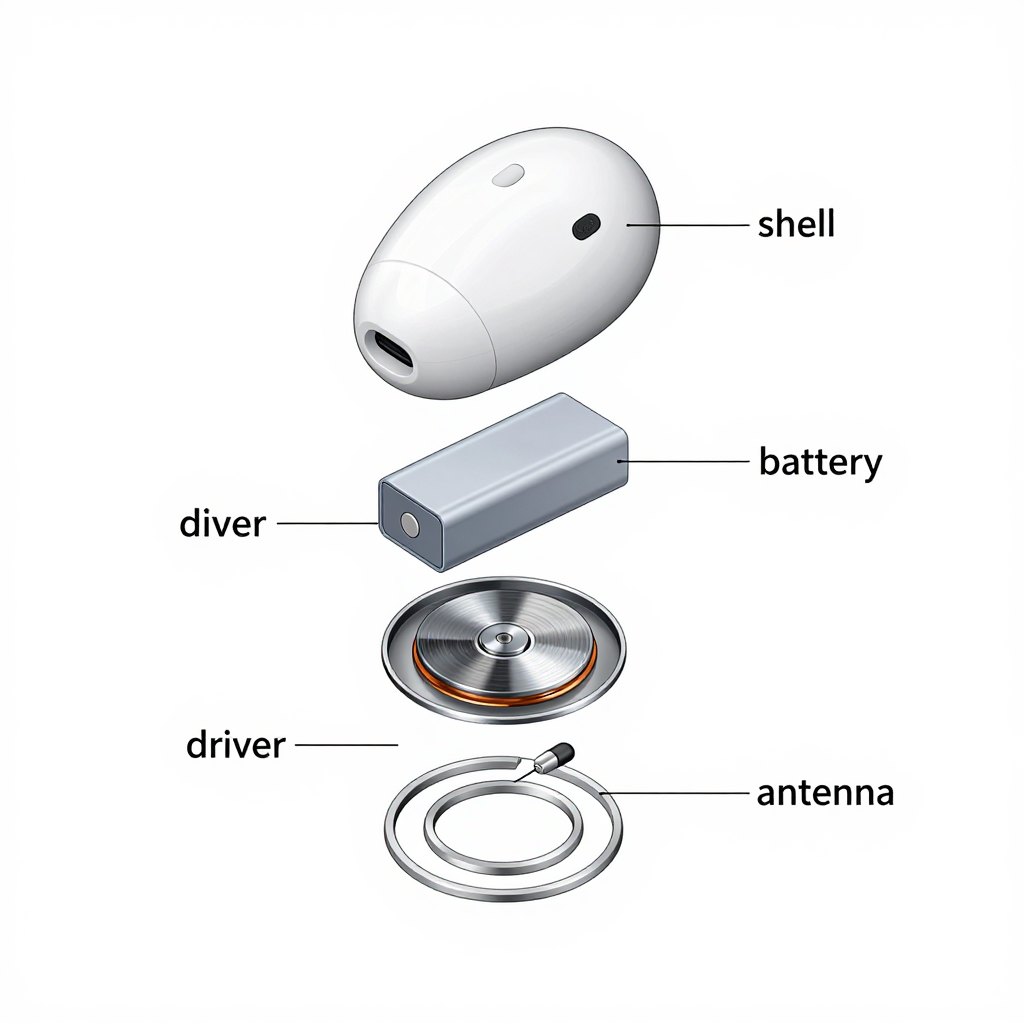
- The label 'diver' is a misspelling of 'driver' and is incorrectly placed next to the battery component.
- The label 'driver' points to the antenna coil at the bottom, which is also labeled 'antenna', creating a conflict.
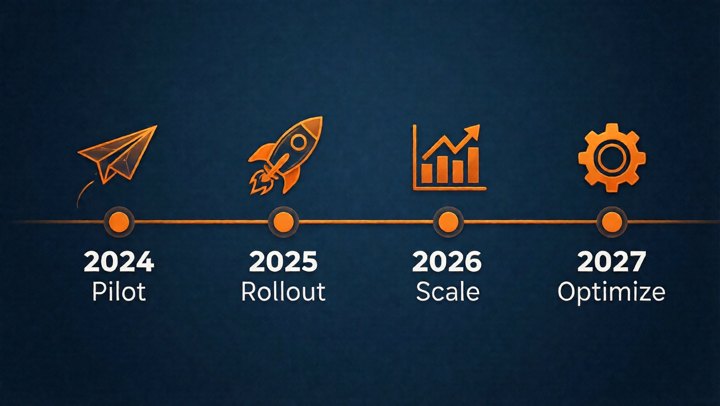
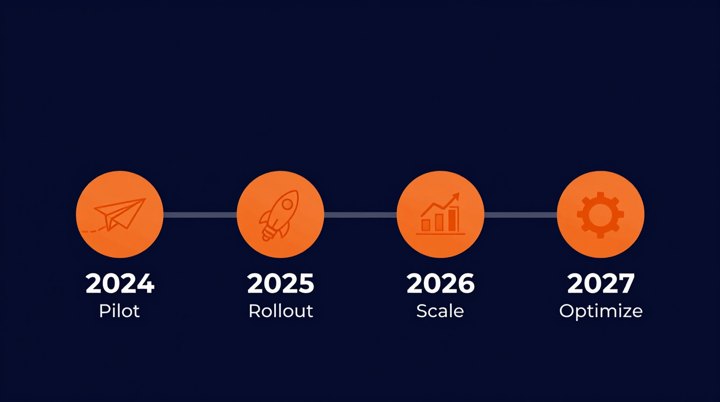
a timeline infographic of four years 2024, 2025, 2026, 2027 on a horizontal line with the milestones Pilot, Rollout, Scale, Optimize, one icon per milestone, dark navy background, orange accents
rewritten prompt sent to every model (176 words, aspect 16:9)
A horizontal timeline infographic displayed on a dark navy blue background, featuring a sleek, continuous line stretching across the center. Four distinct milestones are evenly spaced along this line, each marked by a circular node and a unique, minimalist icon rendered in vibrant orange. The first node on the left displays a paper airplane icon, with the text "2024" and "Pilot" written below in clean, white sans-serif lettering. The second node features a rocket ship icon, accompanied by the text "2025" and "Rollout" in white. The third node shows a bar chart with an upward arrow, labeled with the text "2026" and "Scale" in white. The final node on the right contains a gear icon, with the text "2027" and "Optimize" written beneath in white. The design utilizes a flat vector style with sharp edges and high contrast, ensuring the orange accents pop against the deep navy backdrop. The composition is balanced and symmetrical, with ample negative space surrounding the central timeline to maintain clarity and focus. The image contains no other lettering or decorative elements.
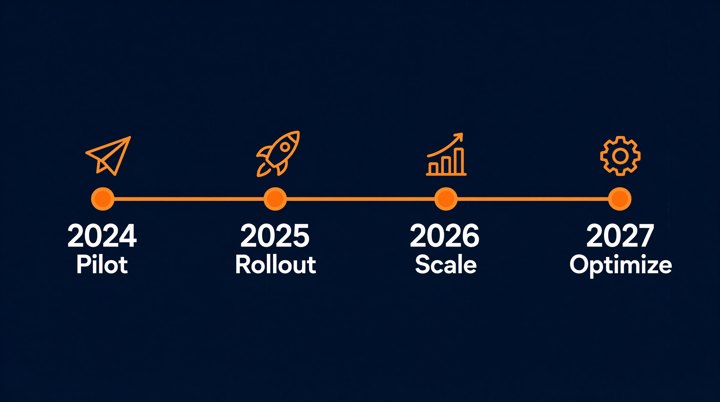
3 · Prompt-format precision
Two fixed sets of eight schema fields (style, subject, pose, upper clothing, environment, shot size, lighting, hair colour) rendered by every PIC STUDIO schema format, each sent raw and rewritten (Ctrl+W) to every model, plus a third variant on Qwen-Image-2.1 only: the rewritten prose with the verbatim field pairs appended. The checklist score is the vision judge's requirement-by-requirement verdict (yes = 100, partial = 50, no = 0) against the eight known field values; the rubric total is the same 0–10 rating as in the other sections.
| Format | Variant | QI-2.1 checklist | QI-2.1 rubric Ø | QI-2512 L checklist | QI-2512 L rubric Ø | Z-Turbo checklist | Z-Turbo rubric Ø |
|---|---|---|---|---|---|---|---|
| Free text (Label: value lines) | raw | 94 % | 8.62 | 69 % | 7.88 | 75 % | 8.00 |
| Free text (Label: value lines) | rewritten | 88 % | 8.75 | 88 % | 8.50 | 78 % | 8.25 |
| Free text (Label: value lines) | rewritten + fields | 88 % | 8.62 | n/a | n/a | 84 % | 8.25 |
| Flowing sentence | raw | 94 % | 8.62 | 84 % | 8.25 | 81 % | 8.50 |
| Flowing sentence | rewritten | 84 % | 8.88 | 78 % | 8.75 | 81 % | 8.75 |
| Flowing sentence | rewritten + fields | 84 % | 8.75 | n/a | n/a | 81 % | 8.75 |
| Comma list | raw | 84 % | 7.25 | 59 % | 8.00 | 75 % | 8.50 |
| Comma list | rewritten | 72 % | 8.75 | 75 % | 8.75 | 72 % | 8.12 |
| Comma list | rewritten + fields | 84 % | 8.75 | n/a | n/a | 78 % | 8.50 |
| Label: value pairs | raw | 94 % | 8.25 | 66 % | 7.88 | 81 % | 8.12 |
| Label: value pairs | rewritten | 84 % | 8.50 | 88 % | 8.38 | 75 % | 8.38 |
| Label: value pairs | rewritten + fields | 88 % | 8.75 | n/a | n/a | 78 % | 8.38 |
| Grouped sections | raw | 81 % | 7.12 | 62 % | 7.88 | 75 % | 8.25 |
| Grouped sections | rewritten | 69 % | 8.38 | 66 % | 8.25 | 59 % | 7.88 |
| Grouped sections | rewritten + fields | 78 % | 8.50 | n/a | n/a | 69 % | 8.00 |
| Series | Value |
|---|---|
| Free text (Label: value lines) · raw | 93.80 % |
| Flowing sentence · raw | 93.80 % |
| Label: value pairs · raw | 93.80 % |
| Free text (Label: value lines) · rewritten | 87.50 % |
| Label: value pairs · rewritten + fields | 87.50 % |
| Free text (Label: value lines) · rewritten + fields | 87.50 % |
| Flowing sentence · rewritten | 84.40 % |
| Flowing sentence · rewritten + fields | 84.40 % |
| Comma list · rewritten + fields | 84.40 % |
| Label: value pairs · rewritten | 84.40 % |
| Comma list · raw | 84.40 % |
| Grouped sections · raw | 81.20 % |
| Grouped sections · rewritten + fields | 78.10 % |
| Comma list · rewritten | 71.90 % |
| Grouped sections · rewritten | 68.80 % |
PIC_STUDIO_PROMPT_SCHEMA=pairs (grouped sections was the weakest format in every variant) and PIC_STUDIO_REWRITE_KEEP_FIELDS=1 (the rewritten prose keeps its quality gain and the appended pairs recover half of the lost field precision; never worse than prose alone).Field set 2
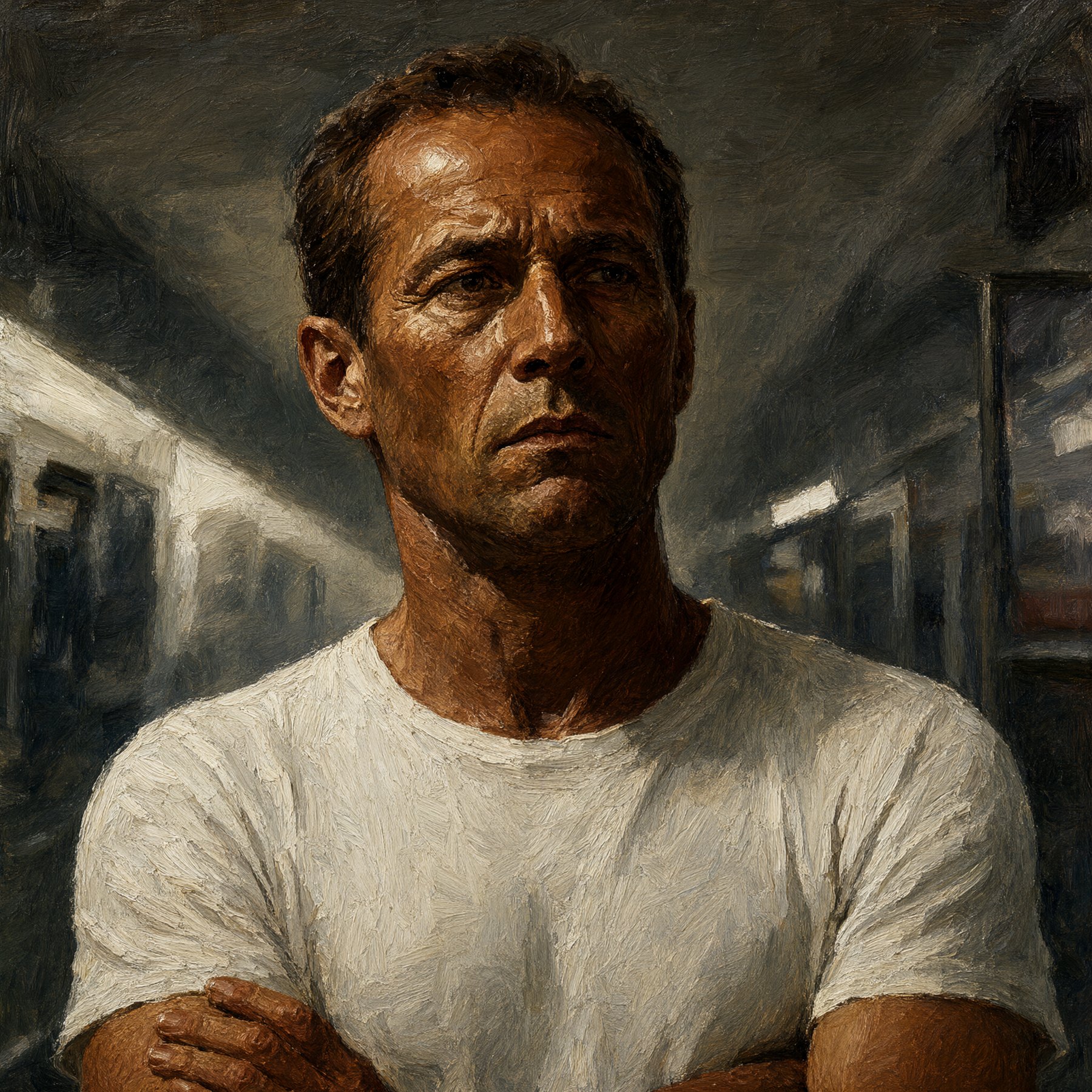
Style: an oil painting · Subject: a middle-aged man · Pose: standing upright with arms crossed · Upper clothing: a plain white t-shirt · Hair color: auburn · Environment: a subway platform · Lighting: dramatic side lighting · Shot size: extreme close-up of the face
Rewritten — Qwen-Image-2.1
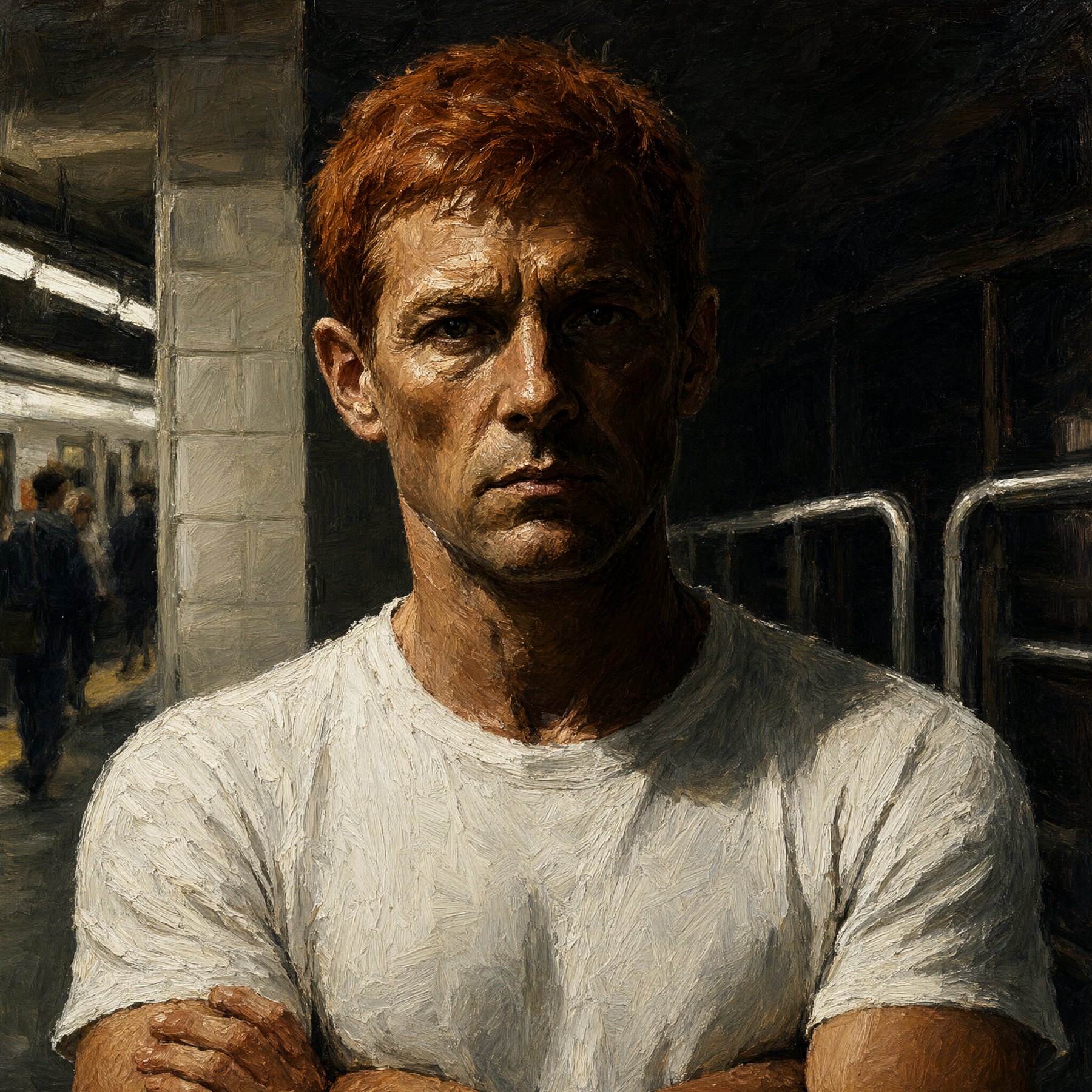
- The shot size is a medium close-up rather than the requested extreme close-up of the face.
- The man's arms are crossed, but the hands and forearms are partially cut off at the bottom edge of the frame.
- Style: yes
- Subject: yes
- Pose: partial
- Upper clothing: yes
- Hair color: yes
- Environment: yes
- Lighting: yes
- Shot size: no
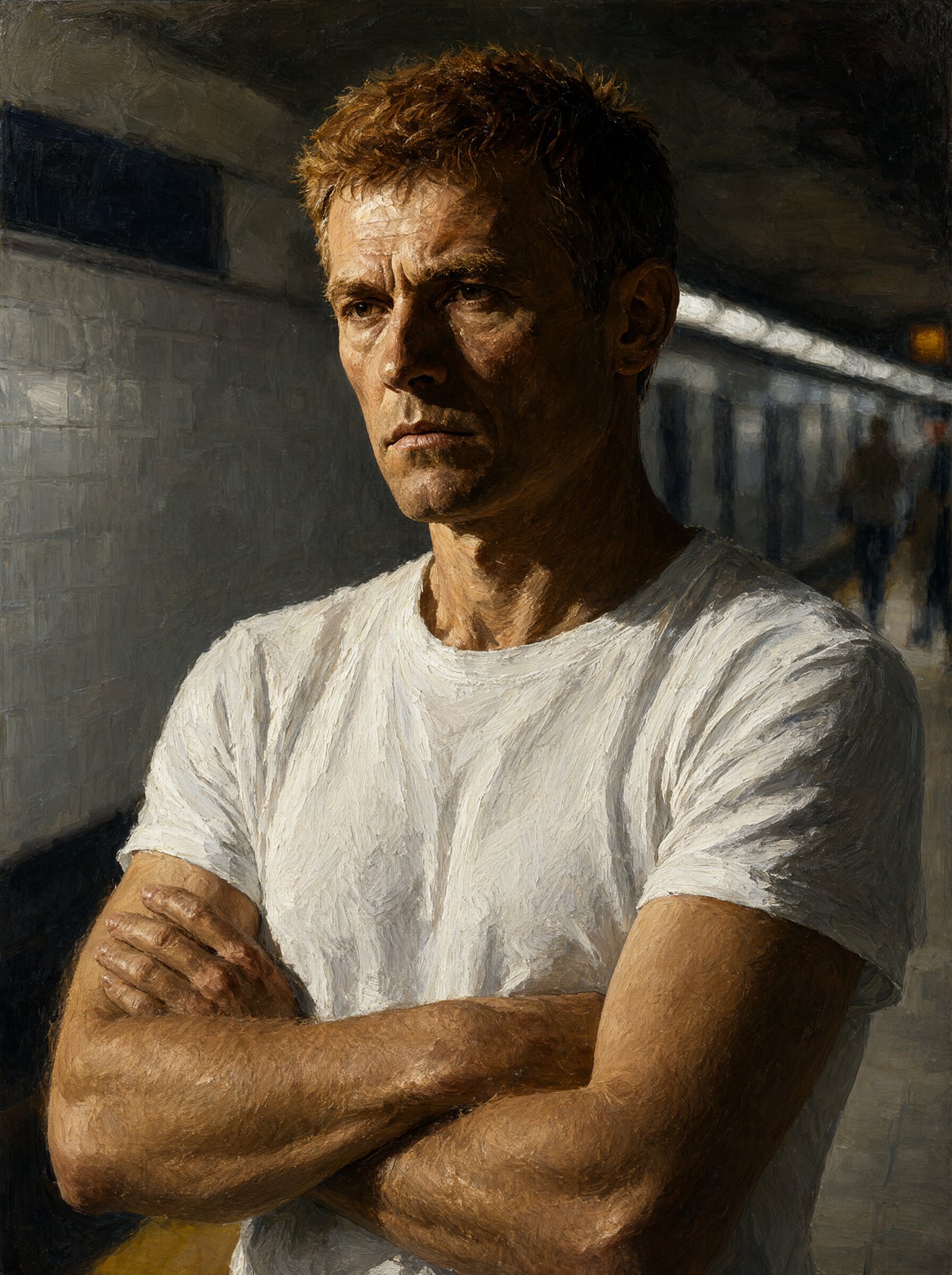
- The framing is a medium shot rather than the requested extreme close-up of the face.
- The man's head is turned in profile, which is not explicitly requested but deviates from a standard frontal portrait interpretation.
- Style: yes
- Subject: yes
- Pose: yes
- Upper clothing: yes
- Hair color: yes
- Environment: yes
- Lighting: yes
- Shot size: no
- The framing is a medium close-up rather than the requested extreme close-up of the face.
- The word 'auburn' from the prompt is not clearly represented in the image's color palette or subject attributes.
- Style: yes
- Subject: yes
- Pose: partial
- Upper clothing: yes
- Hair color: no
- Environment: partial
- Lighting: yes
- Shot size: no
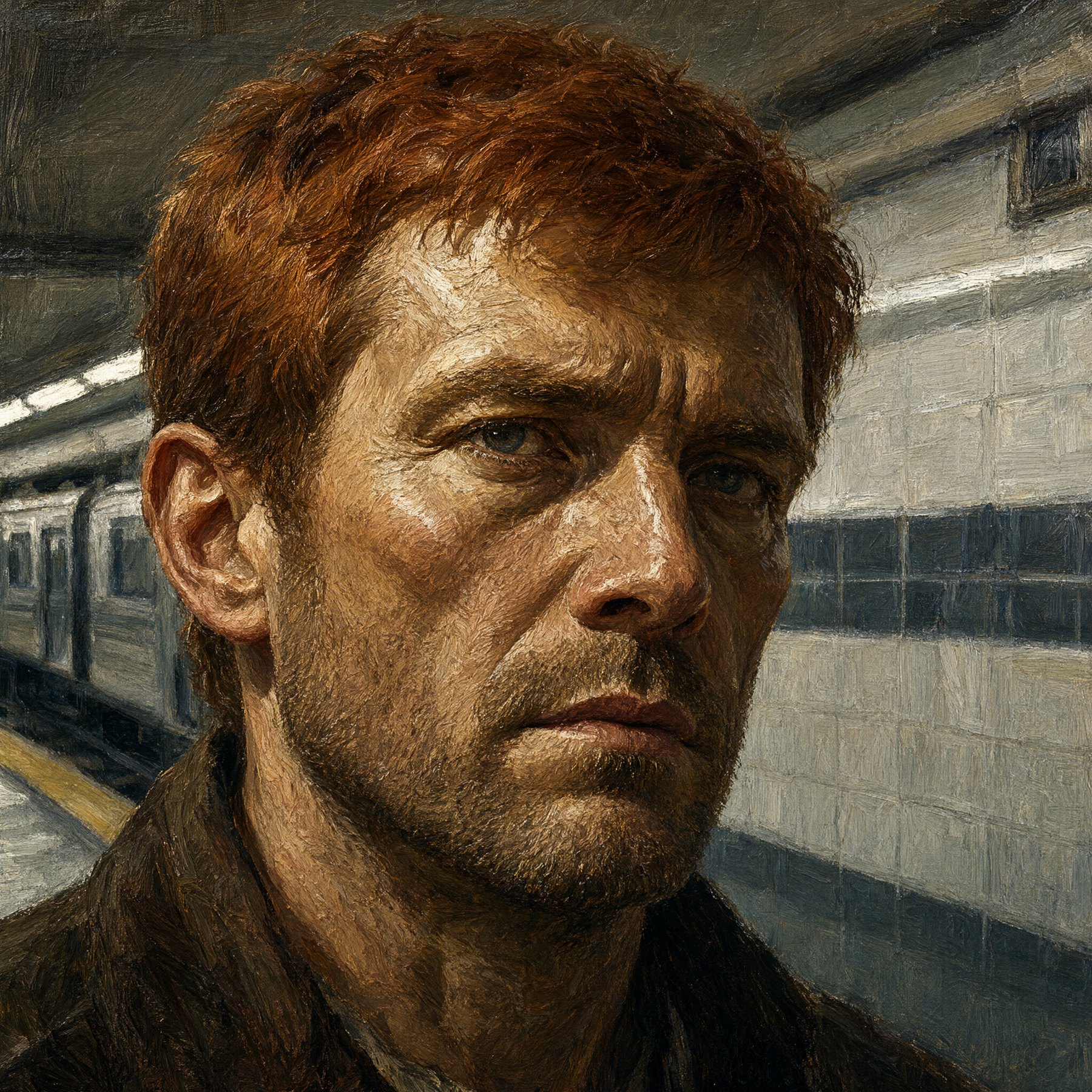
- The pose is not visible as the extreme close-up framing excludes the body and arms.
- The upper clothing appears to be a dark brown shirt rather than the requested plain white t-shirt.
- Style: yes
- Subject: yes
- Pose: no
- Upper clothing: no
- Hair color: yes
- Environment: yes
- Lighting: yes
- Shot size: yes
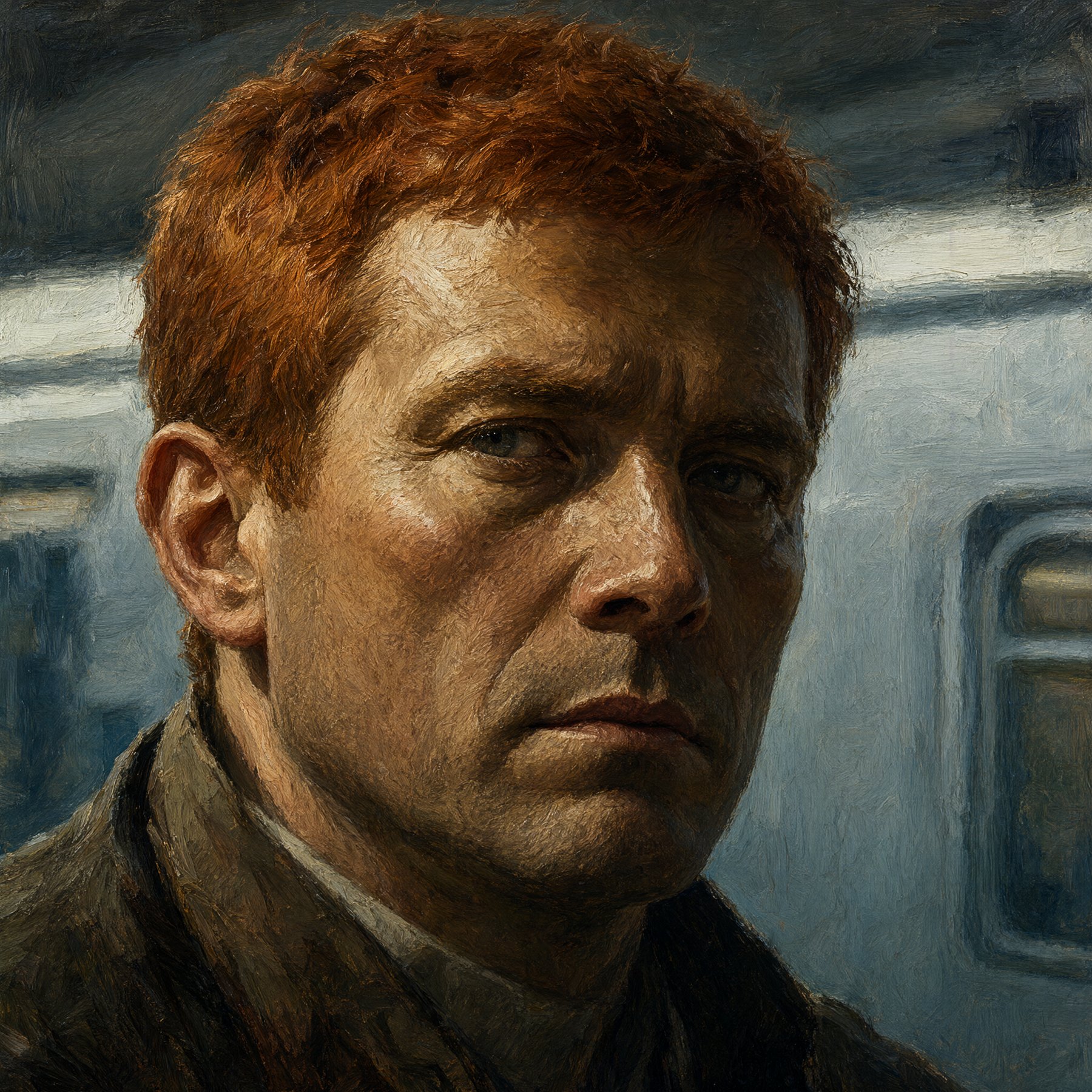
- The requested plain white t-shirt is not visible; the subject wears a dark collared jacket instead.
- The 'arms crossed' pose is not depicted due to the extreme close-up framing.
- Style: yes
- Subject: yes
- Pose: no
- Upper clothing: no
- Hair color: yes
- Environment: partial
- Lighting: yes
- Shot size: yes
Rewritten + fields — Qwen-Image-2.1
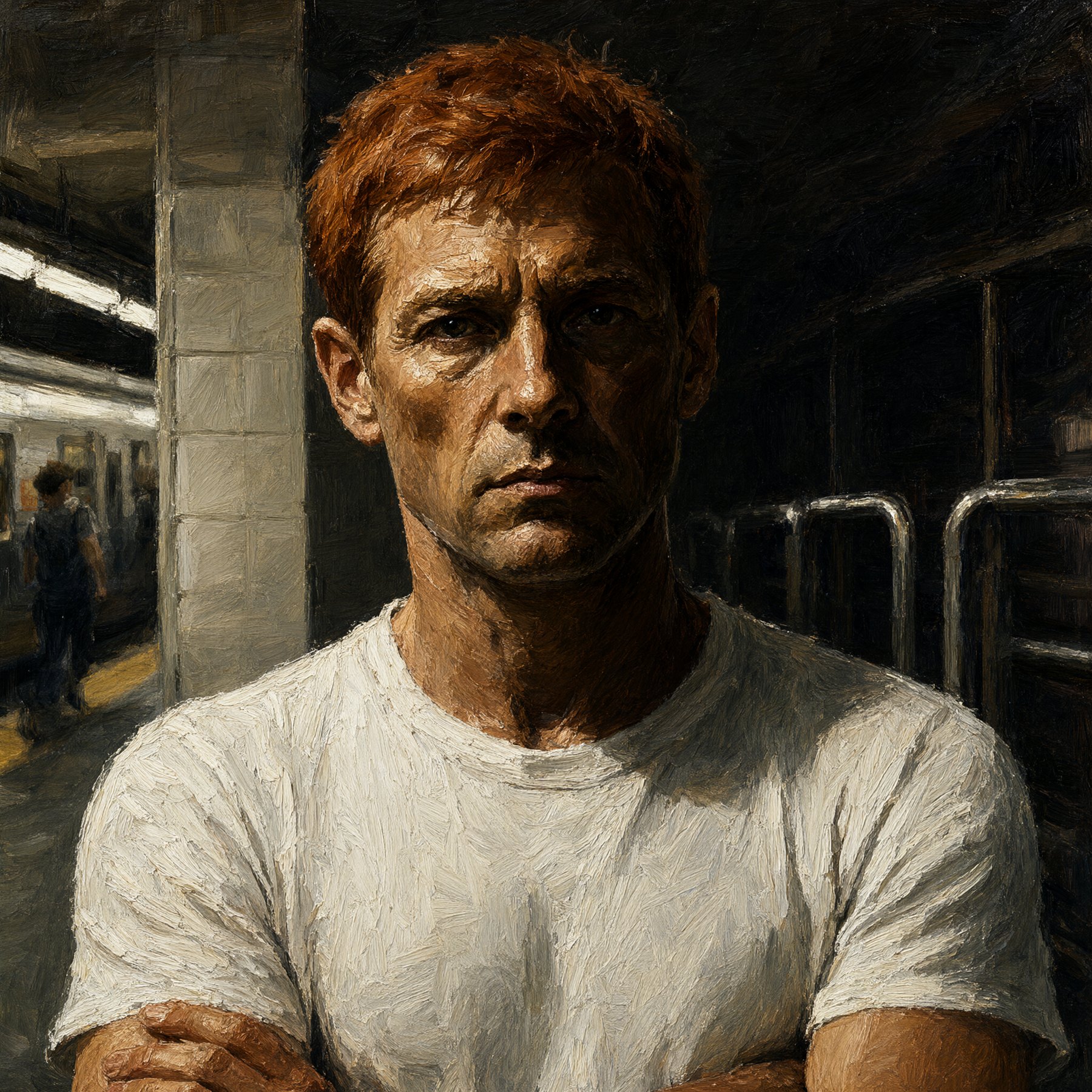
- The shot size is a medium close-up rather than the requested extreme close-up of the face.
- The man's arms are crossed, but the hands are not fully visible to confirm the pose completely.
- Style: yes
- Subject: yes
- Pose: partial
- Upper clothing: yes
- Hair color: yes
- Environment: yes
- Lighting: yes
- Shot size: no
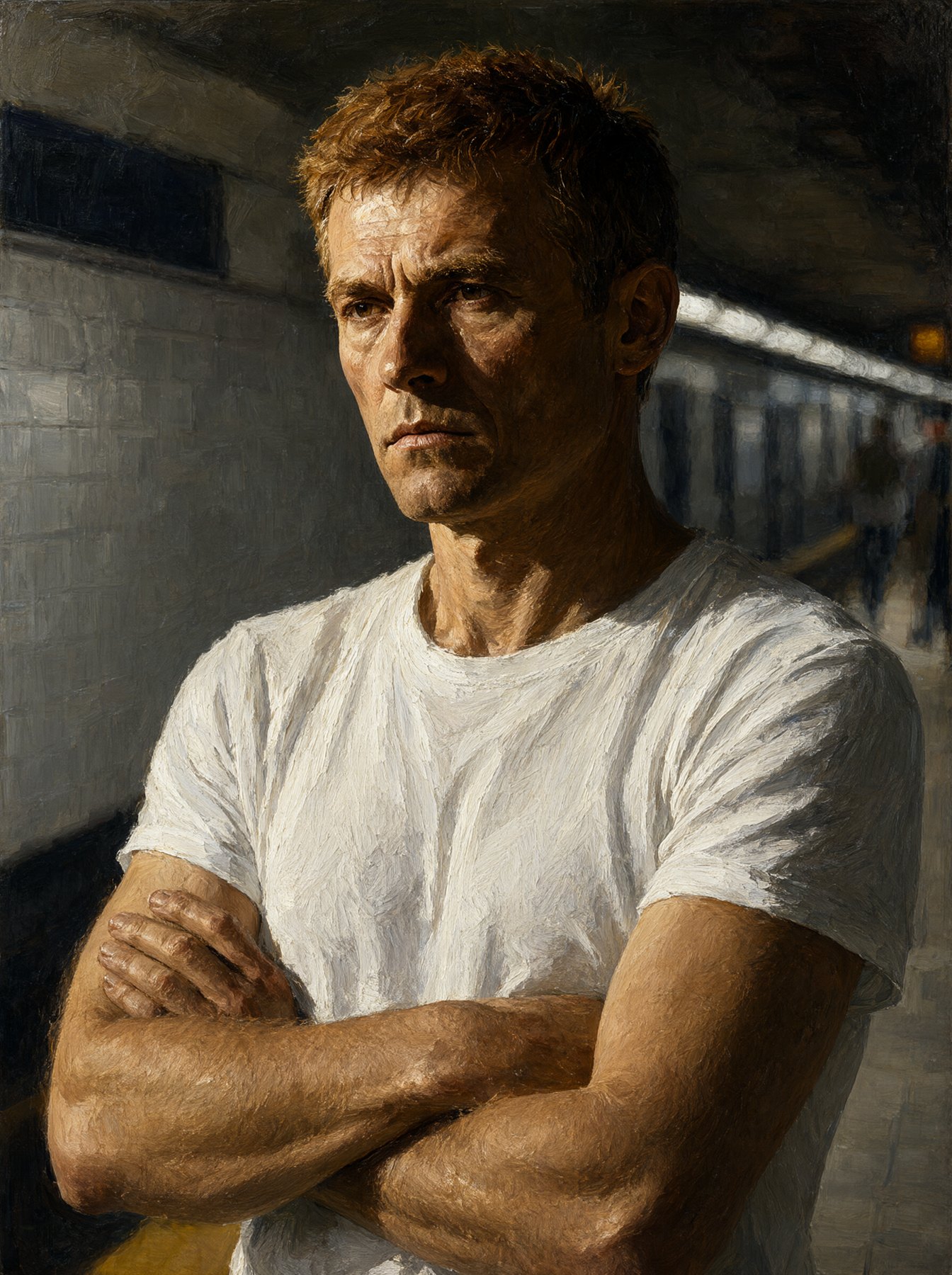
- The framing is a medium shot rather than the requested extreme close-up of the face.
- The man's head is turned in profile, which is not explicitly requested but deviates from a standard frontal portrait interpretation.
- Style: yes
- Subject: yes
- Pose: yes
- Upper clothing: yes
- Hair color: yes
- Environment: yes
- Lighting: yes
- Shot size: no
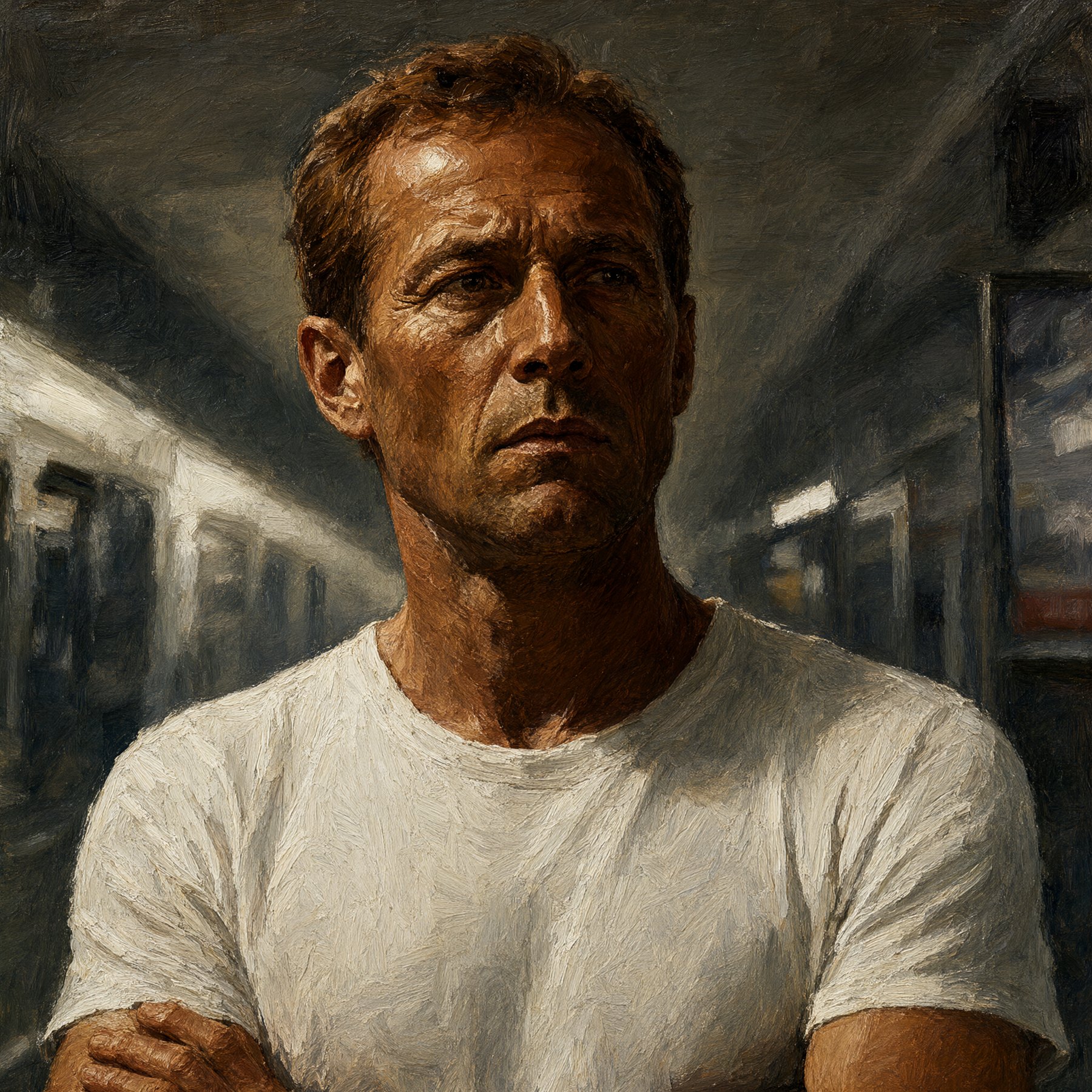
- The framing is a medium close-up rather than the requested extreme close-up of the face.
- The man's hair is brown rather than the requested auburn color.
- Style: yes
- Subject: yes
- Pose: partial
- Upper clothing: yes
- Hair color: yes
- Environment: yes
- Lighting: yes
- Shot size: no
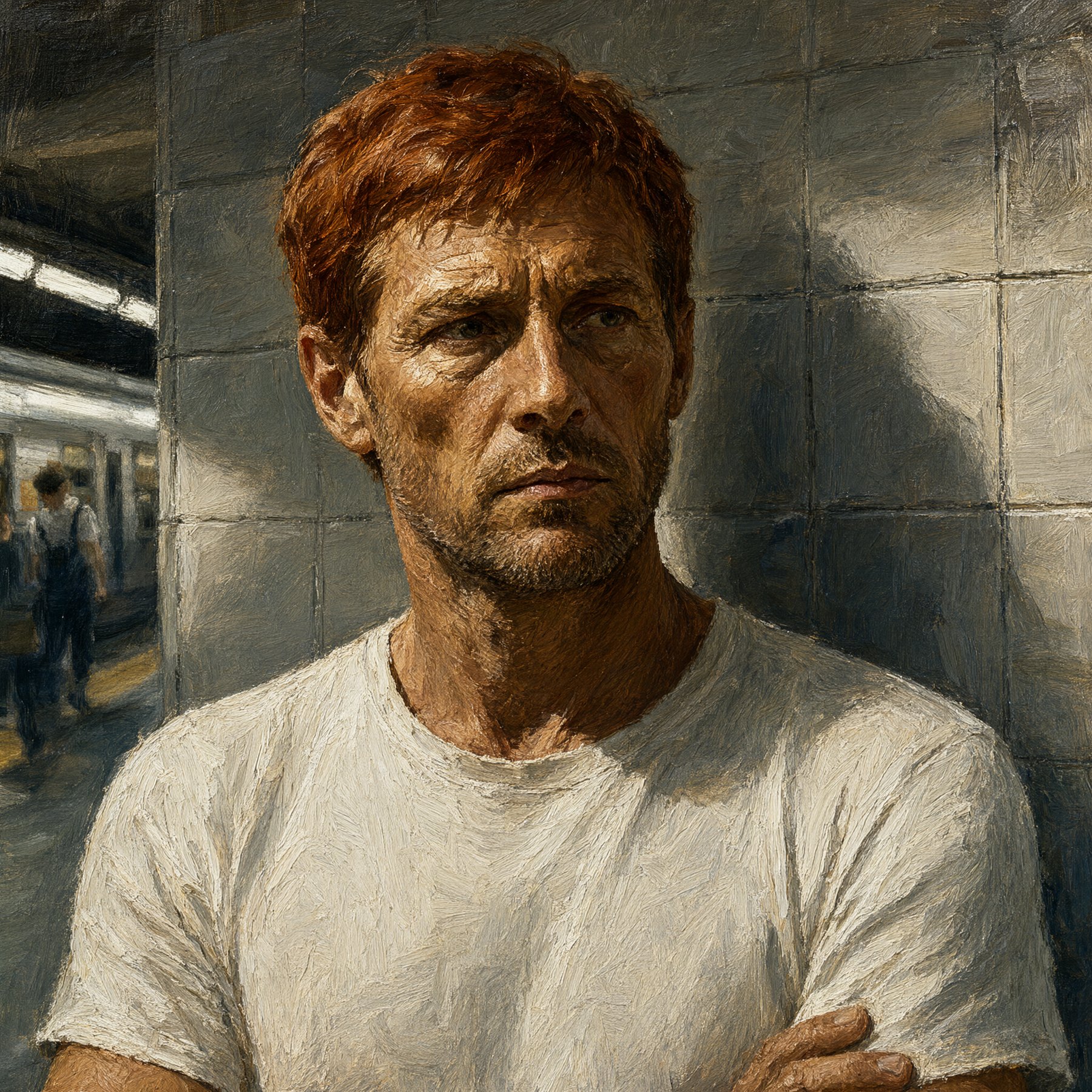
- The shot size is a medium close-up rather than the requested extreme close-up of the face.
- The arms are only partially visible at the bottom edge, making the crossed pose difficult to confirm.
- Style: yes
- Subject: yes
- Pose: partial
- Upper clothing: yes
- Hair color: yes
- Environment: yes
- Lighting: yes
- Shot size: no
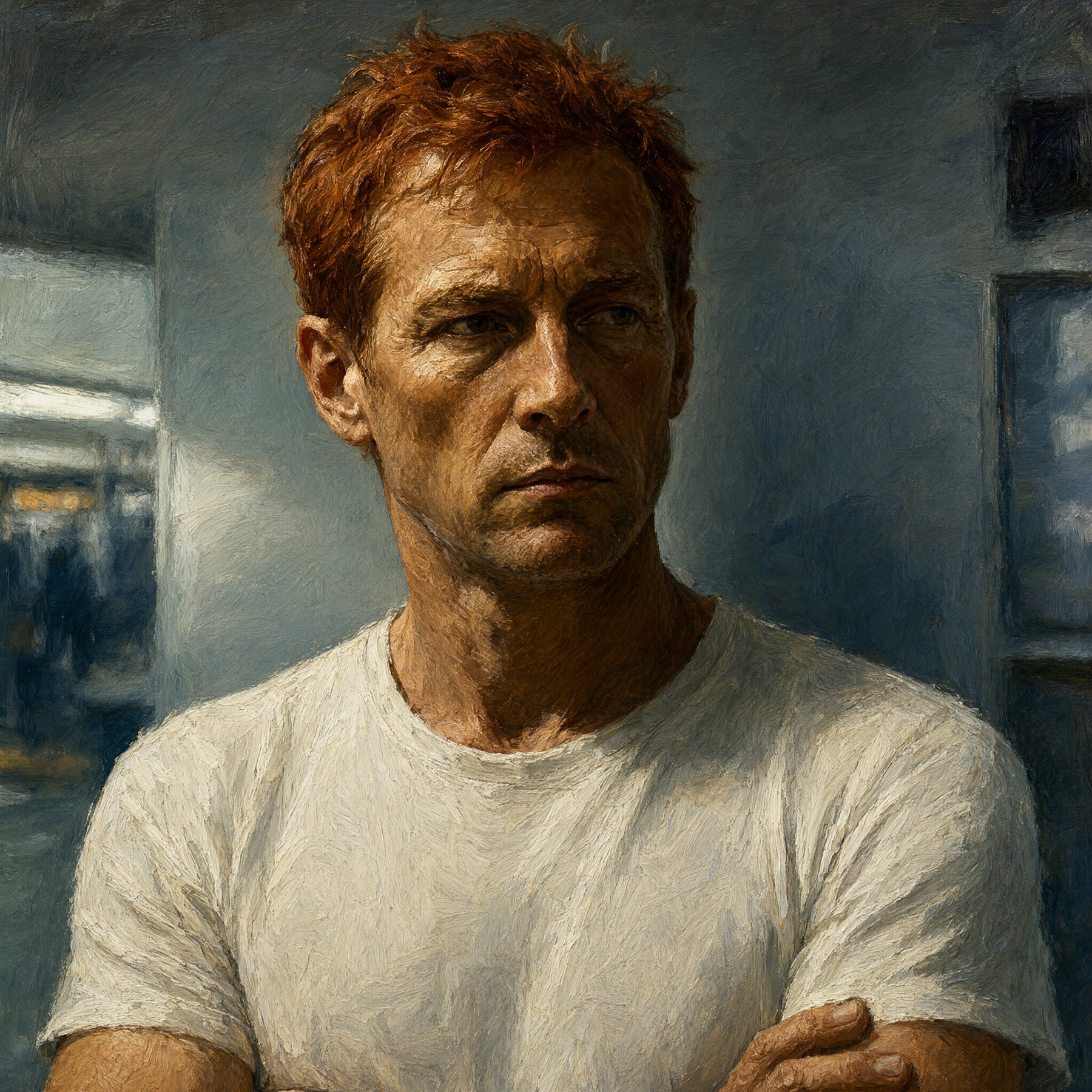
- The framing is a medium close-up of the torso and head rather than the requested extreme close-up of the face.
- The background is too abstract and blurry to clearly identify as a subway platform.
- Style: yes
- Subject: yes
- Pose: partial
- Upper clothing: yes
- Hair color: yes
- Environment: partial
- Lighting: yes
- Shot size: no
Raw — Qwen-Image-2.1
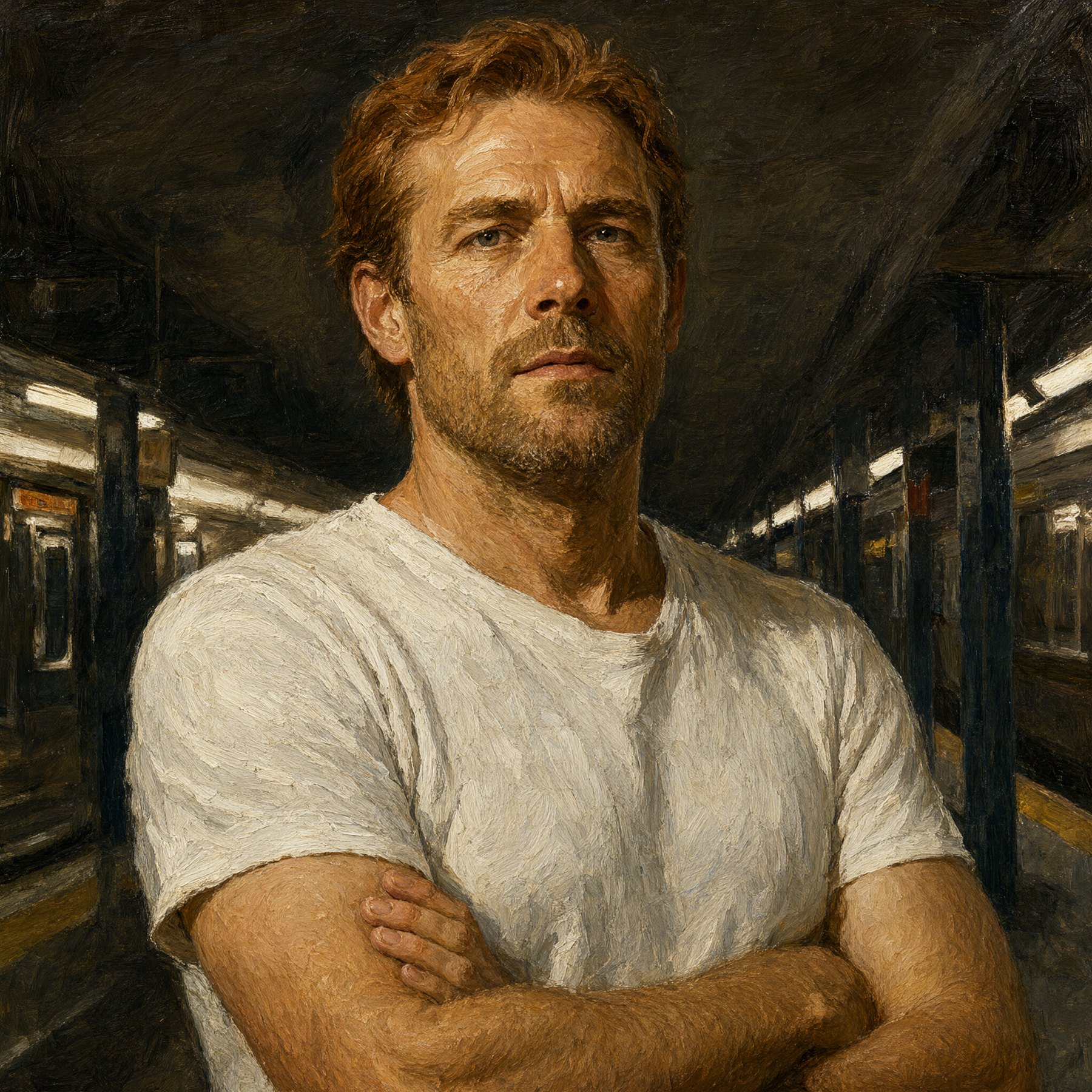
- The shot size is a medium close-up, not the requested extreme close-up of the face.
- The man's arms are crossed, but the pose is not clearly 'standing upright' as the framing cuts off the lower body.
- Style: yes
- Subject: yes
- Pose: yes
- Upper clothing: yes
- Hair color: yes
- Environment: yes
- Lighting: yes
- Shot size: no
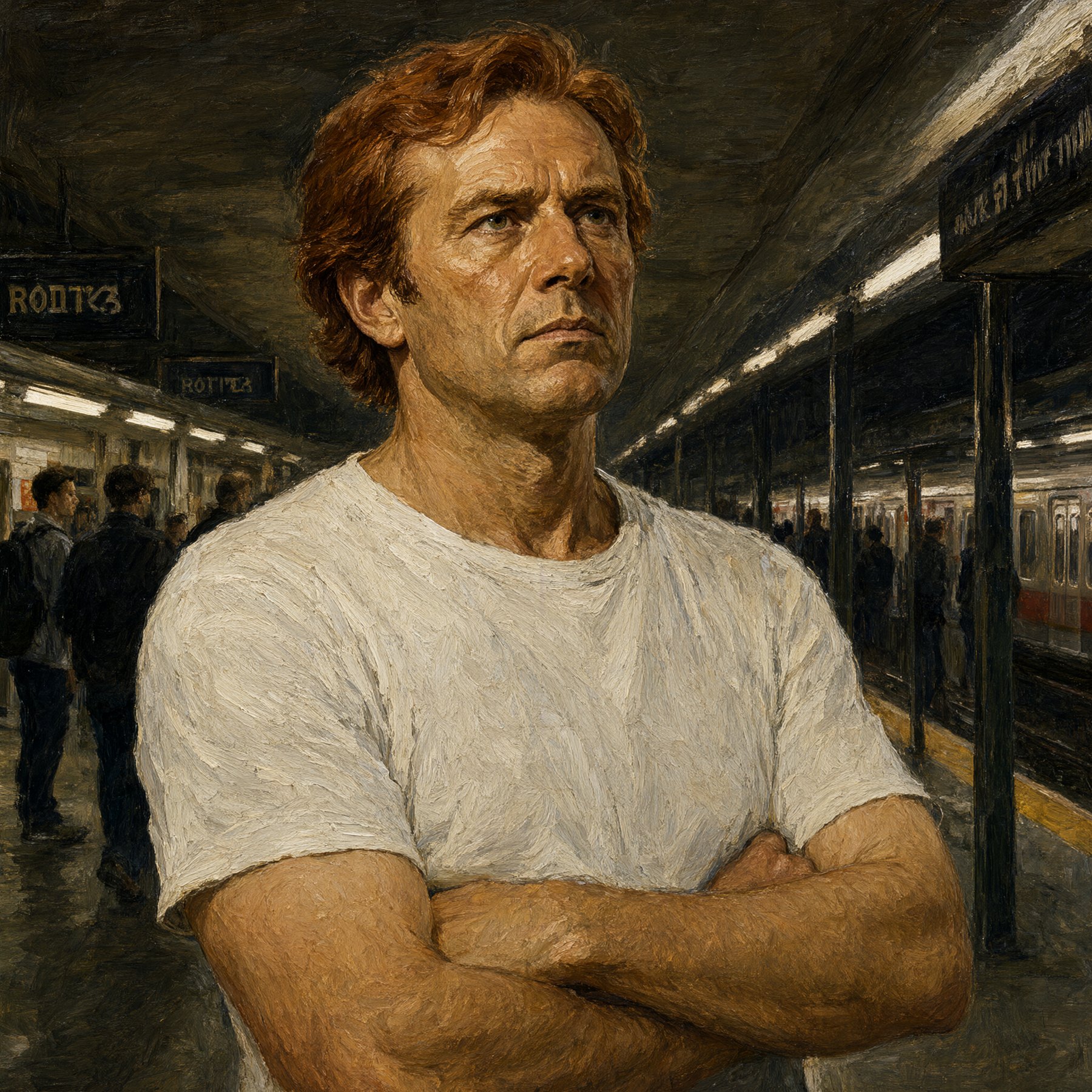
- The framing is a medium shot rather than the requested extreme close-up of the face.
- The background signage contains garbled, unreadable lettering that resembles Cyrillic characters.
- Style: yes
- Subject: yes
- Pose: yes
- Upper clothing: yes
- Hair color: yes
- Environment: yes
- Lighting: yes
- Shot size: no
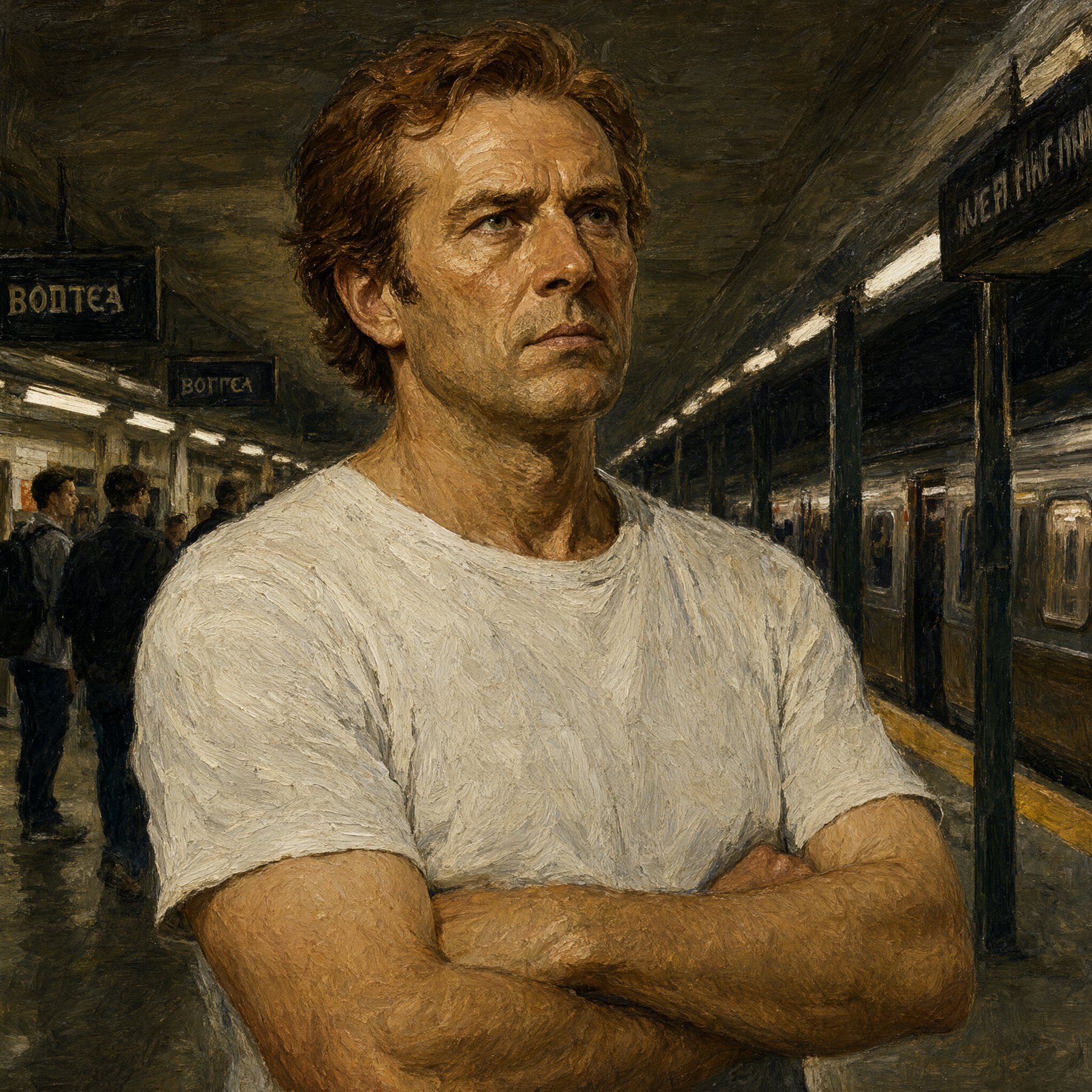
- The requested 'extreme close-up of the face' is not present; the image is a medium shot showing the torso and arms.
- The requested 'dramatic side lighting' is absent; the lighting is relatively soft and frontal.
- Style: yes
- Subject: yes
- Pose: yes
- Upper clothing: yes
- Hair color: yes
- Environment: yes
- Lighting: yes
- Shot size: no
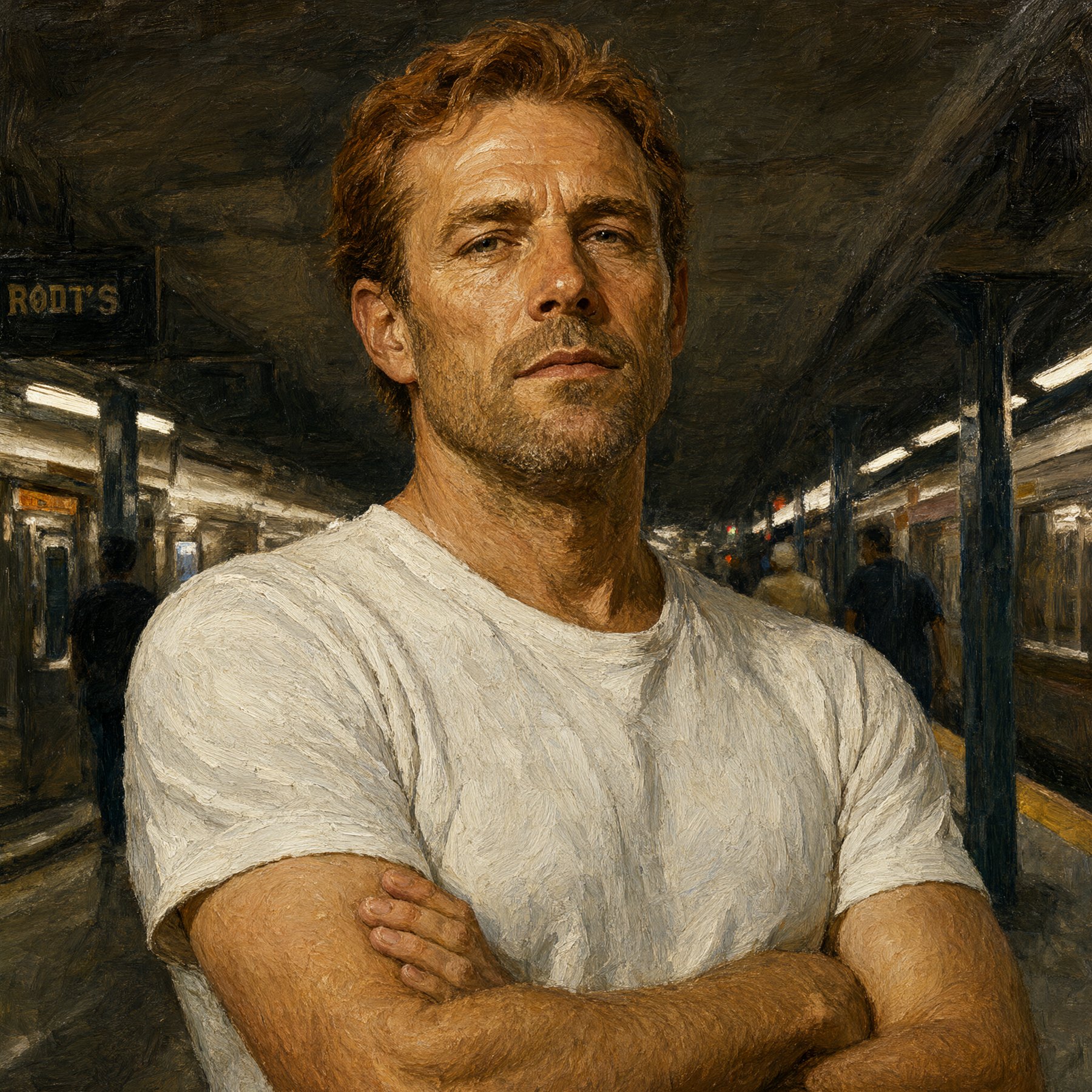
- The shot size is a medium shot showing the torso, not the extreme close-up of the face requested.
- The man's hair is a reddish-brown rather than the specific auburn color requested.
- Style: yes
- Subject: yes
- Pose: yes
- Upper clothing: yes
- Hair color: yes
- Environment: yes
- Lighting: yes
- Shot size: no
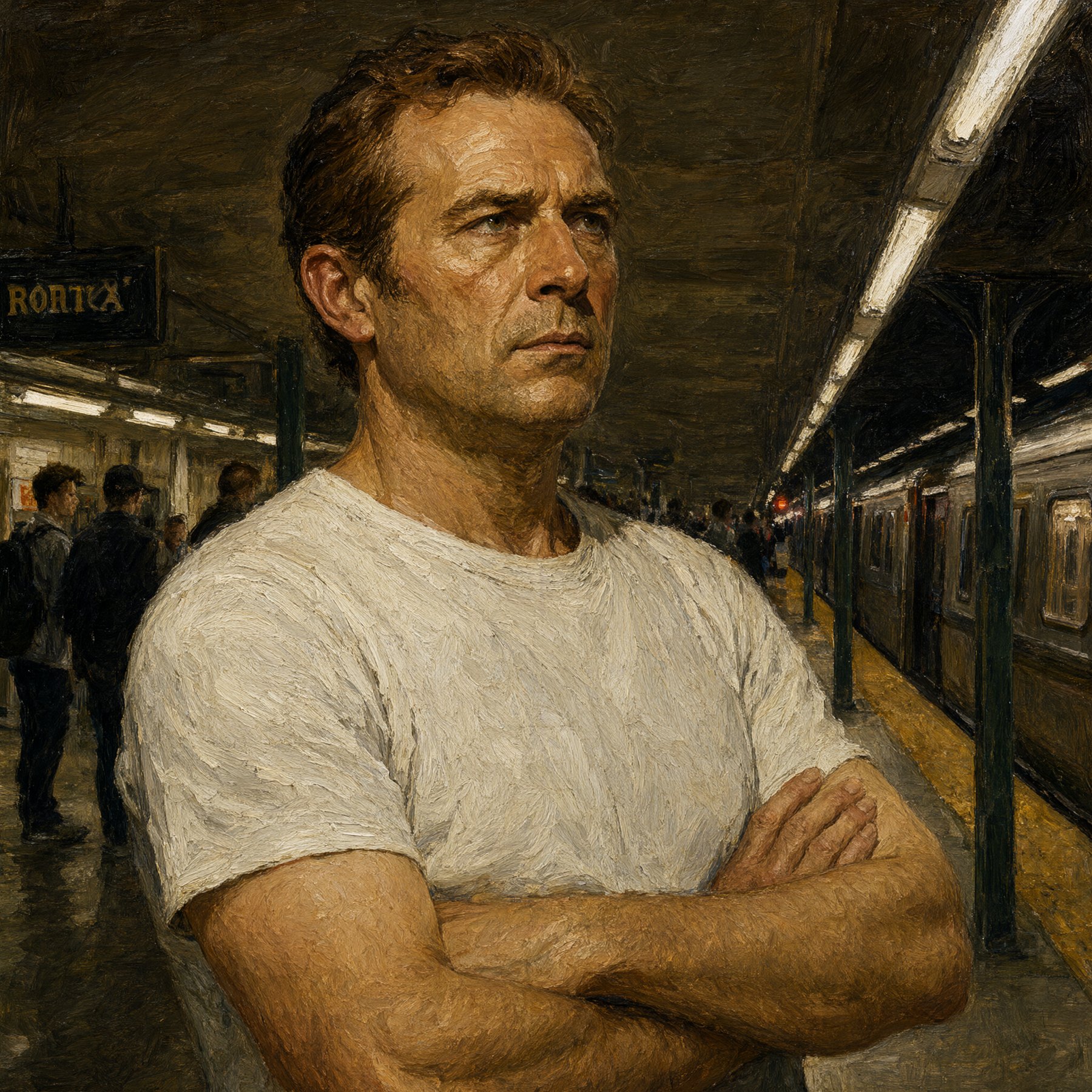
- The requested 'extreme close-up of the face' is not met; the image is a medium shot showing the torso and arms.
- The hair color is a dark brown rather than the requested auburn.
- Style: yes
- Subject: yes
- Pose: yes
- Upper clothing: yes
- Hair color: yes
- Environment: yes
- Lighting: yes
- Shot size: no
Predecessors, rewritten, all formats
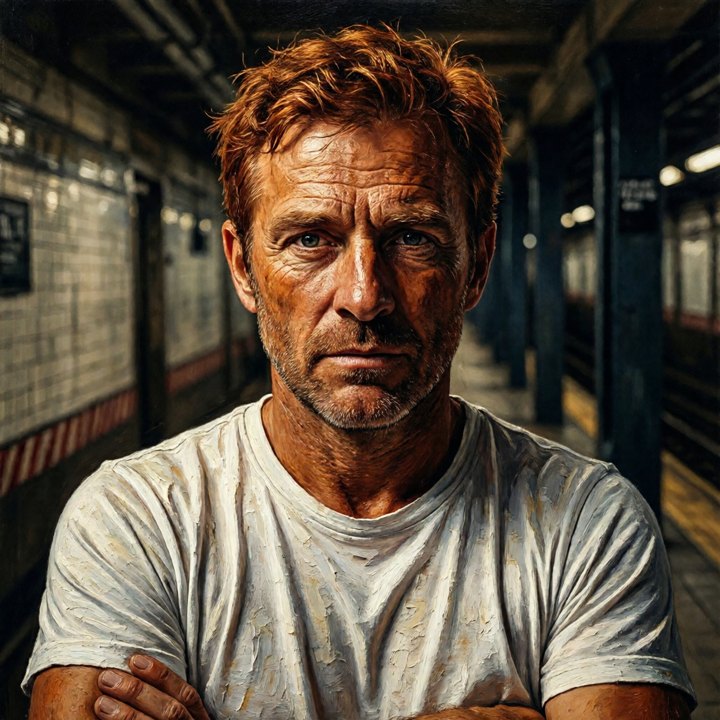
- The shot size is a medium close-up showing the torso and arms, rather than the requested extreme close-up of the face.
- The hands visible at the bottom left appear slightly compressed and the finger anatomy is somewhat ambiguous.
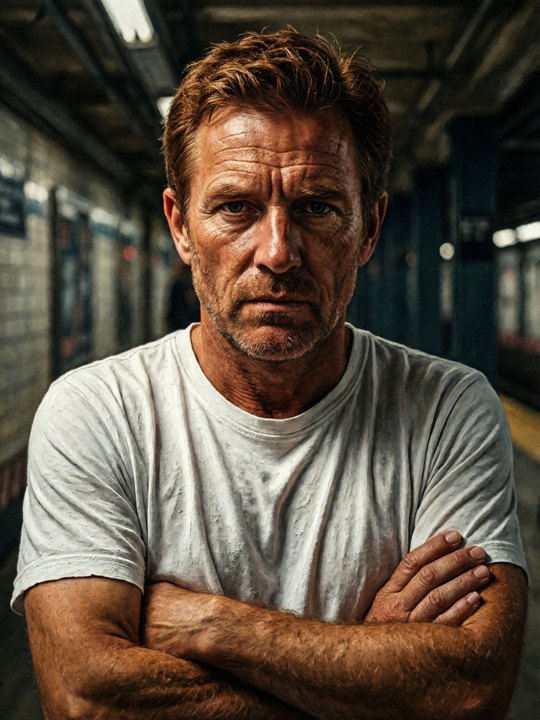
- The image is a photorealistic digital render rather than an oil painting as requested.
- The framing is a medium shot showing the torso, not an extreme close-up of the face.
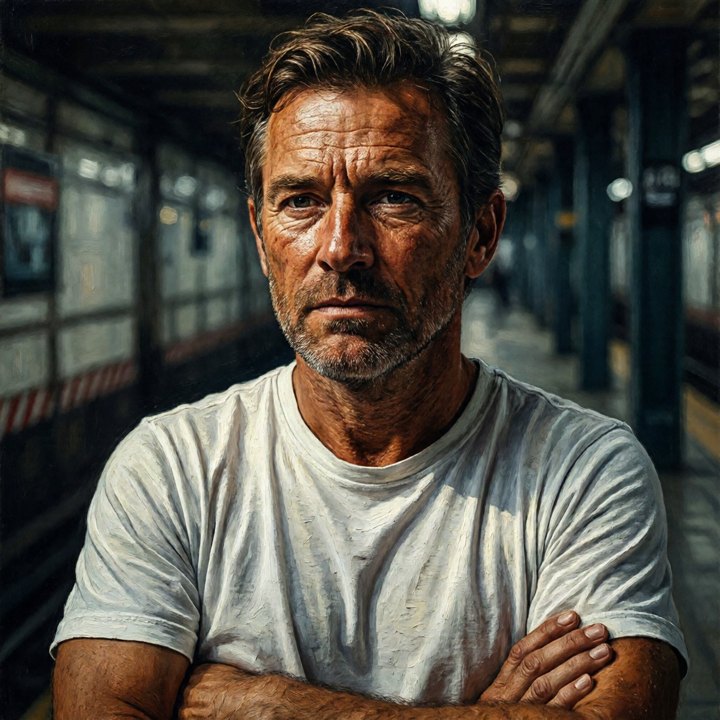
- The framing is a medium close-up showing the torso and crossed arms, rather than the requested extreme close-up of the face.
- The man's hair is dark brown with grey streaks, not the auburn color specified in the prompt.
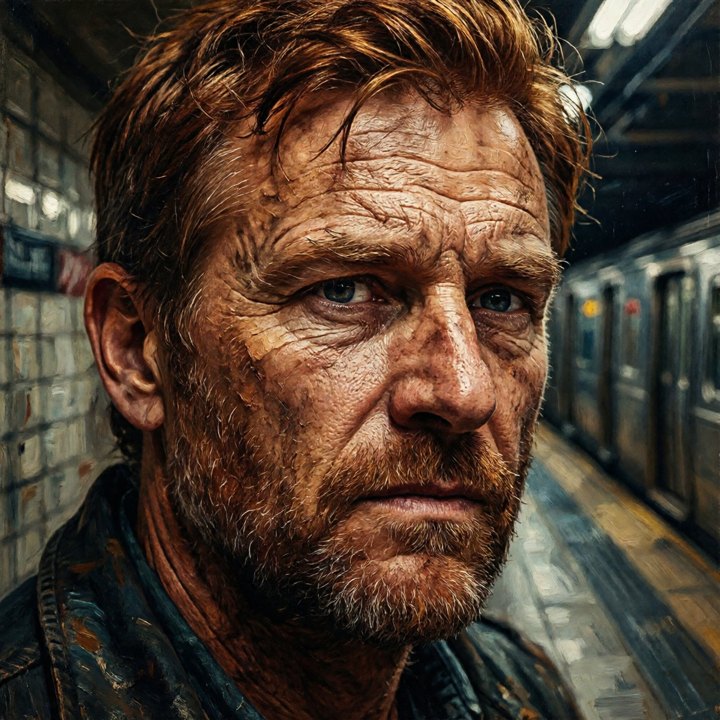
- The upper clothing is a dark, textured jacket rather than the requested plain white t-shirt.
- The pose cannot be verified as standing upright with arms crossed because the shot is an extreme close-up of the face.
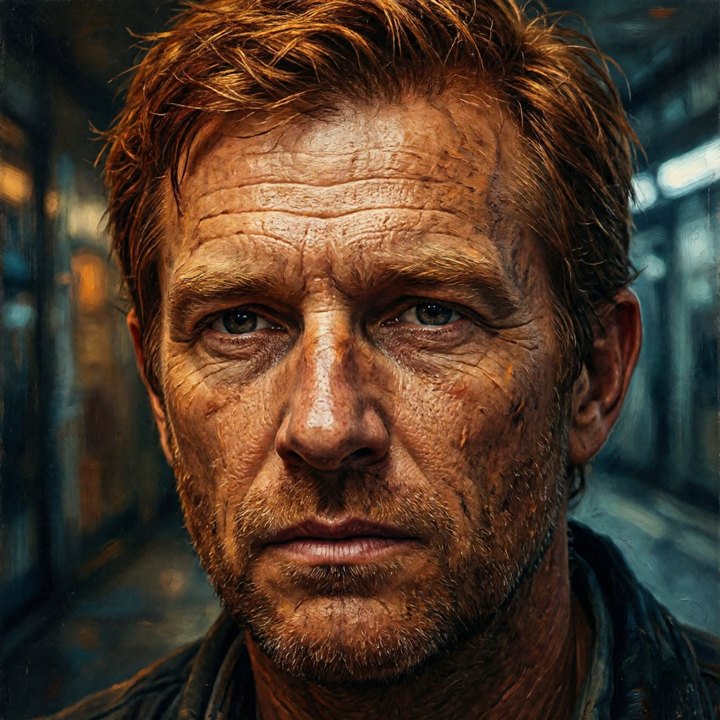
- The subject is not wearing a plain white t-shirt as requested, but rather a dark, textured garment.
- The pose of standing upright with arms crossed is not visible due to the extreme close-up framing.
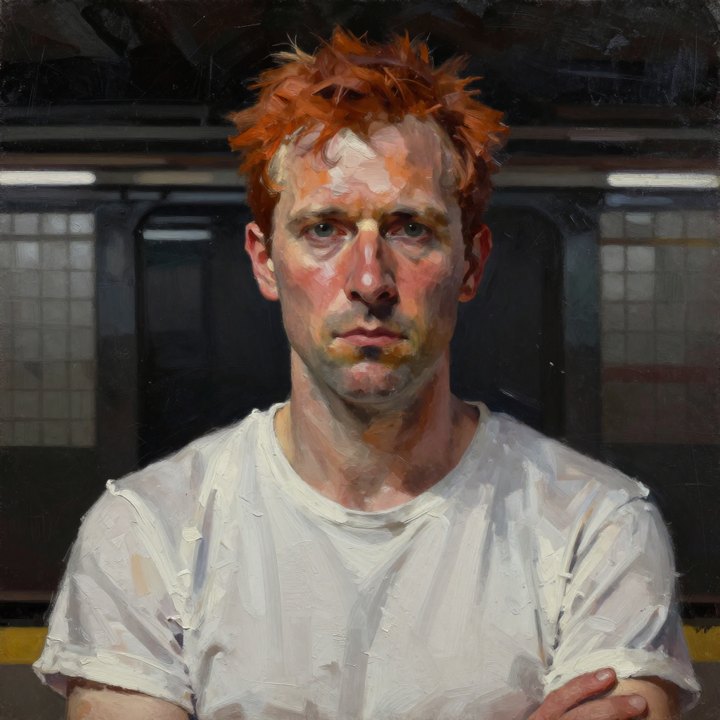
- The shot size is a medium close-up, not the requested extreme close-up of the face.
- The pose is not clearly standing upright with arms crossed; the arms are mostly out of frame and the crossed position is ambiguous.
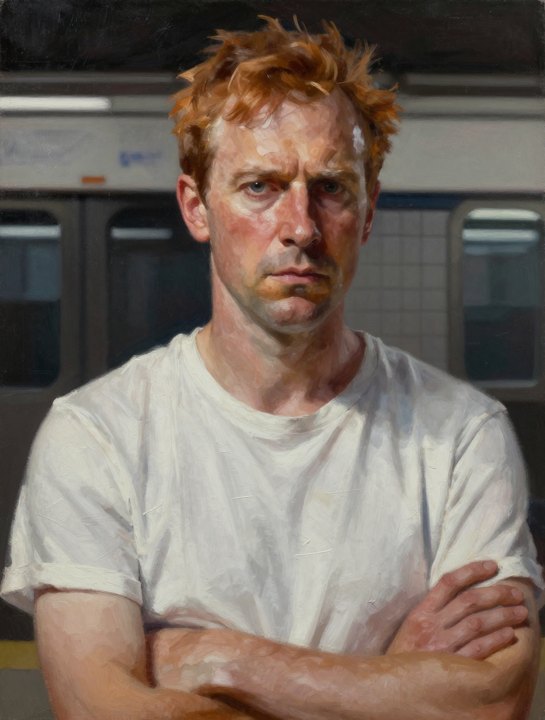
- The framing is a medium shot rather than the requested extreme close-up of the face.
- The lighting is relatively soft and frontal, lacking the strong contrast of dramatic side lighting.
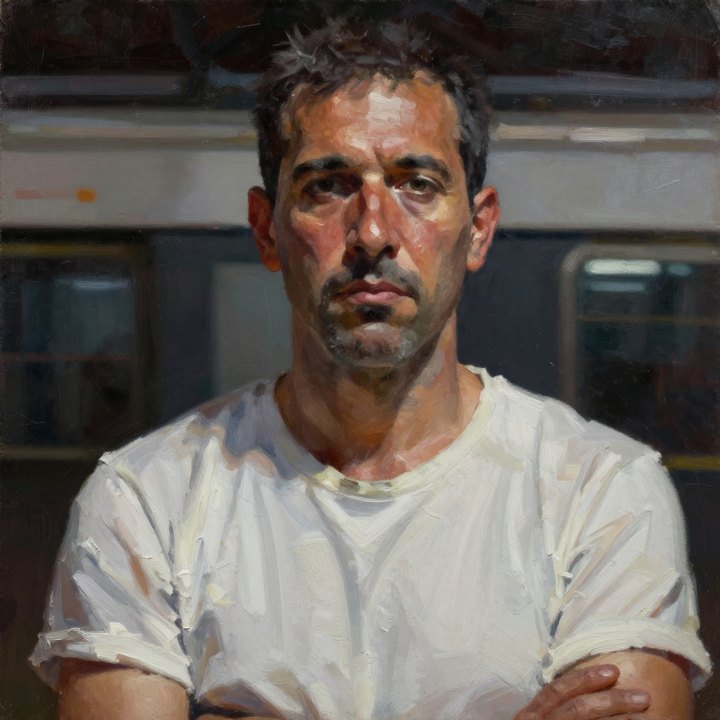
- The framing is a medium close-up showing the torso, not the extreme close-up of the face requested.
- The man's hair is dark brown or black, not the auburn color specified in the prompt.
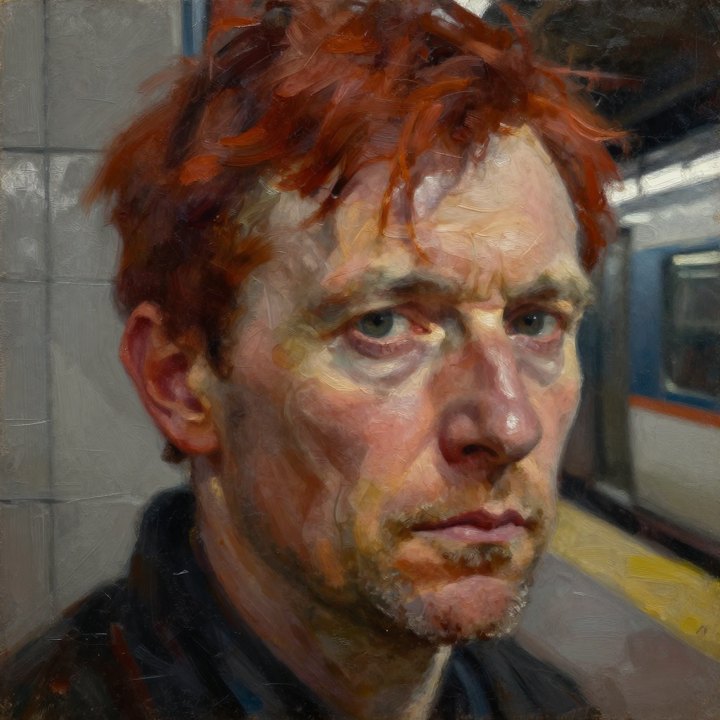
- The pose is not visible as the extreme close-up framing excludes the body and arms.
- The upper clothing appears to be a dark jacket or shirt rather than the requested plain white t-shirt.
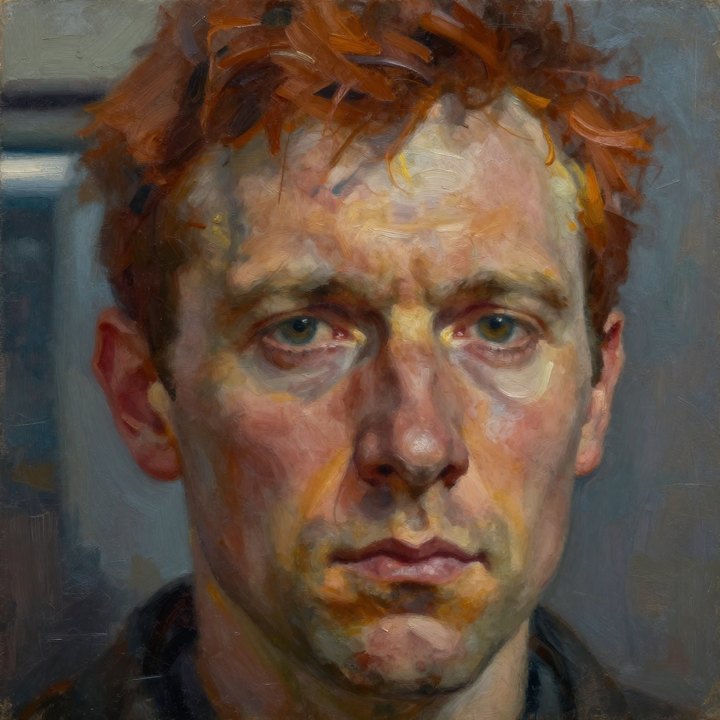
- The requested plain white t-shirt is not visible; the figure appears to be wearing a dark garment.
- The subway platform setting is not depicted, with only a vague, indistinct background.
4 · Brand & campaign consistency
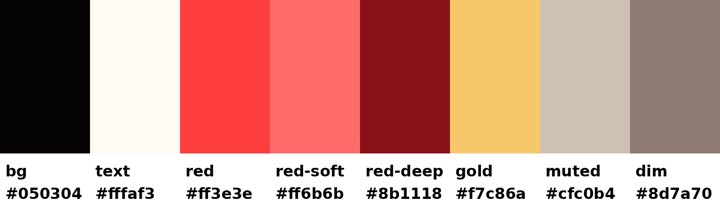
Real brand assets of year2066.ai: the official wordmark (cropped from the site's social cover) and its colour palette sheet, used as reference images (COMPOSE / EDIT with references). The judge sees the wordmark next to every result and scores logo fidelity, colour discipline, scene adherence and advertising quality; palette is a measured value: the share of pixels within ΔE 12 (CIE76) of the eight brand colours.

| Series | Value |
|---|---|
| QI-2.1 · logo | 6 |
| QI-2.1 · colours | 7.80 |
| QI-2.1 · adherence | 7.80 |
| QI-2.1 · quality | 8.80 |
| Edit-2511 · logo | 5.33 |
| Edit-2511 · colours | 8.33 |
| Edit-2511 · adherence | 9 |
| Edit-2511 · quality | 8.50 |
| Series | Value |
|---|---|
| QI-2.1 · palette share | 57.20 % |
| Edit-2511 · palette share | 63.30 % |
| QI-2512 L · palette share | 58.60 % |
| Z-Turbo · palette share | 64.80 % |
Pairwise verdicts
| Pair (both A/B orders judged) | 2.1 wins | predecessor wins | ties | 2.1 win rate | verdicts |
|---|---|---|---|---|---|
| Qwen-Image-2.1 vs Qwen-Image-2512 Lightning (FP4) | 3 | 1 | 0 | 75 % | 4 |
| Qwen-Image-2.1 vs Z-Image-Turbo | 1 | 3 | 0 | 25 % | 4 |
| Qwen-Image-2.1 vs Qwen-Image-Edit-2511 (GGUF) | 11 | 3 | 0 | 79 % | 14 |
a key visual for a digital advertising campaign of the company whose wordmark is image 1, using exactly the colour palette of image 2: the wordmark large and unchanged in the upper third, below it a stylised glowing neural network made of thin red lines and gold nodes on a near-black background, 16:9
rewritten prompt
A digital advertising key visual in a 16:9 landscape format. The background is a deep, near-black color with a subtle dark red radial glow in the center. In the upper third of the composition, the wordmark from image 1 is placed large and unchanged, preserving its exact typography, white and red coloring, and the tagline below it. In the lower two-thirds, a stylized neural network is depicted. This network consists of thin, glowing red lines connecting small, bright gold nodes. The network structure is abstract and organic, spreading across the dark space. The entire image strictly uses the color palette from image 2, utilizing the near-black background, the specific reds for the lines and wordmark accents, and the gold for the nodes and text details.


- The wordmark is not in the upper third but is centered vertically in the frame.
- Faint, ghost-like duplicate text is visible behind the main logo letters.
an empty white billboard on a modern city street at dusk, wet asphalt reflecting the lights, photographed from the pavement
rewritten prompt
A large, blank white billboard stands prominently on a modern city street corner during the blue hour of dusk. The smooth, matte surface of the sign is completely empty, devoid of any graphics or lettering. Below, the wet asphalt pavement glistens with rain, creating a mirror-like surface that reflects the warm amber glow of streetlamps and the cool blue tones of the fading sky. The viewpoint is low, positioned directly on the pavement, looking slightly upward toward the billboard, which dominates the upper frame. In the background, blurred silhouettes of contemporary glass skyscrapers rise against the twilight sky, their windows twinkling with interior lights. The scene is bathed in soft, diffused ambient light, with sharp specular highlights on the wet ground. The color palette features deep indigos, slate grays, and vibrant orange reflections. The image is a high-resolution photograph with a shallow depth of field, keeping the billboard in sharp focus while the distant cityscape remains softly out of focus, evoking a quiet, urban atmosphere.
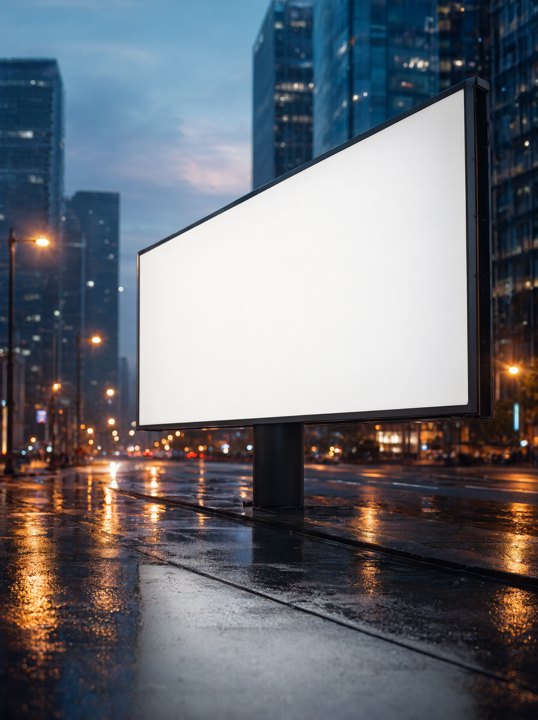
- The reflection of the billboard on the wet pavement is slightly distorted and lacks sharpness.
- The base of the billboard pole appears to merge slightly with the ground texture.
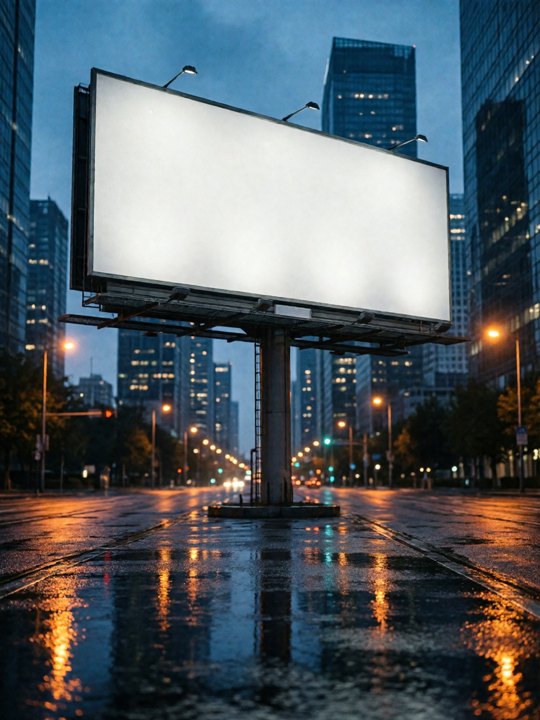
- The billboard's support structure and ladder appear slightly indistinct and merged with the background.
- The reflections on the wet asphalt are somewhat uniform and lack the sharp, chaotic detail of real rain-slicked pavement.
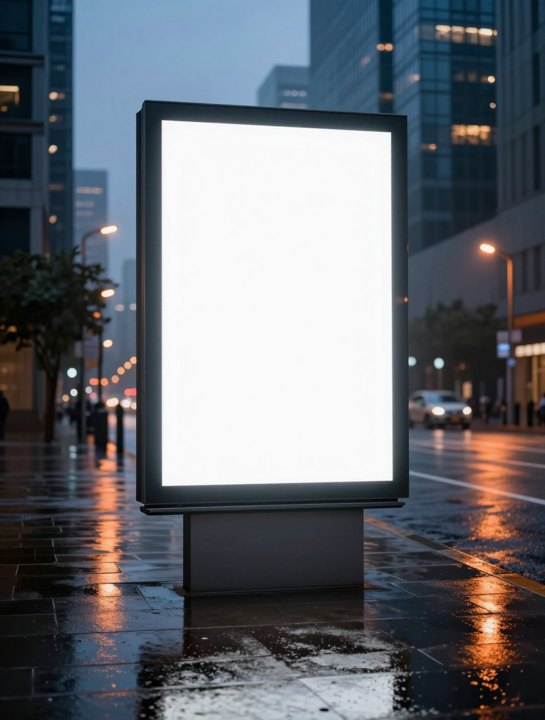
- The wet pavement reflections are slightly smeared and lack sharp detail in the foreground.
- The background elements, such as the car and distant lights, are heavily blurred which is consistent with depth of field but reduces detail.
put the wordmark of image 2 onto the empty billboard of image 1, filling the billboard with a near-black background and the wordmark centred, keeping the street, the lighting and the reflections exactly as they are
rewritten prompt
Place the wordmark from image 2 onto the empty white billboard in image 1. The billboard surface is filled with a near-black background, and the wordmark is centered on it. The wordmark consists of the text "YEAR2066.ai" in a bold sans-serif font, with "YEAR" and ".ai" in white and "2066" in red, positioned above the text "AHEAD OF ITS TIME" in smaller, gold, spaced-out capital letters. The surrounding environment remains exactly as in image 1: the wet street with its golden reflections, the city skyline in the background, the streetlights, and the overall lighting and composition are preserved without any changes.

- The perspective of the wordmark is slightly flattened relative to the billboard's angle, making it look like a decal rather than part of the screen.
- The reflection of the billboard on the wet street is not visible, which breaks the physical consistency of the scene.

- The year in the wordmark is misspelled as 2060 instead of the reference 2066.
- The text on the billboard is not perfectly flat, showing perspective distortion that makes it look curved.
print the wordmark of image 2 in vivid red on the white ceramic mug in image 1, correctly wrapped around the curved surface, everything else unchanged
rewritten prompt
The white ceramic mug in image 1 is the only element that changes. The wordmark of image 2 is printed on the visible side of the mug in vivid red, following the curvature of the ceramic surface so the lettering wraps naturally around the cylinder. The wordmark is copied exactly from image 2, including its lettering style, the red accent on the digits, and the smaller tagline beneath it. Everything else in image 1 stays exactly as in the source: the black over-ear headphones, the dark wooden table, the soft directional lighting, the shadows, the background wall, the composition, the camera angle, and the overall colour palette.
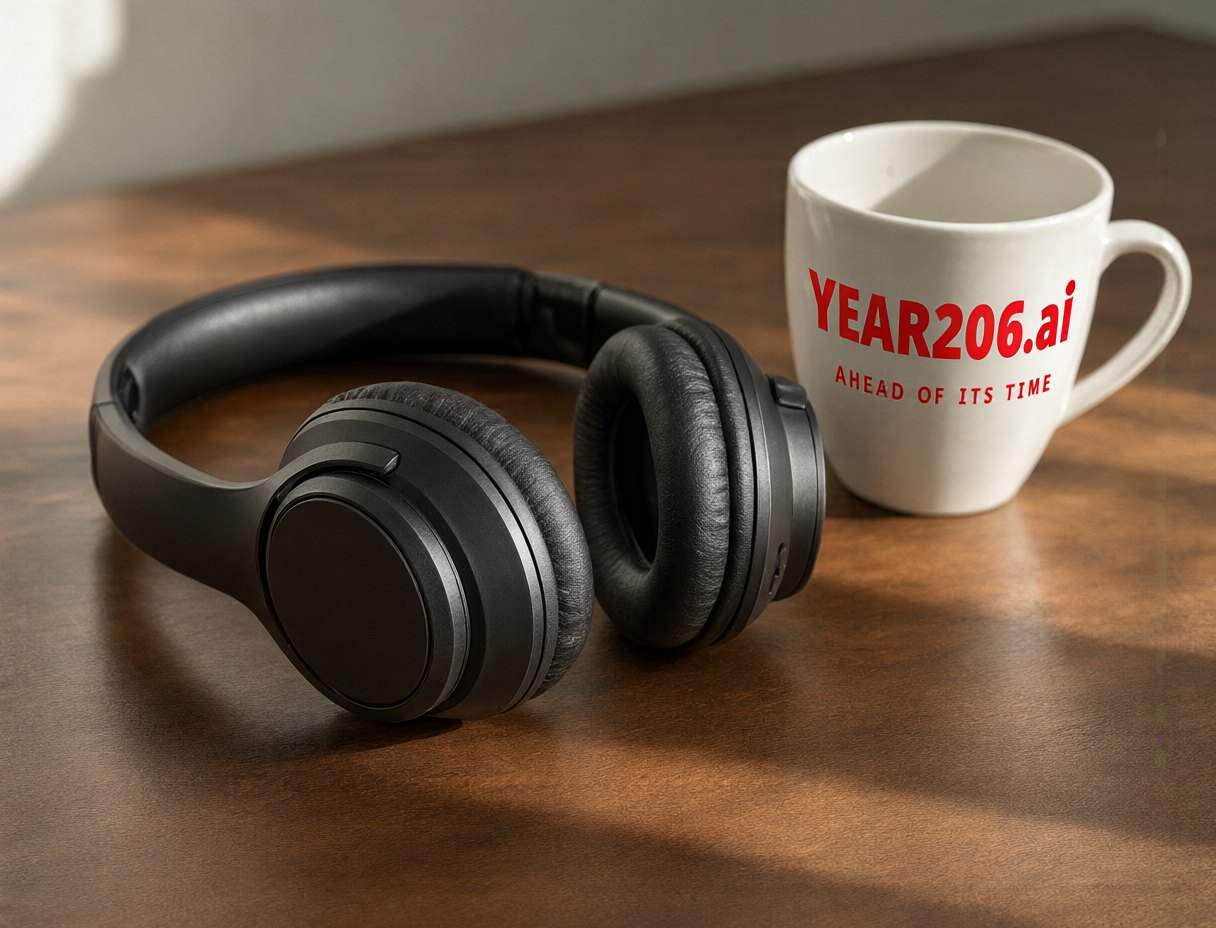
- The wordmark on the mug is misspelled as 'YEAR206.ai' instead of 'YEAR2066.ai'.
- The wordmark is printed in a single solid red color, failing to reproduce the reference's white and red split coloring.
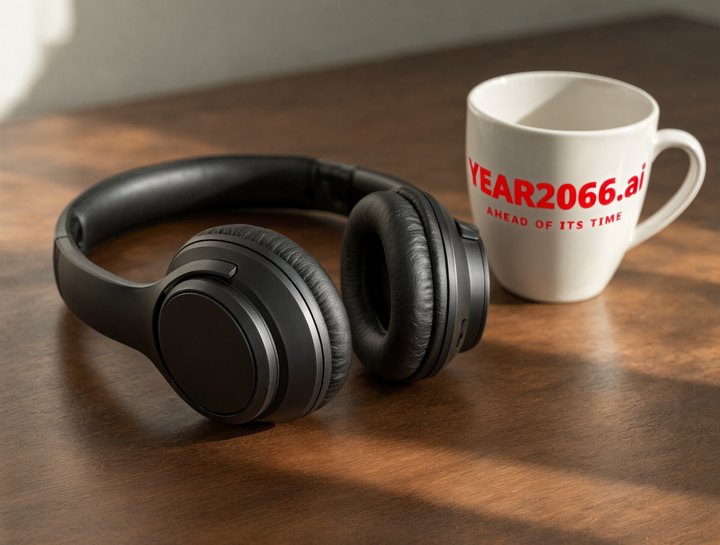
- The wordmark is printed in a single solid red color, failing to reproduce the two-tone white and red design of the reference.
- The tagline 'AHEAD OF ITS TIME' is printed in red instead of the gold color specified in the reference.
a campaign photo for the company whose wordmark is image 1: a diverse team of four people in a modern office looking at a large wall screen that shows the wordmark of image 1 with near-black background, vivid red accents, a gold highlight and warm white text, bold geometric sans-serif typography; the wordmark also appears small in the top-left corner of the picture; palette as in image 2
rewritten prompt
A campaign photograph of a diverse team of four people standing in a modern office, looking at a large wall screen. The screen displays the wordmark of image 1 against a near-black background, featuring vivid red accents, a gold highlight, and warm white text in bold geometric sans-serif typography. The wordmark of image 1 also appears small in the top-left corner of the picture. The scene uses the color palette from image 2, with a dark background, warm white text, and red and gold accents. The lighting is professional and even, highlighting the faces of the team members and the screen. The composition is balanced, with the team positioned in the foreground and the screen dominating the background.
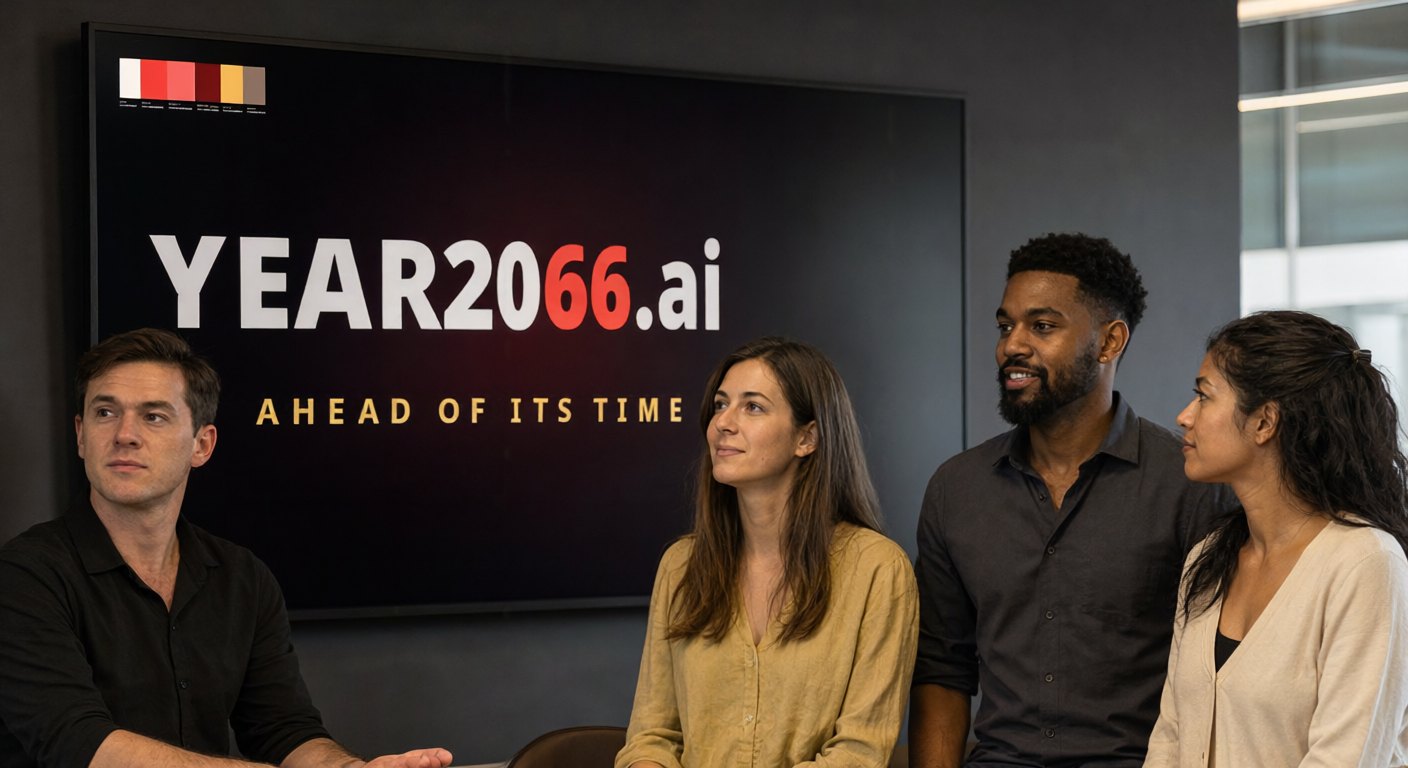
- The small wordmark in the top-left corner is too small to be legible.
- The screen content appears slightly washed out compared to the high-contrast reference image.

a campaign photo for the company whose wordmark is image 1: a close-up of a laptop on a desk showing a dark dashboard with red and gold charts and the wordmark of image 1 in its header, near-black background, vivid red accents, a gold highlight and warm white text, bold geometric sans-serif typography; palette as in image 2
rewritten prompt
A close-up campaign photograph of a laptop resting on a dark desk, its screen displaying a dark analytics dashboard. The dashboard header features the wordmark of image 1, rendered in bold geometric sans-serif typography with the red and gold color treatment visible in that image. The dashboard interface includes vivid red charts, gold highlight bars, and warm white text labels, all set against a near-black background. The surrounding environment is dimly lit, emphasizing the glow of the screen. The color palette strictly follows the swatches in image 2, utilizing the deep black background, warm white text, vivid red, soft red, deep red, gold, muted beige, and dim brown tones. The composition is a tight, angled shot focusing on the laptop screen, with shallow depth of field blurring the desk surface slightly.
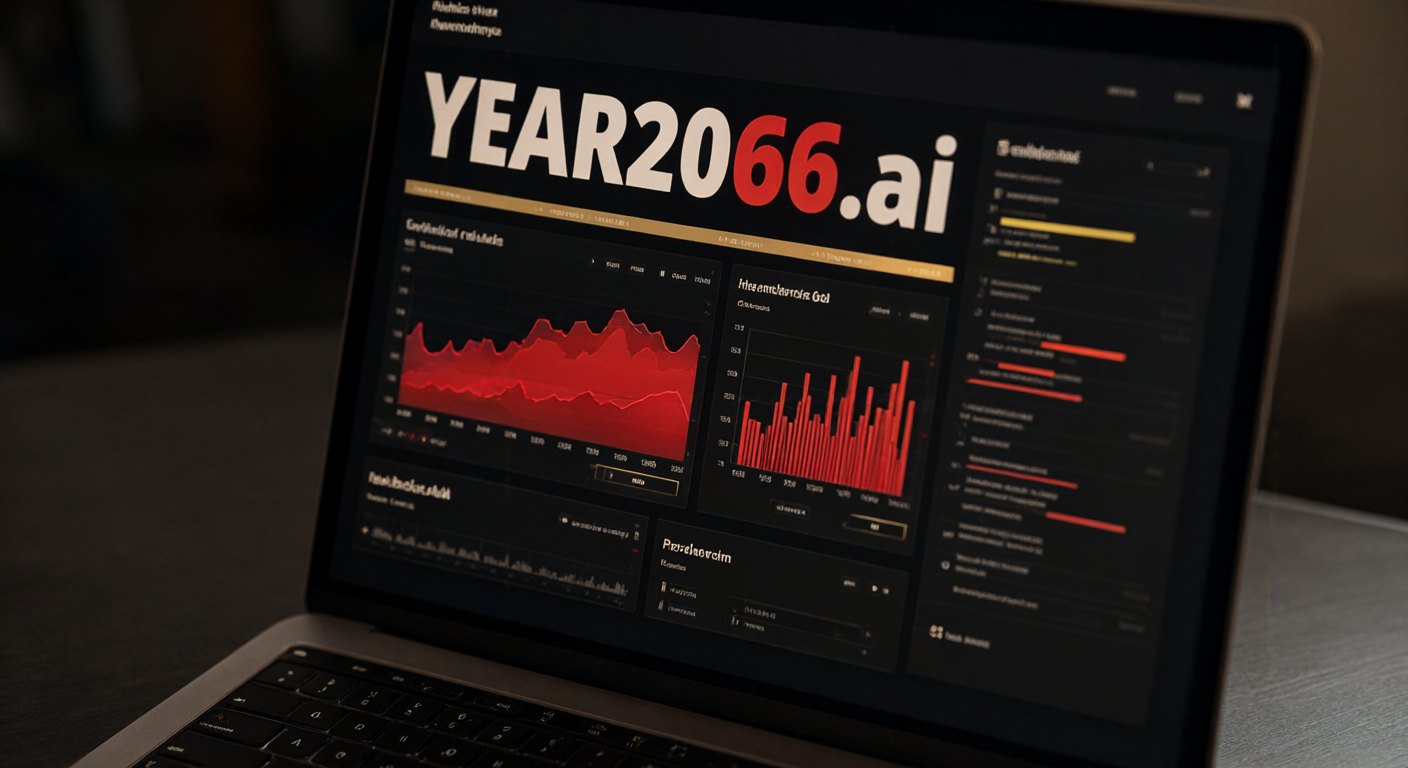
- The dashboard text below the main logo is rendered as illegible placeholder gibberish rather than realistic data labels.
- The laptop screen has a slight glare that slightly reduces the contrast of the white text in the header.

- The dashboard text on the laptop screen is illegible gibberish rather than realistic data labels.
- The background contains large, faint, ghosted text that is distracting and not part of the requested scene.
a campaign photo for the company whose wordmark is image 1: two business people shaking hands in front of a dark glass wall that carries the wordmark of image 1 in warm white, a red light strip along the floor, near-black background, vivid red accents, a gold highlight and warm white text, bold geometric sans-serif typography; palette as in image 2
rewritten prompt
A wide campaign photograph of two business people shaking hands in the center of the frame. They stand in front of a dark glass wall that displays the wordmark of image 1 in warm white. A red light strip runs along the floor, and the background is near-black. The scene uses the color palette from image 2, featuring vivid red accents, a gold highlight, and warm white text. The overall aesthetic is defined by bold geometric sans-serif typography and a modern, professional atmosphere.
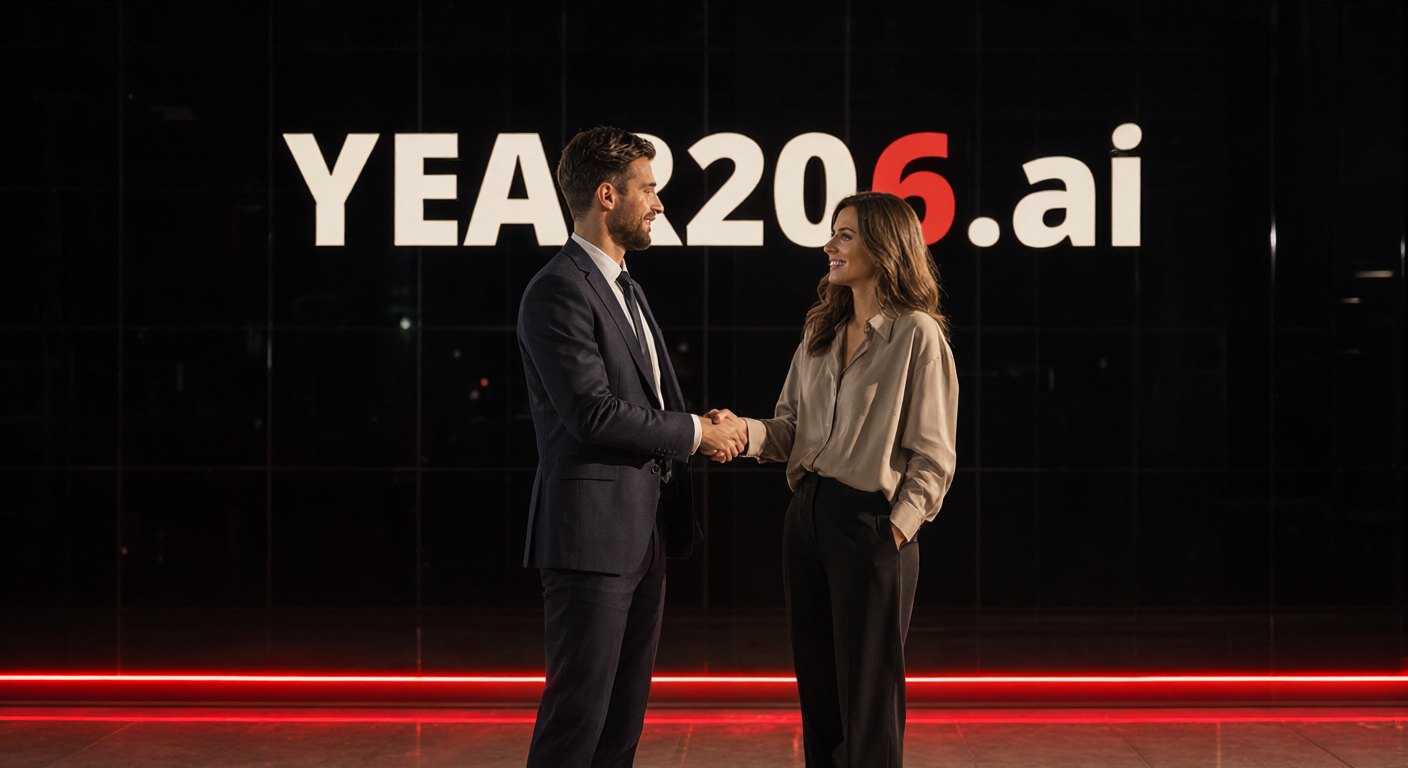
- The wordmark is misspelled as 'YEAR206.ai' instead of 'YEAR2066.ai'.
- The man's head obscures the second '6' in the logo, making it partially illegible.
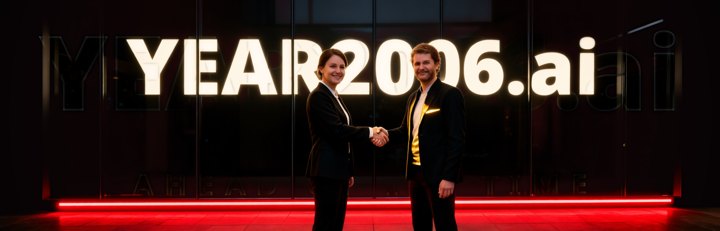
- The wordmark is misspelled as 'YEAR2006.ai' instead of the reference 'YEAR2066.ai'.
- The reference logo uses red for the digits '66', but the image shows them in white.
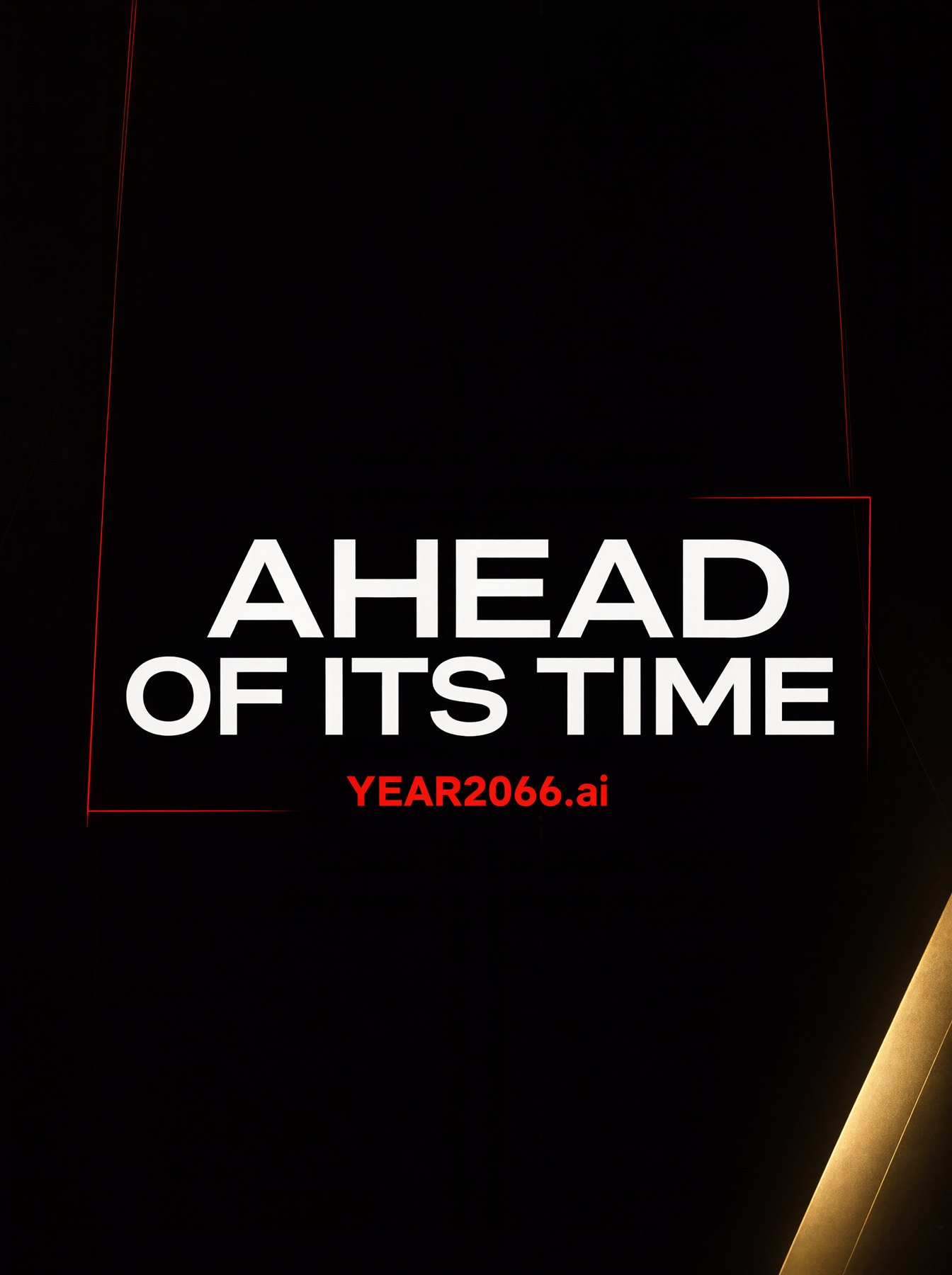
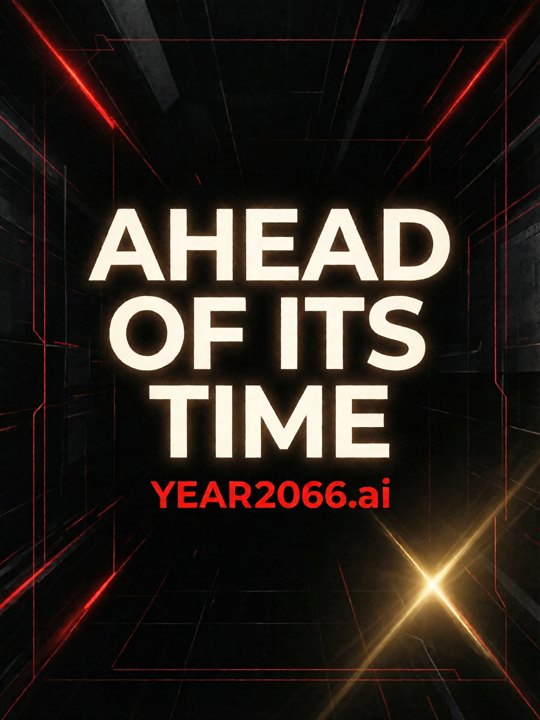
a minimalist advertising poster, near-black background, vivid red accents, a gold highlight and warm white text, bold geometric sans-serif typography, the headline "AHEAD OF ITS TIME" in huge white letters in the centre and the text "YEAR2066.ai" in red below it, nothing else, 3:4
rewritten prompt
A minimalist advertising poster features a near-black background that absorbs light, creating a deep, void-like atmosphere. Vivid red accents appear as thin, sharp geometric lines framing the composition, while a single gold highlight adds a subtle metallic sheen to the lower right corner. The headline "AHEAD OF ITS TIME" is written in the centre in huge, bold, warm white letters using a geometric sans-serif typeface. Below the headline, the text "YEAR2066.ai" is written in vivid red, maintaining the same bold geometric style but at a smaller scale. The layout is strictly centered with ample negative space, emphasizing the stark contrast between the dark background and the bright typography. The lighting is flat and even, ensuring the text remains the sole focal point without shadows or gradients. The overall mood is futuristic, clean, and authoritative, relying on the interplay of black, white, red, and gold to create a striking visual impact. The image contains no other objects, figures, or decorative elements, focusing entirely on the typographic design.

an abstract hero image for a technology website using only the colours shown in image 1 (near-black background, the reds, the gold and the warm white), flowing light trails and soft glows, 16:9, no text
rewritten prompt
Create an abstract hero image for a technology website in a wide 16:9 frame, using only the colours from image 1: the near-black background #050304, the warm white #fffaf3, the bright red #ff3e3e, the soft red #ff6b6b, the deep red #8b1118, the gold #f7c86a, and the muted warm tones #cfc0b4 and #8d7a70. The scene shows flowing light trails and soft glows drifting across the dark field, with red and gold streaks curving like luminous ribbons, gentle halos of warm white and soft red blooming in the background, and subtle deep-red shadows anchoring the composition. The trails vary in thickness and opacity, some sharp and bright, others diffused into misty glows, creating a sense of motion and depth. No text, no letters, no symbols, no recognizable objects, no people, no logos. The overall mood is sleek, modern, and energetic, suitable as a full-width banner for a technology website.
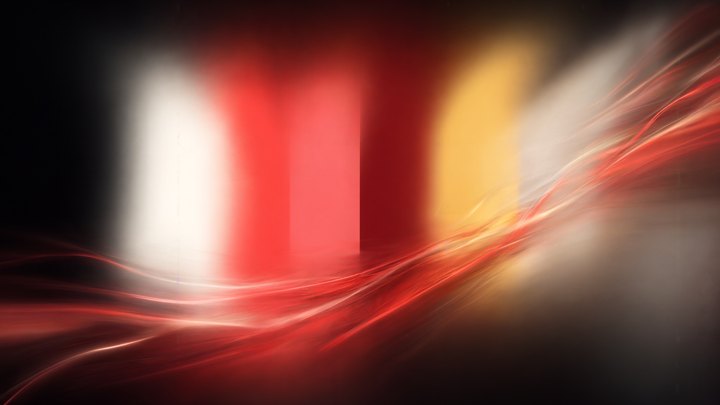
- The vertical color bands in the background are somewhat blocky and lack the soft, diffused quality of a true glow.
- The light trails on the right side feel slightly disconnected from the central vertical elements, creating a minor compositional split.
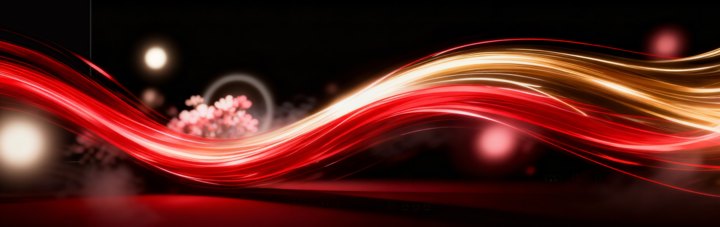
- A faint vertical line artifact is visible in the upper left quadrant of the background.
- The light trails on the far right edge appear slightly cut off or compressed against the frame boundary.
Follow-up: fewer condition images, more working area
Two of the seven wordmark reproductions above lost a digit; both runs carried two condition images (wordmark plus palette sheet, or source photo plus wordmark), which halves the working area per image (side / √2). The same requests again with the wordmark as the only condition image and the palette described in words, plus the mug with an explicit character-exactness sentence:
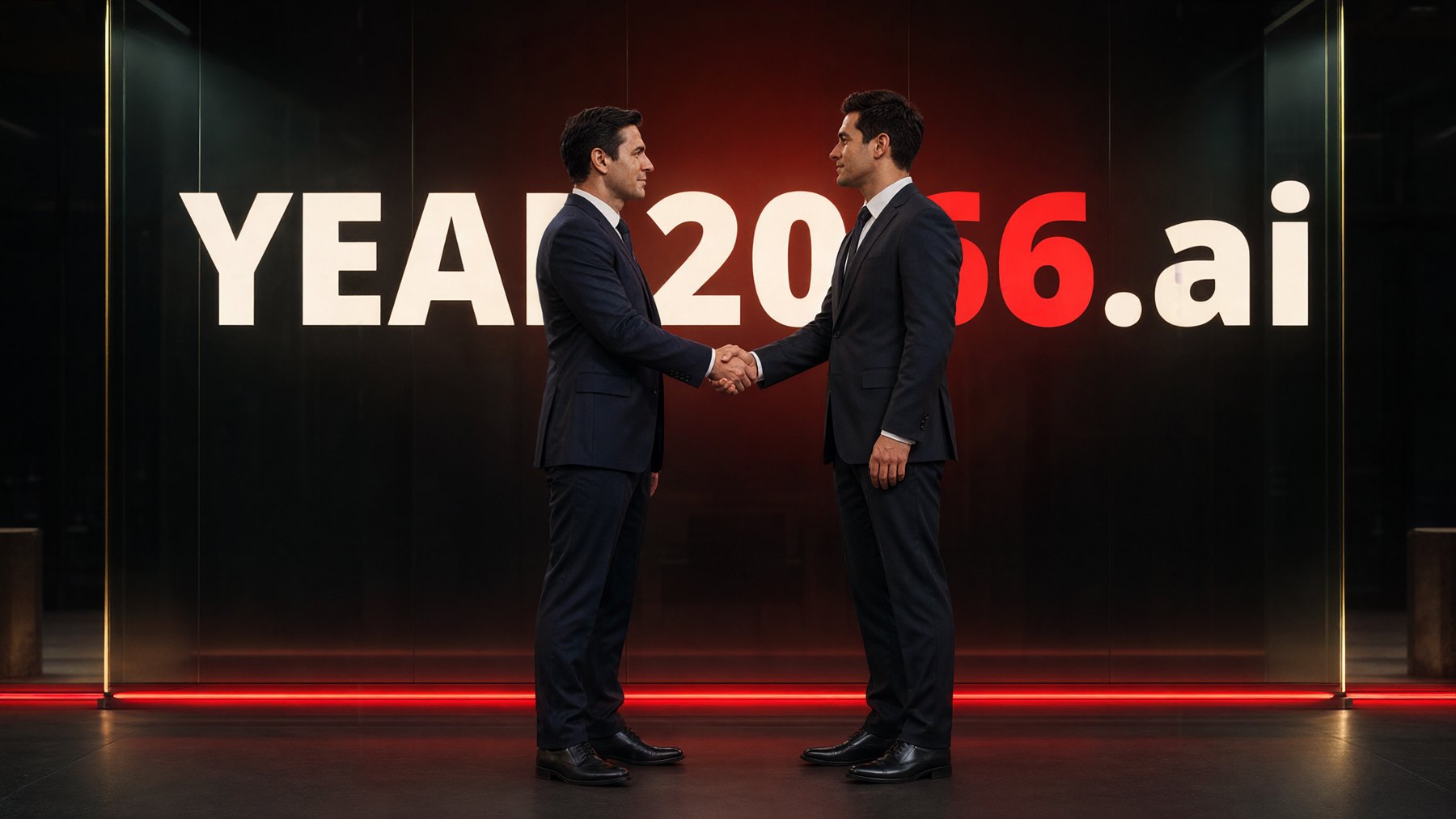
- The wordmark is misspelled as 'YEAR2056.ai' instead of 'YEAR2066.ai'.
- The tagline 'AHEAD OF ITS TIME' from the reference is missing from the wall.

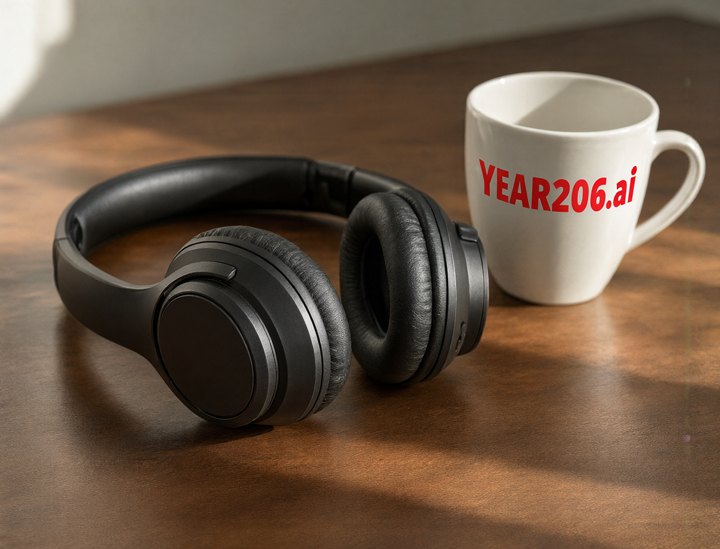
- The wordmark on the mug is misspelled as 'YEAR206.ai' instead of 'YEAR2066.ai'.
- The text on the mug is monochromatic red, failing to reproduce the mixed white and red color scheme of the reference logo.
5 · Editing: Qwen-Image-2.1 as editor vs Qwen-Image-Edit-2511
One generated source, six typical PIC STUDIO edits. Qwen-Image-2.1 receives the rewritten natural-language instruction (EDIT mode, editor QWEN-2.1). The 2511 editor receives the same rewritten instruction for plain edits and its tab-native adapter prompts for ADD, REMOVE and ANGLE (the way PIC STUDIO drives it). The judge rates whether exactly the instructed change was made and nothing else.
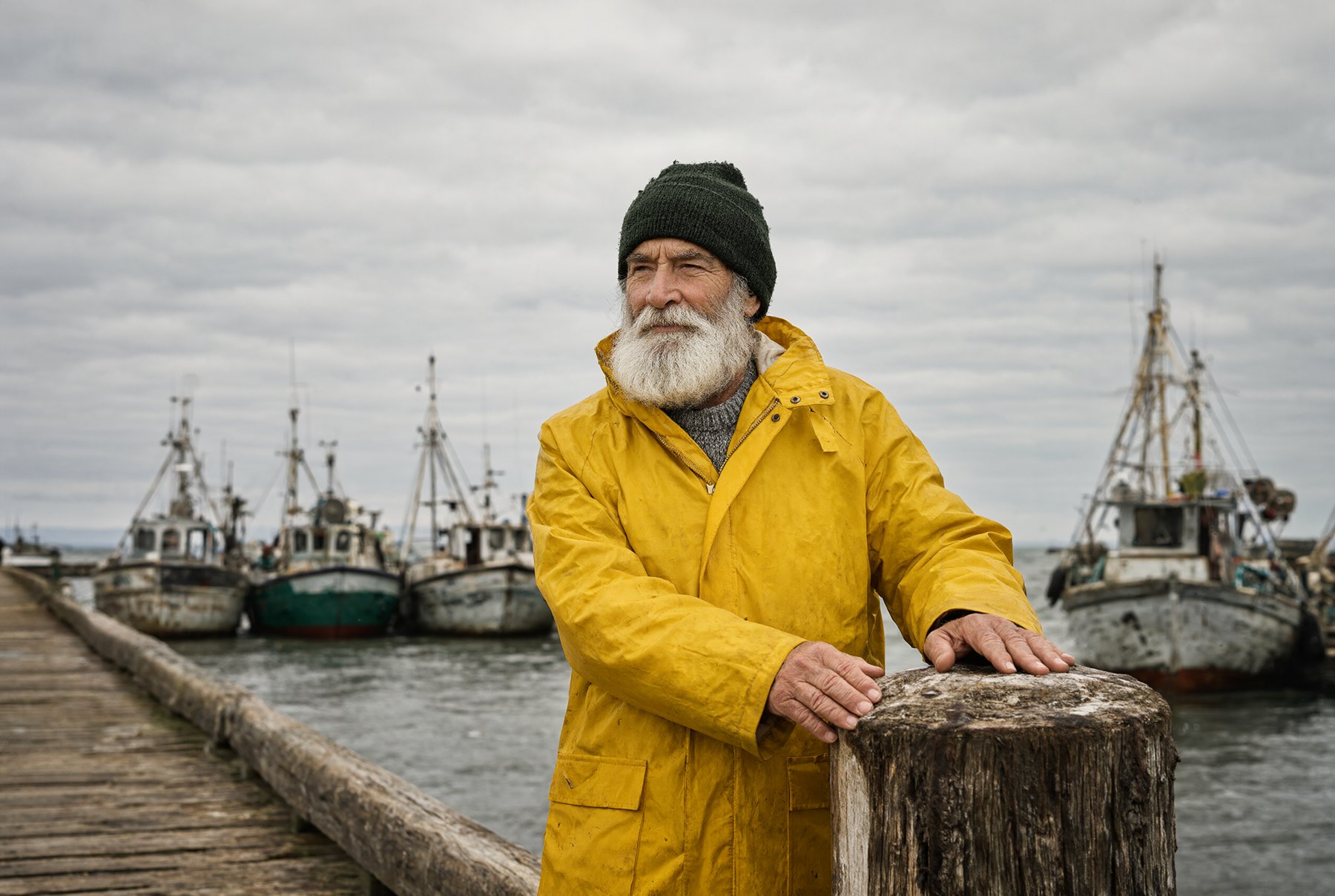
- The wooden mooring post appears to be a floating stump rather than a fixed structure, lacking a visible base or connection to the pier.
- The texture on the top of the mooring post is slightly smeared and lacks the sharp definition of weathered wood.
| Series | Value |
|---|---|
| QI-2.1 | 9.00 |
| Edit-2511 | 8.67 |
| Series | Value |
|---|---|
| QI-2.1 · adherence | 8.43 |
| QI-2.1 · realism | 8.57 |
| QI-2.1 · aesthetics | 9 |
| Edit-2511 · adherence | 8.33 |
| Edit-2511 · realism | 7.67 |
| Edit-2511 · aesthetics | 8.67 |
Pairwise verdicts
| Pair (both A/B orders judged) | 2.1 wins | predecessor wins | ties | 2.1 win rate | verdicts |
|---|---|---|---|---|---|
| Qwen-Image-2.1 vs Qwen-Image-Edit-2511 (GGUF) | 10 | 2 | 0 | 83 % | 12 |
replace the background of image 1 with a stormy sea under dark clouds and big waves, keeping the fisherman exactly as he is
rewritten instruction
Replace the background of image 1 with a stormy sea under dark clouds and big waves. The fisherman in image 1 stays exactly as he is: his identity, face, white beard, green knit beanie, yellow raincoat, grey sweater, hands resting on the weathered wooden post, his pose, proportions, and the wooden pier in the foreground all remain unchanged. The new background shows a turbulent ocean with large crashing waves, a heavy dark overcast sky, and a moody, dramatic atmosphere. The lighting on the fisherman is preserved as in the source image, and the overall composition, framing, and camera viewpoint follow image 1.
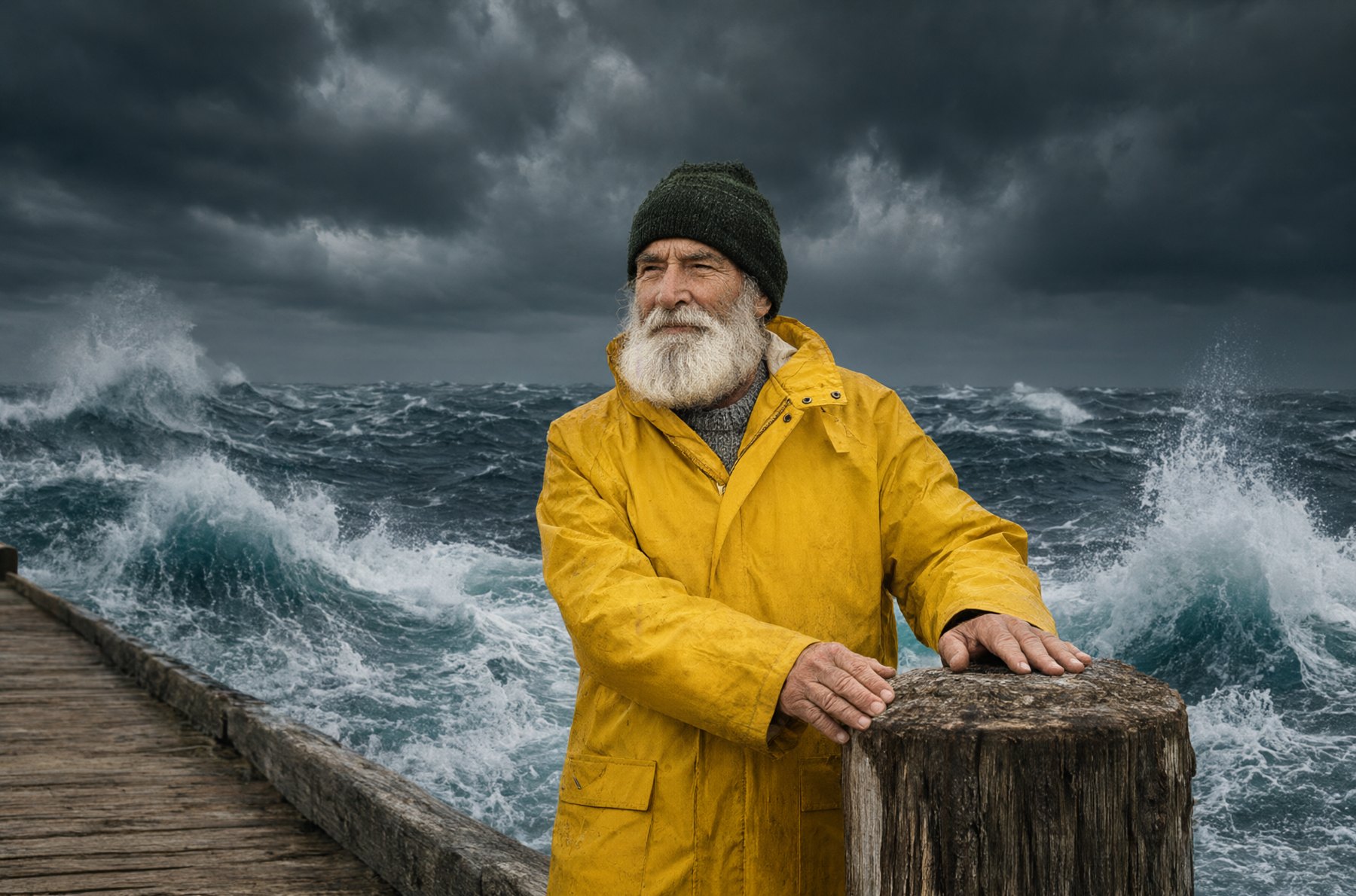
- The lighting on the fisherman's face and jacket is slightly too bright and even for the dark, overcast sky behind him.
- The transition between the wooden pier and the water on the left is a bit soft and lacks sharp detail.
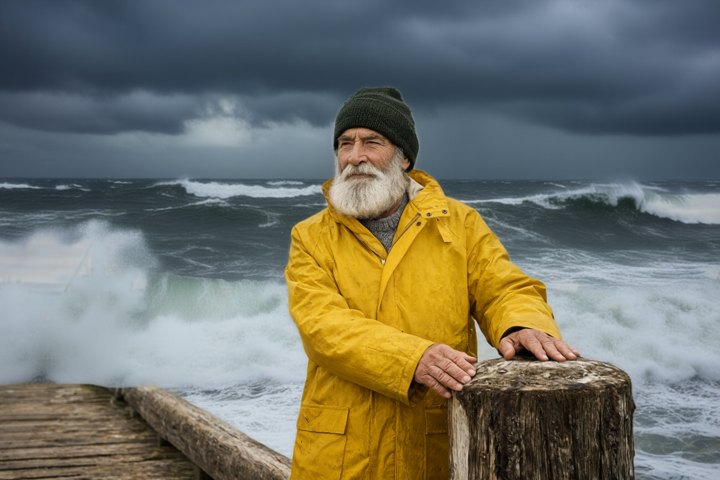
- The lighting on the fisherman's face and jacket appears slightly too bright and even for the dark, overcast sky behind him.
- The transition between the fisherman's yellow coat and the background waves is sharp, suggesting a potential composite edge.
add a white seagull sitting on the wooden mooring post in image 1, matching the light
rewritten instruction
In image 1, a white seagull sits calmly on top of the weathered wooden mooring post in the lower right foreground, positioned just beside the man's resting hand. The seagull faces slightly toward the left, its feathers rendered in clean white with soft grey shading on the wings, matching the overcast, diffused lighting of the scene. Its posture is relaxed and natural, as if it has settled there for a moment. Every other element of image 1 remains exactly as in the source: the elderly man with his white beard, green beanie, and yellow raincoat, his pose and expression, the wooden pier extending to the left, the fishing boats moored in the background, the grey cloudy sky, the water, and the overall composition, proportions, colours, and photographic style.
2511 prompt (tab-native adapter prompt): Add the white seagull sitting on the wooden mooring post to the image while preserving the background lighting and surrounding elements maintaining realism and original details
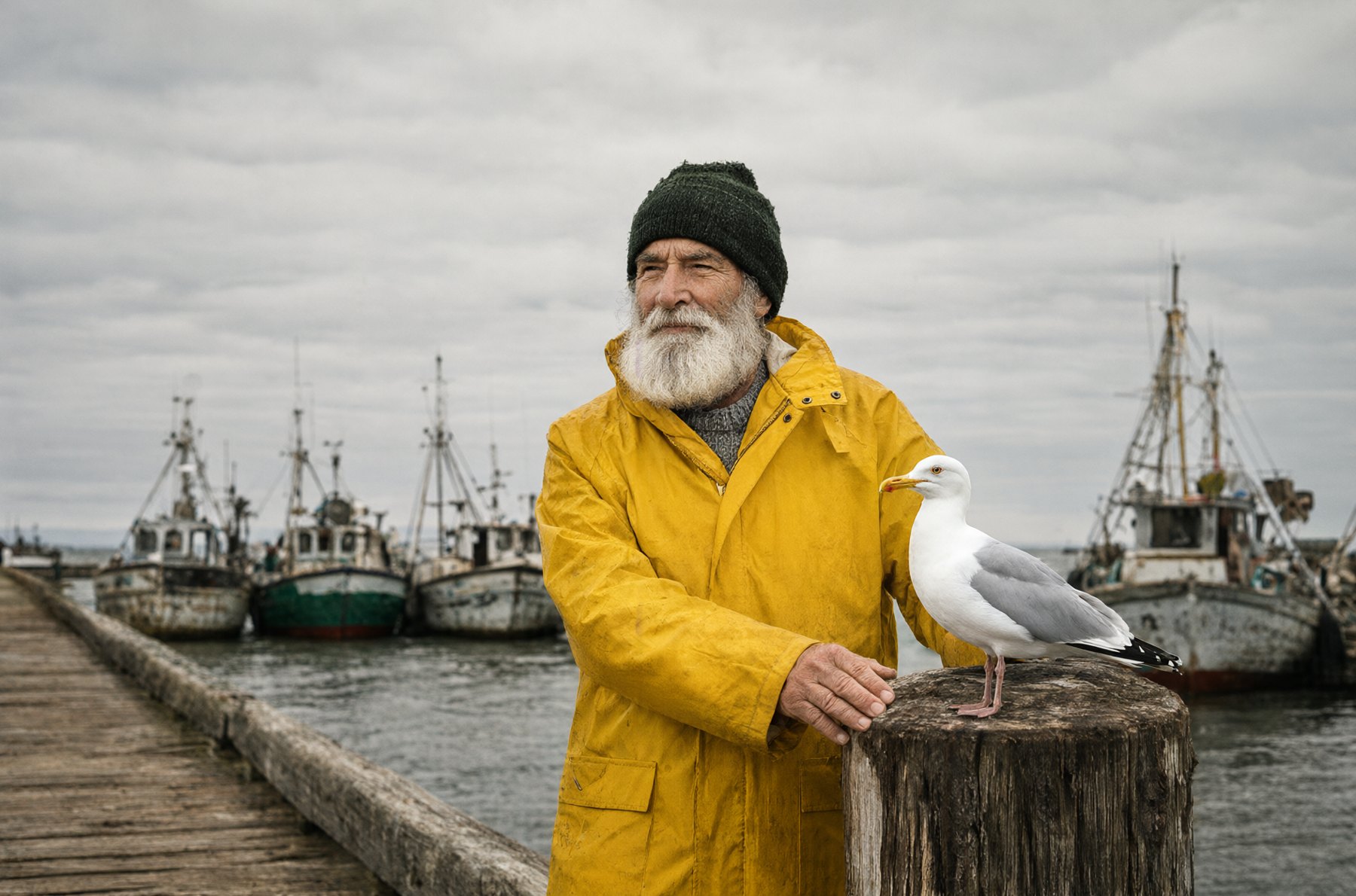
- The seagull's feet appear slightly flat and lack the detailed texture of real bird claws gripping the wood.
- The shadow cast by the seagull on the post is very faint and lacks the definition expected from the ambient light.
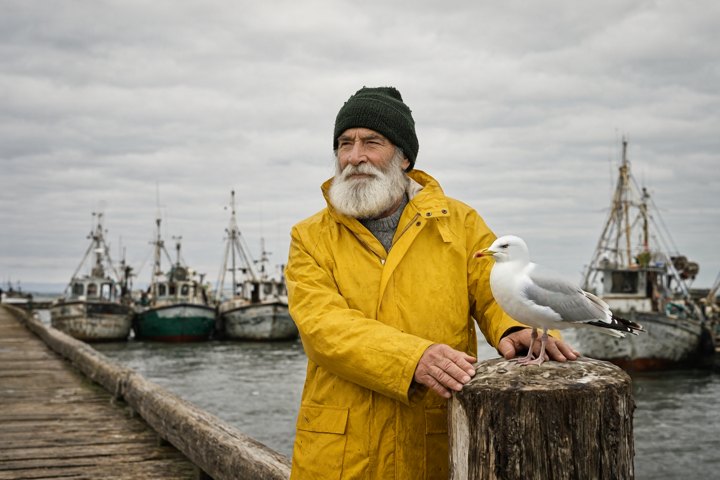
- The seagull's feet appear slightly translucent where they meet the man's hand, suggesting a minor compositing seam.
- The shadow cast by the seagull on the wooden post is very faint and lacks the definition expected from the ambient light.
remove the three fishing boats from image 1 and fill the harbour with calm water
rewritten instruction
Edit image 1 by removing the three fishing boats moored in the background on the left side of the harbour, including their masts, rigging and hulls, and fill the area they occupied with calm, flat harbour water that matches the existing water surface in tone, colour and texture. The water extends smoothly to the horizon under the overcast sky, with no boats, masts or reflections of vessels remaining in that section. Everything else in image 1 stays exactly as in the source: the elderly bearded man in the yellow raincoat and dark knit hat, his pose with both hands resting on the weathered wooden post, the wooden pier in the foreground, the remaining boat on the right, the cloudy sky, the lighting, the colours, the composition, the proportions and the photographic style are all preserved unchanged.
2511 prompt (tab-native adapter prompt): Remove the three fishing boats in the harbour from the image while preserving the background and remaining elements maintaining realism and original details
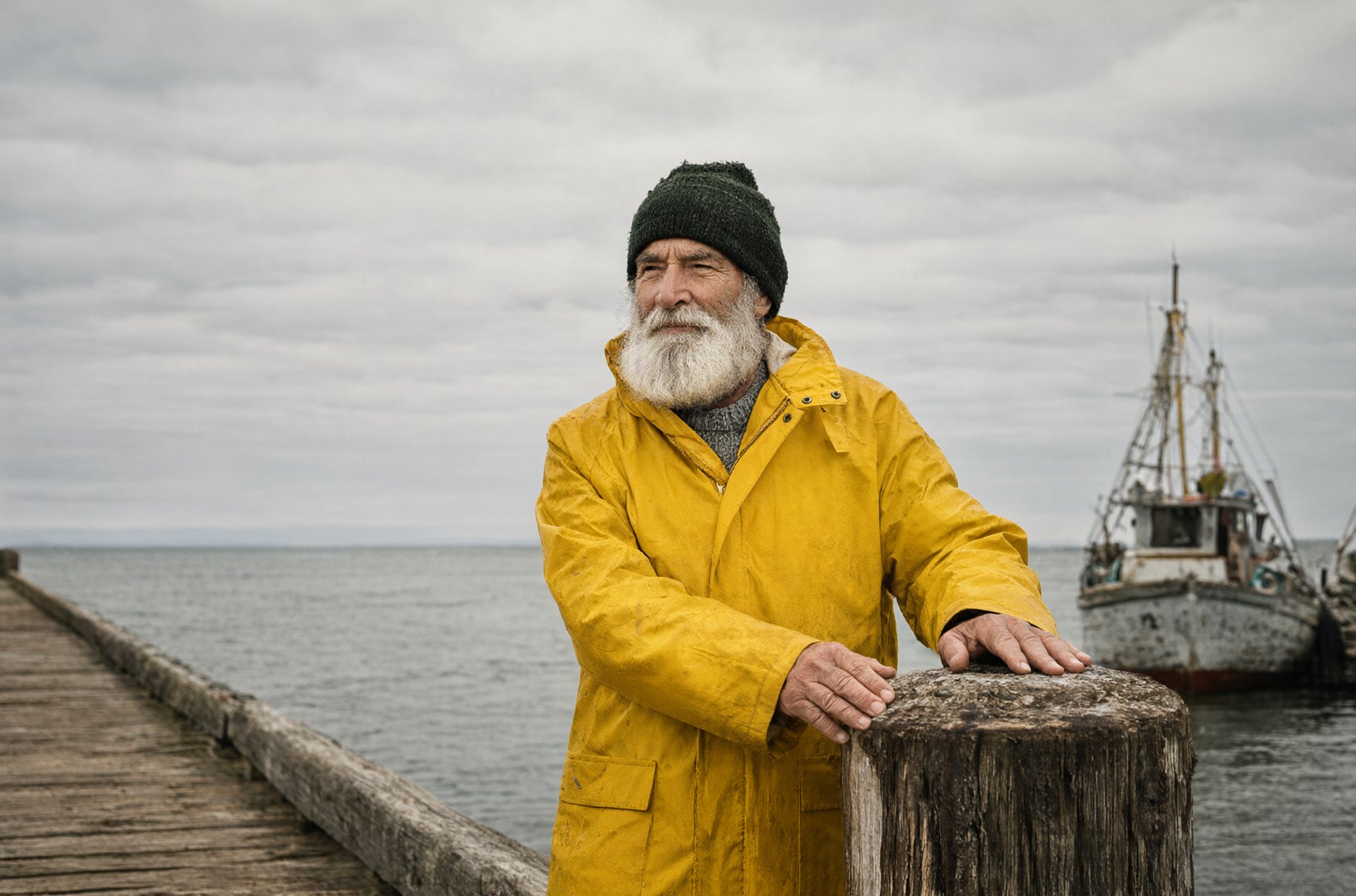
- A large fishing boat is still clearly visible in the background on the right side.
- The instruction to remove three boats was not fully executed as one remains.
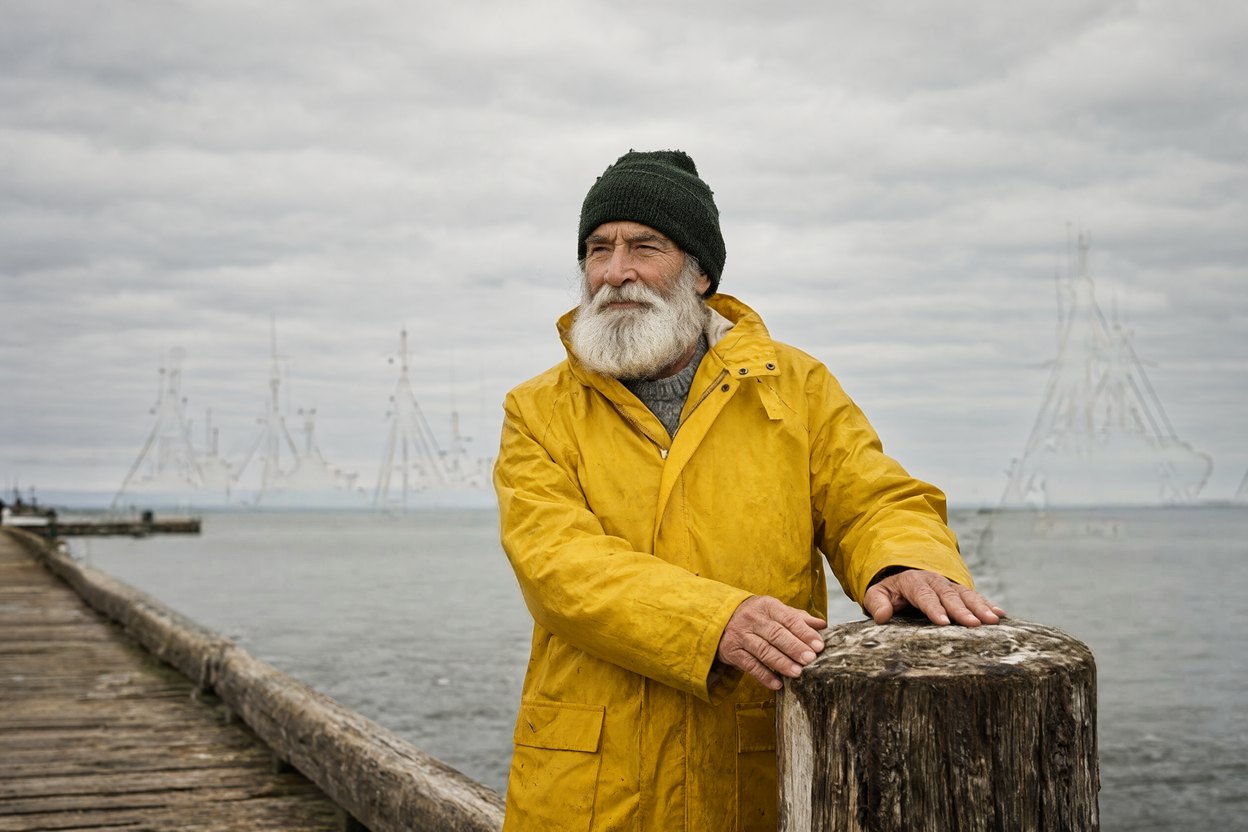
- Ghostly, semi-transparent outlines of the removed boats remain visible in the sky and water background.
- The water surface is not calm; it shows significant ripples and waves.
change the fisherman's sweater in image 1 to red and his cap to dark blue, everything else unchanged
rewritten instruction
In image 1, change the colour of the fisherman's knitted beanie cap from dark green to dark blue, and change the colour of the sweater visible at his neckline from grey to red. Keep the man's face, white beard, yellow raincoat, pose, hands on the wooden post, the harbour, the fishing boats, the pier, the water, the overcast sky, the lighting, the composition, the proportions and every other element exactly as in image 1.
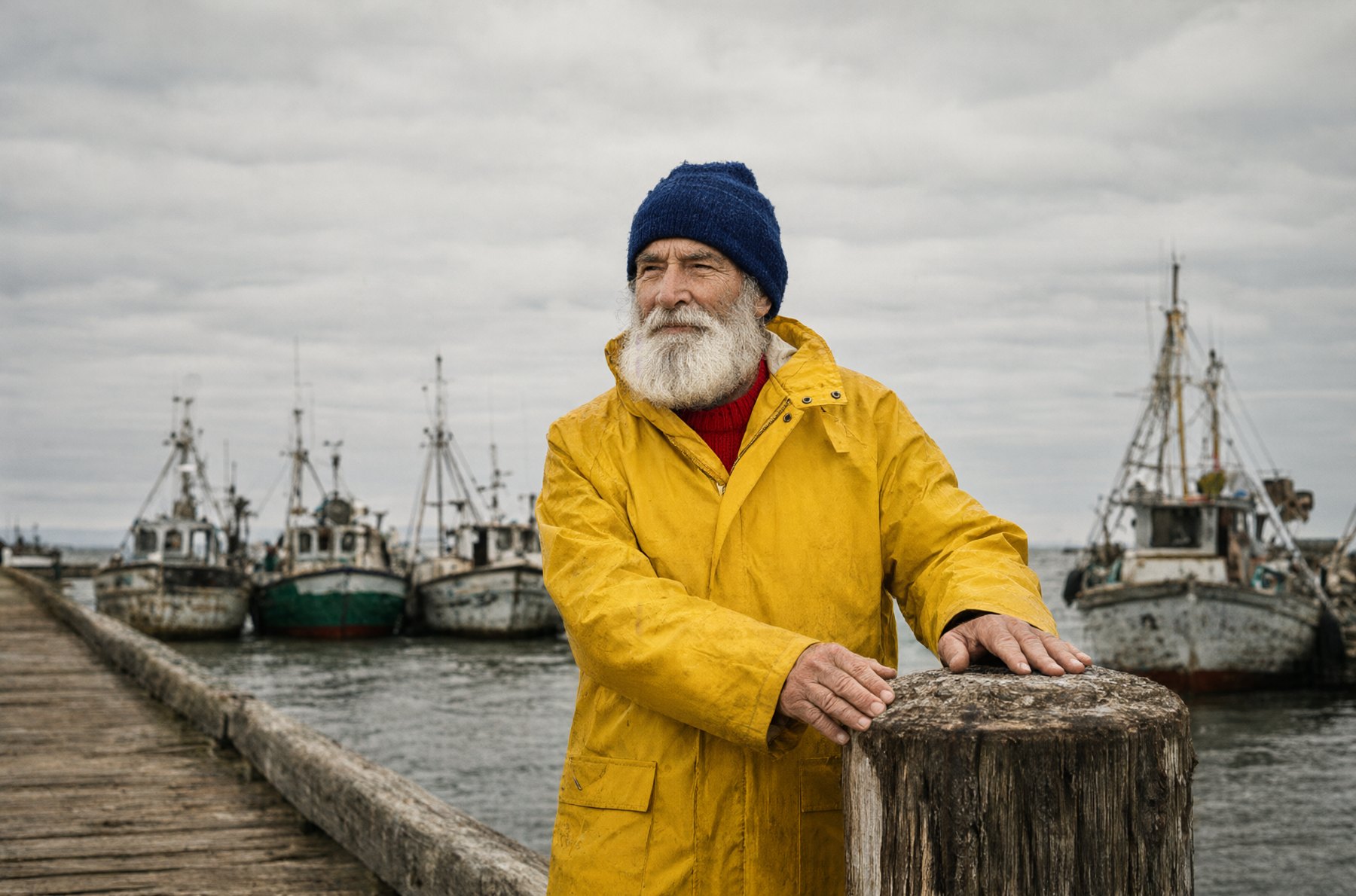
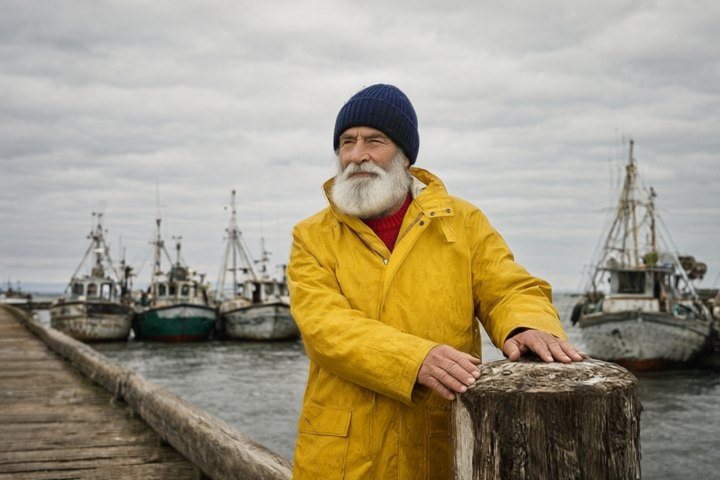
- The red sweater is only partially visible at the collar, making it difficult to confirm the full extent of the color change.
- The transition between the yellow jacket and the red sweater at the neckline is slightly abrupt.
turn image 1 into an impressionist oil painting with visible brush strokes, keeping the composition
rewritten instruction
Transform image 1 into an impressionist oil painting with visible, textured brush strokes throughout the entire frame. The old bearded man in the yellow raincoat and green beanie, the weathered wooden pier, the moored fishing boats, the grey water, and the overcast sky are all rendered in loose, painterly strokes of color rather than photographic detail. The composition, framing, and placement of every element remain exactly as in image 1: the man stands center-right leaning on the wooden post, the pier extends to the left, and the boats sit in the background under a cloudy sky. The lighting, color palette, and proportions are preserved from the source, now expressed through the characteristic dabs and directional strokes of an impressionist oil medium.
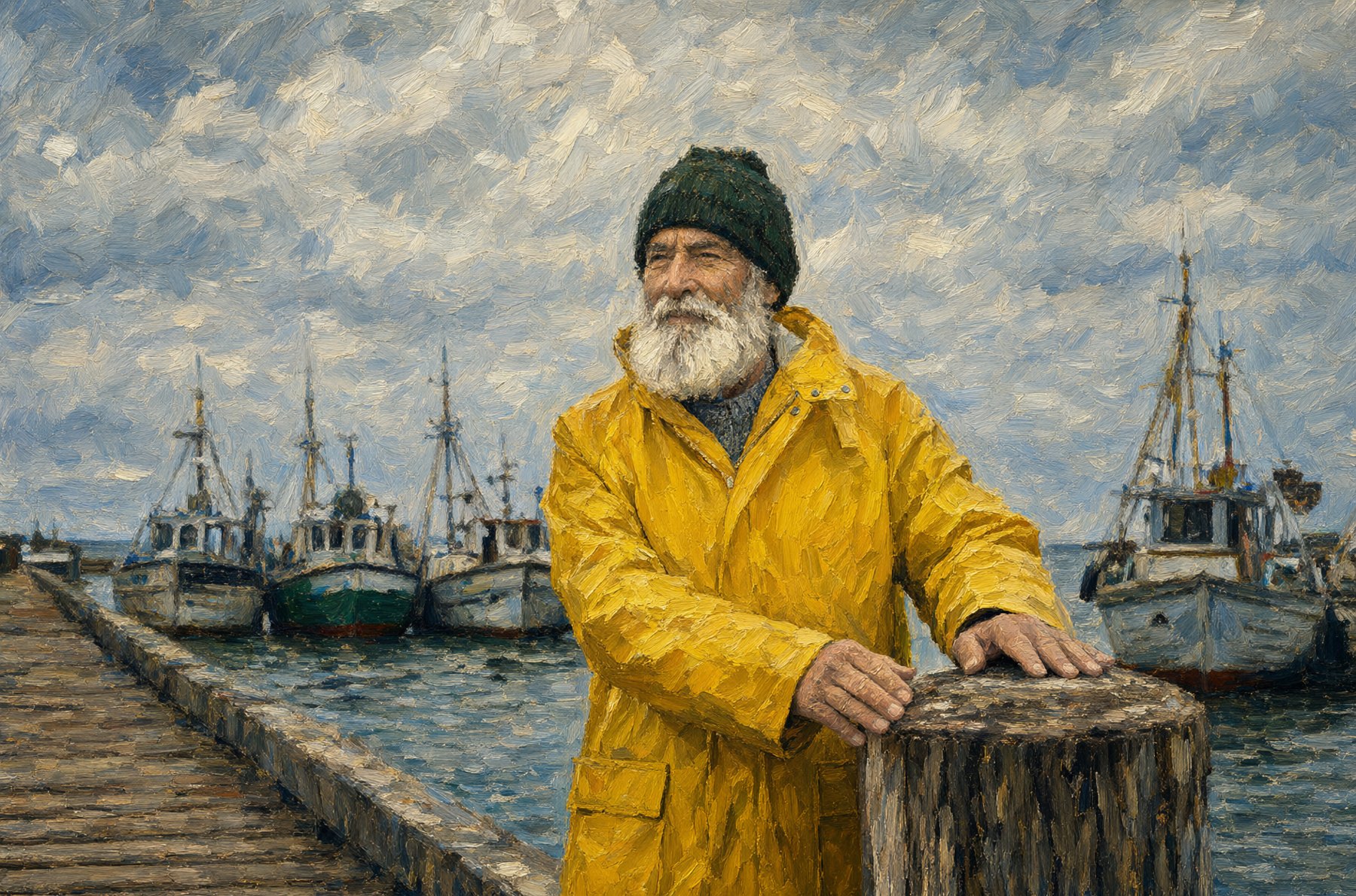
- The brush strokes on the man's face are slightly less distinct than the rest of the image, creating a minor texture inconsistency.
- The hands resting on the wooden post appear slightly stiff and lack the fluidity of the surrounding painterly style.
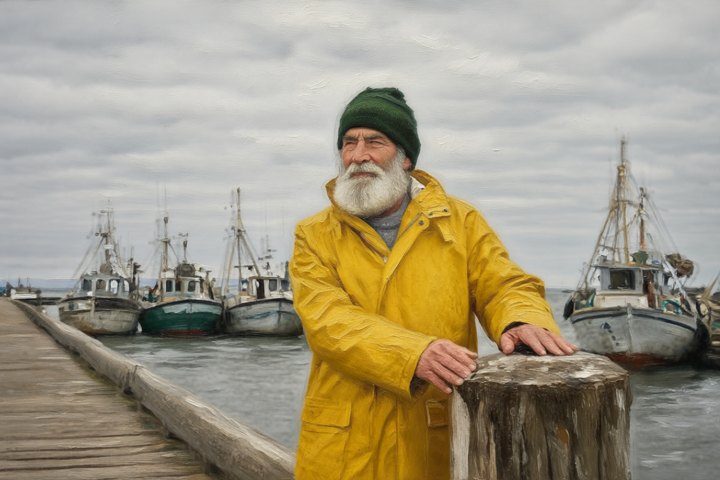
- The brush strokes on the man's face are slightly too smooth, lacking the distinct impasto texture seen on the jacket.
- The wooden post in the foreground has a somewhat smeared and indistinct texture that blends oddly with the hand resting on it.
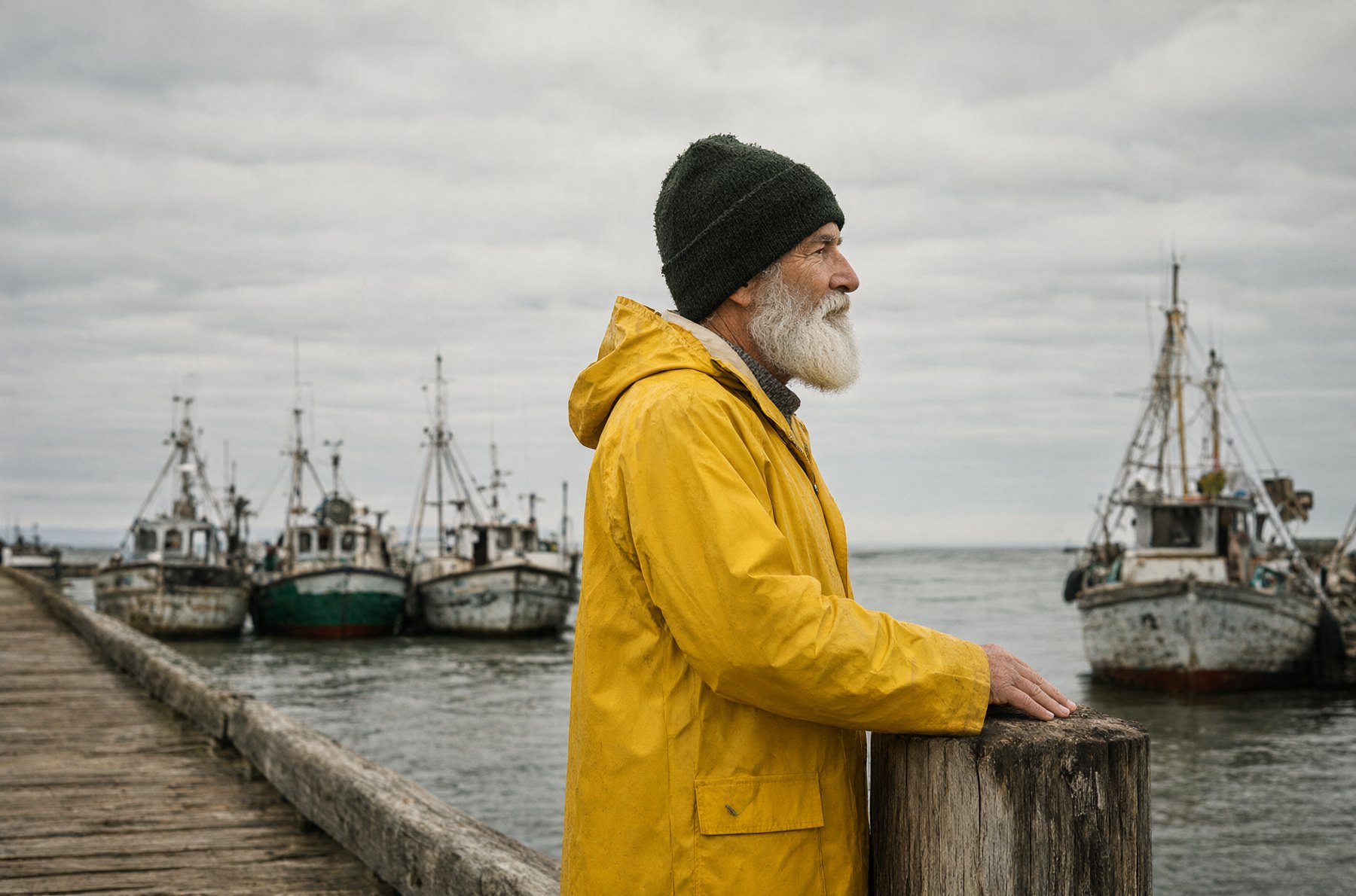
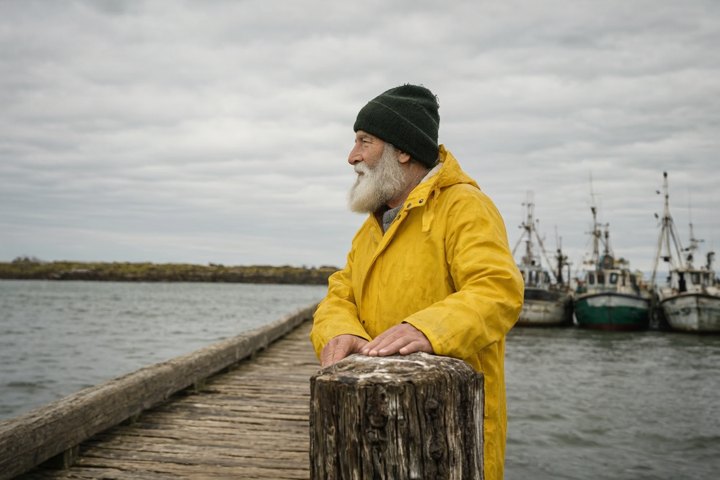
re-render image 1 from a right side view at eye level, medium shot, keeping the fisherman, his clothing and the pier
rewritten instruction
Re-render image 1 as a medium shot taken from a right side view at eye level. The fisherman stands on the wooden pier, his body turned so the camera captures his right profile. He keeps his exact identity, face, white beard, and proportions. He wears the same dark green knit beanie, grey sweater, and bright yellow raincoat. His hands rest on the weathered wooden post in the foreground. The background shows the same harbour scene with the row of moored fishing boats, the calm water, and the overcast grey sky. The lighting, colours, and photographic style remain identical to the source image.
2511 prompt (tab-native adapter prompt): <sks> right side view eye-level shot medium shot
6 · Capability gallery (Qwen-Image-2.1 only)
The features no predecessor offers in PIC STUDIO: configured aspect ratios at native 2K, exact text from German requests, up to ten reference images, and transparent RGBA output. Regenerated after the seam fix; requests are German on purpose so the rewriter's translation is part of the demonstration.
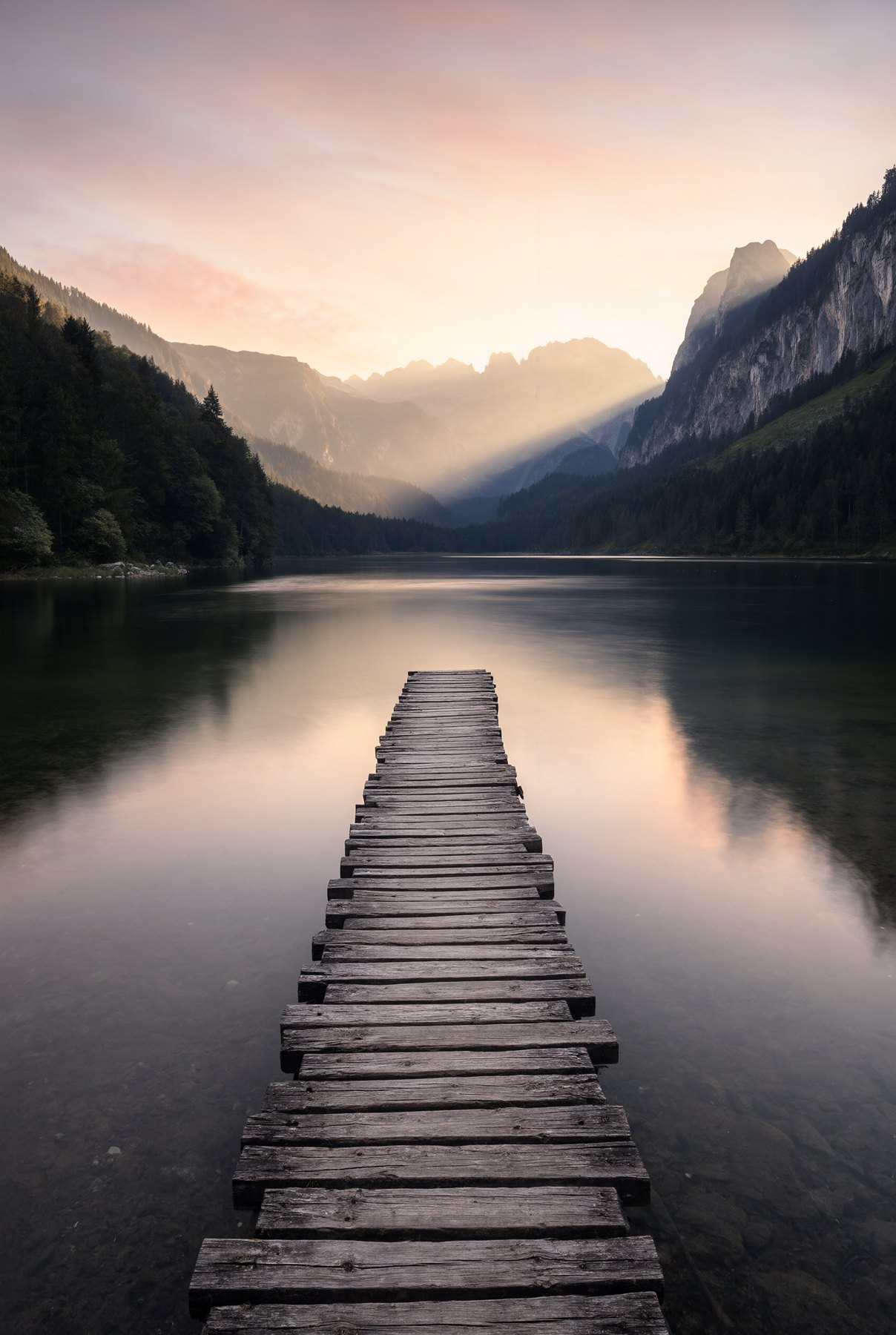
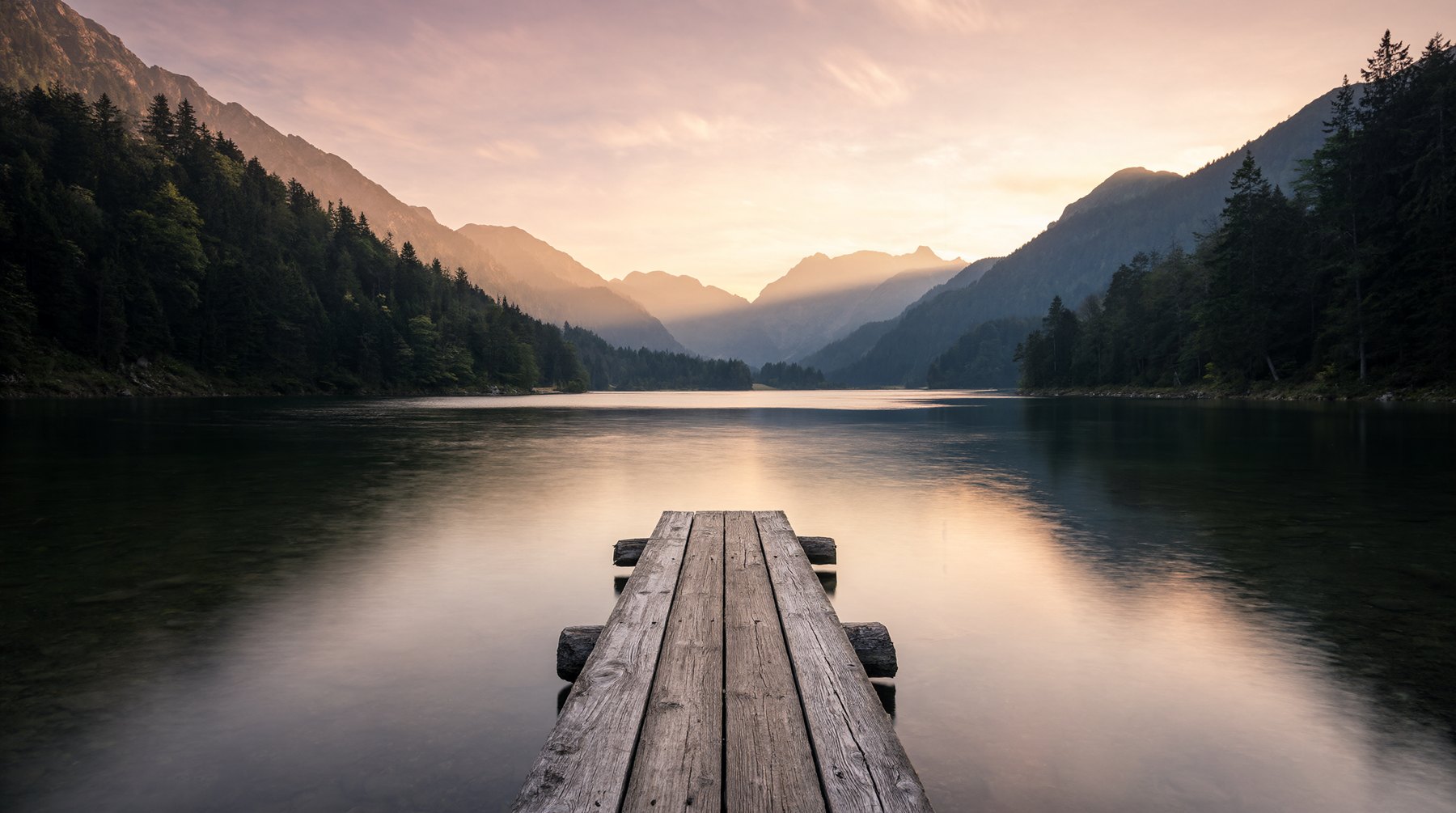
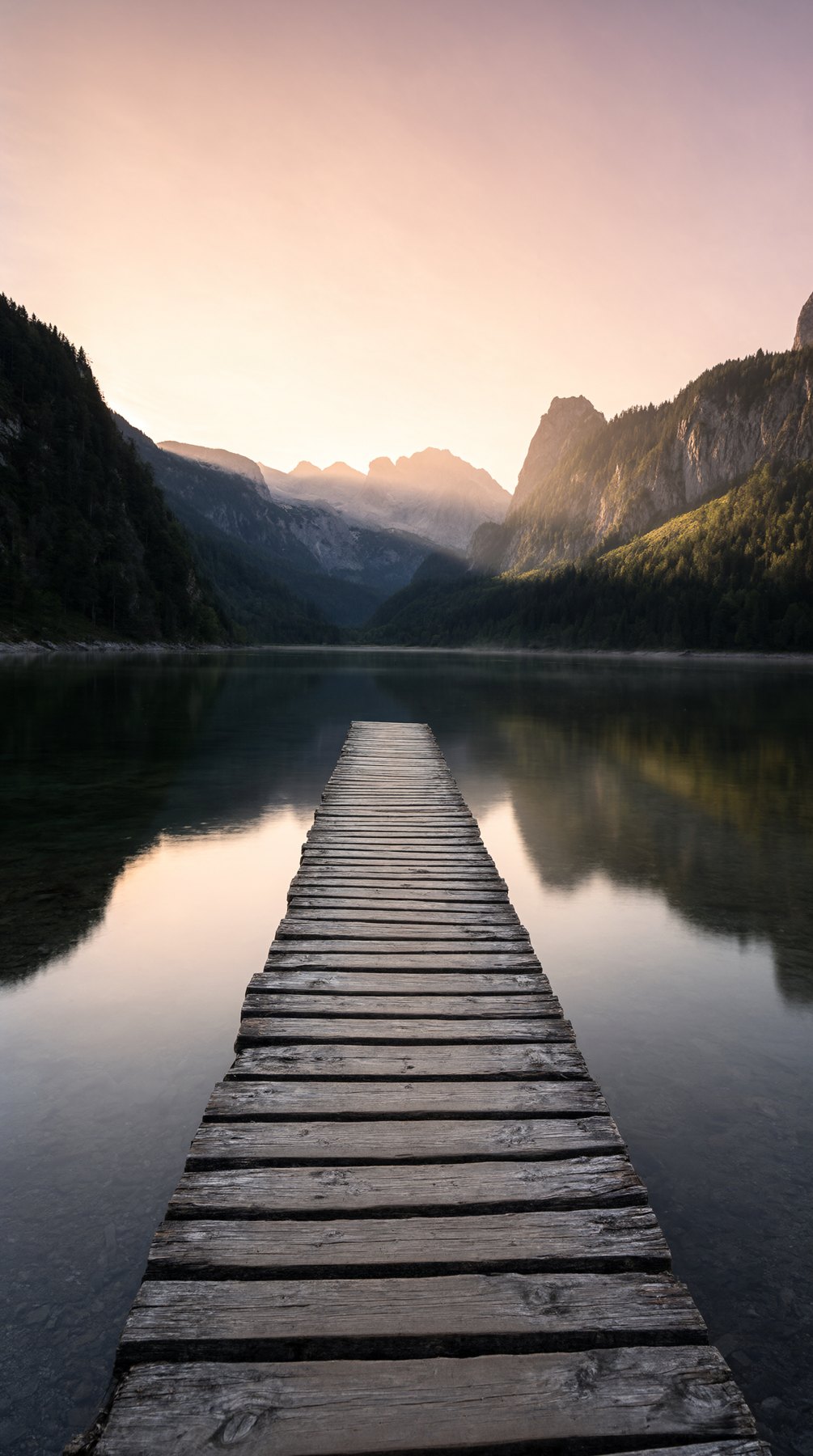
Aspect request: bergsee bei sonnenaufgang mit holzsteg
rewritten prompt
A serene mountain lake named Bergsee sits in a high alpine valley during the early moments of sunrise. A rustic wooden boardwalk, constructed from weathered grey planks, extends from the foreground shoreline directly into the calm, mirror-like water. The surface of the lake reflects the soft pastel hues of the sky, blending pale pinks, warm oranges, and gentle lavenders. Surrounding the water, steep slopes covered in dense evergreen forests rise sharply, their dark green silhouettes contrasting with the brightening horizon. The first rays of the sun peek over the distant peaks, casting long, ethereal shadows across the water and illuminating the mist that hovers just above the surface. The lighting is soft and diffused, creating a tranquil and peaceful atmosphere. The camera captures the scene from a low angle near the water's edge, using a wide-angle lens to encompass the expansive landscape. The image is a high-resolution digital photograph with sharp details on the wood grain and smooth gradients in the sky, evoking a sense of quiet natural beauty. The image contains no lettering.
Aspect ratios: one German request, one rewrite, seven configured framings at native 2K
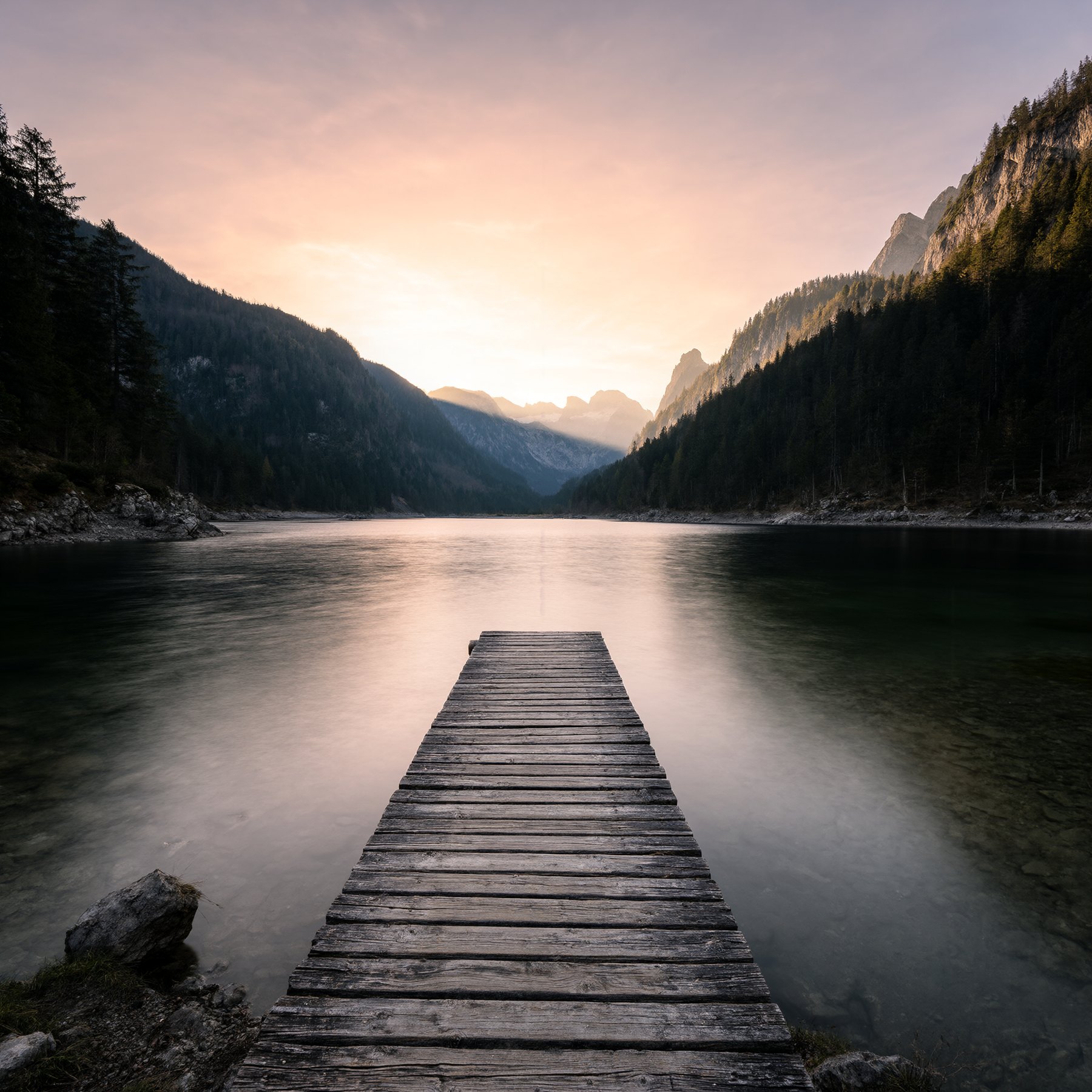
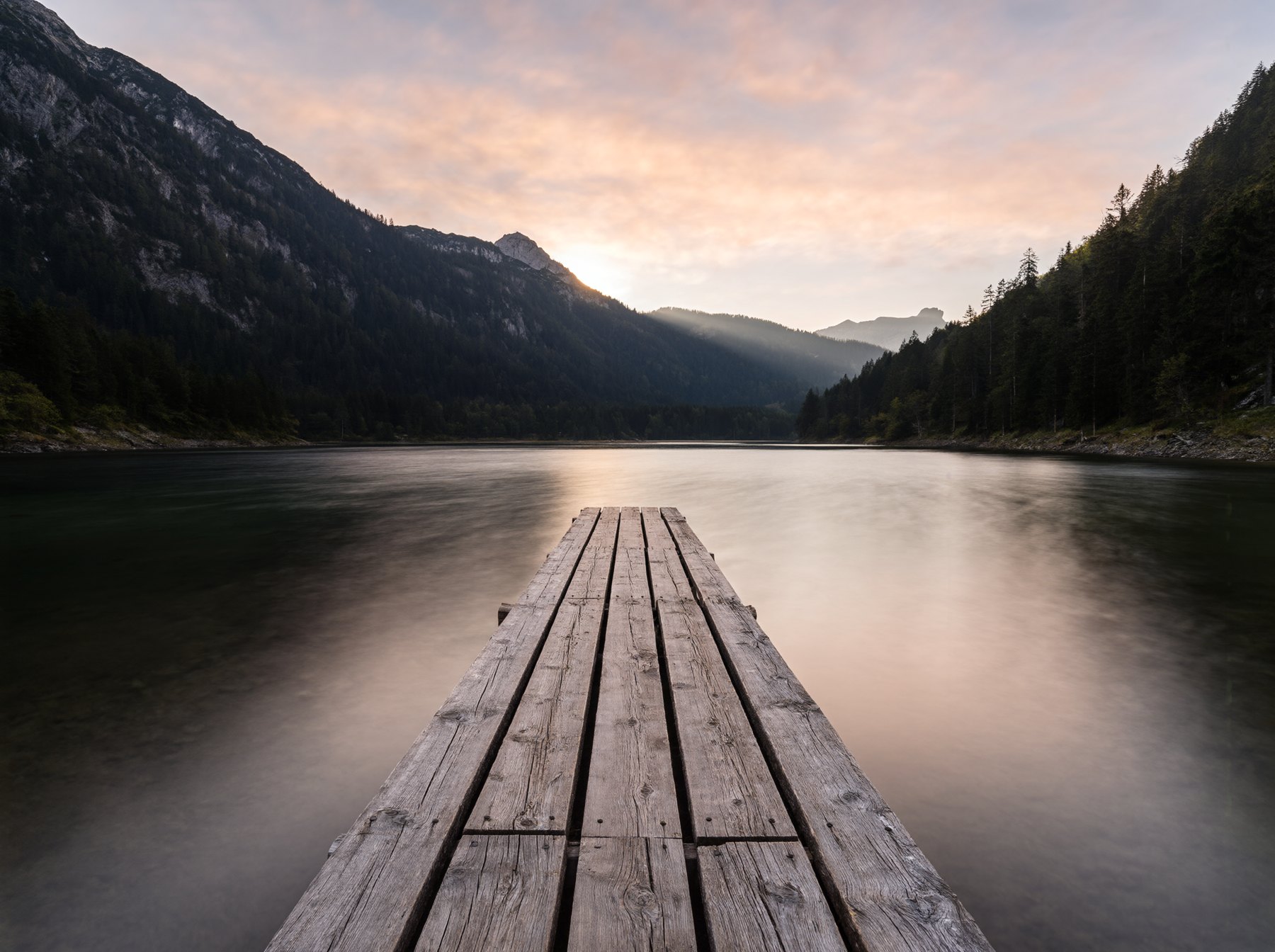
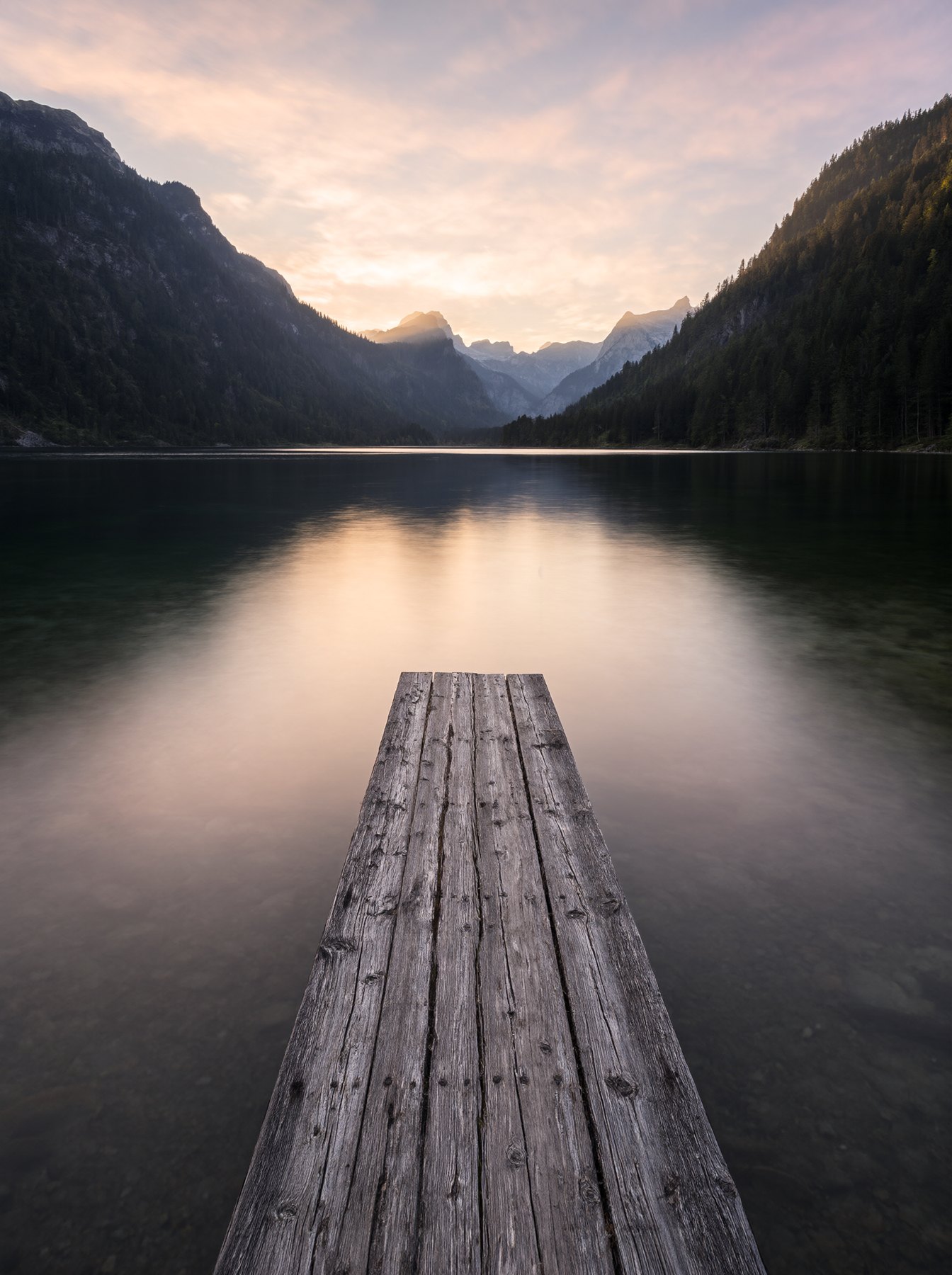
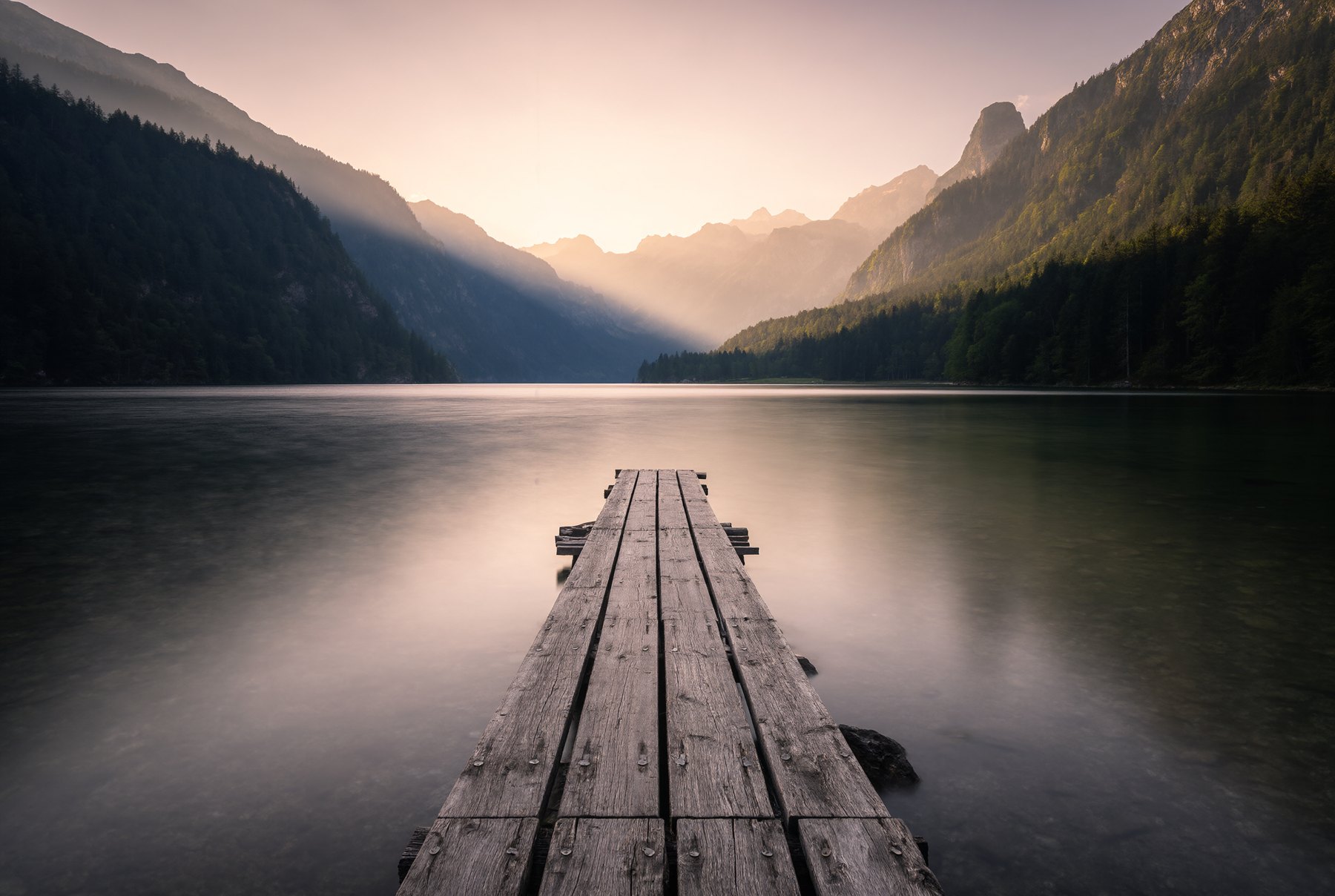
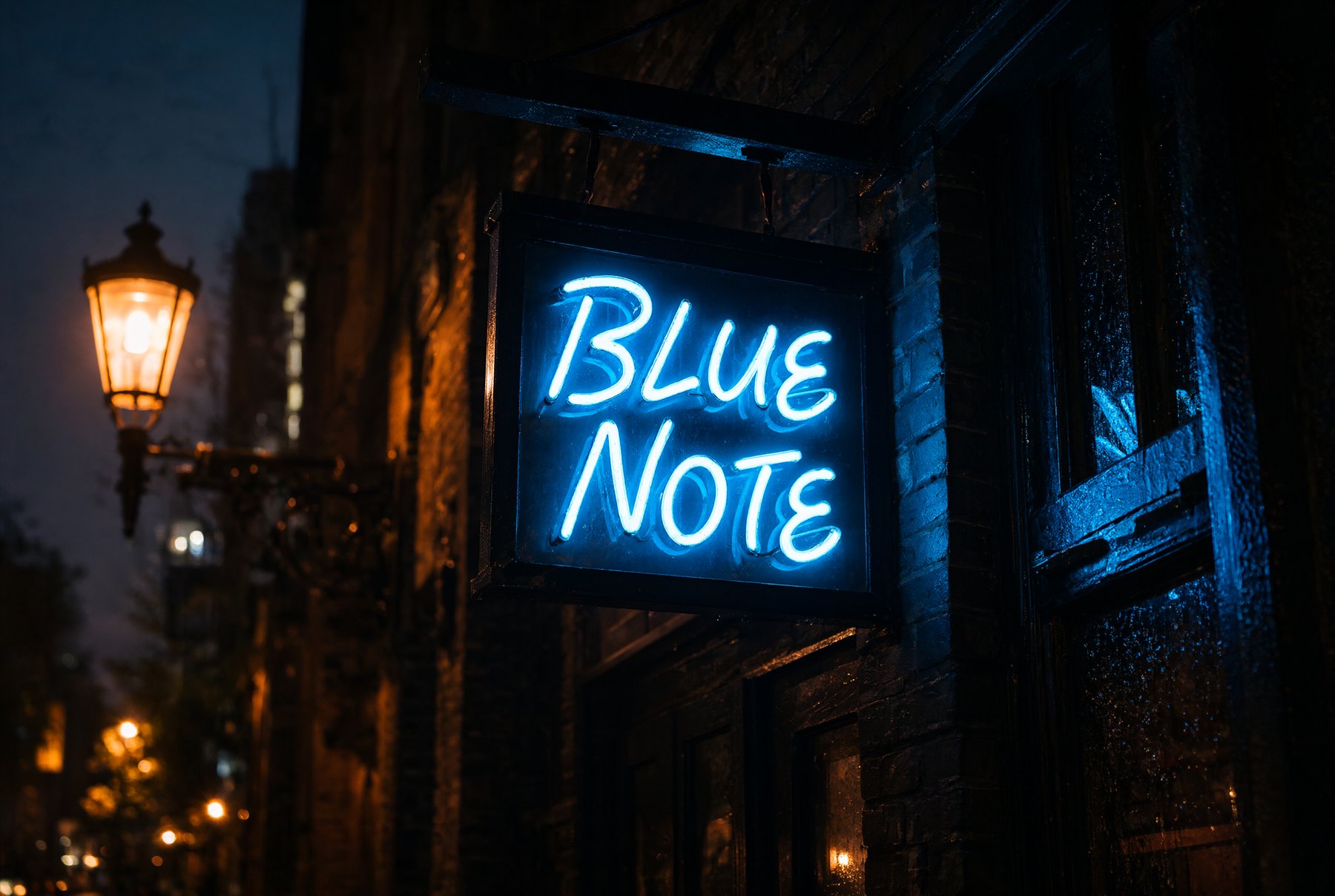
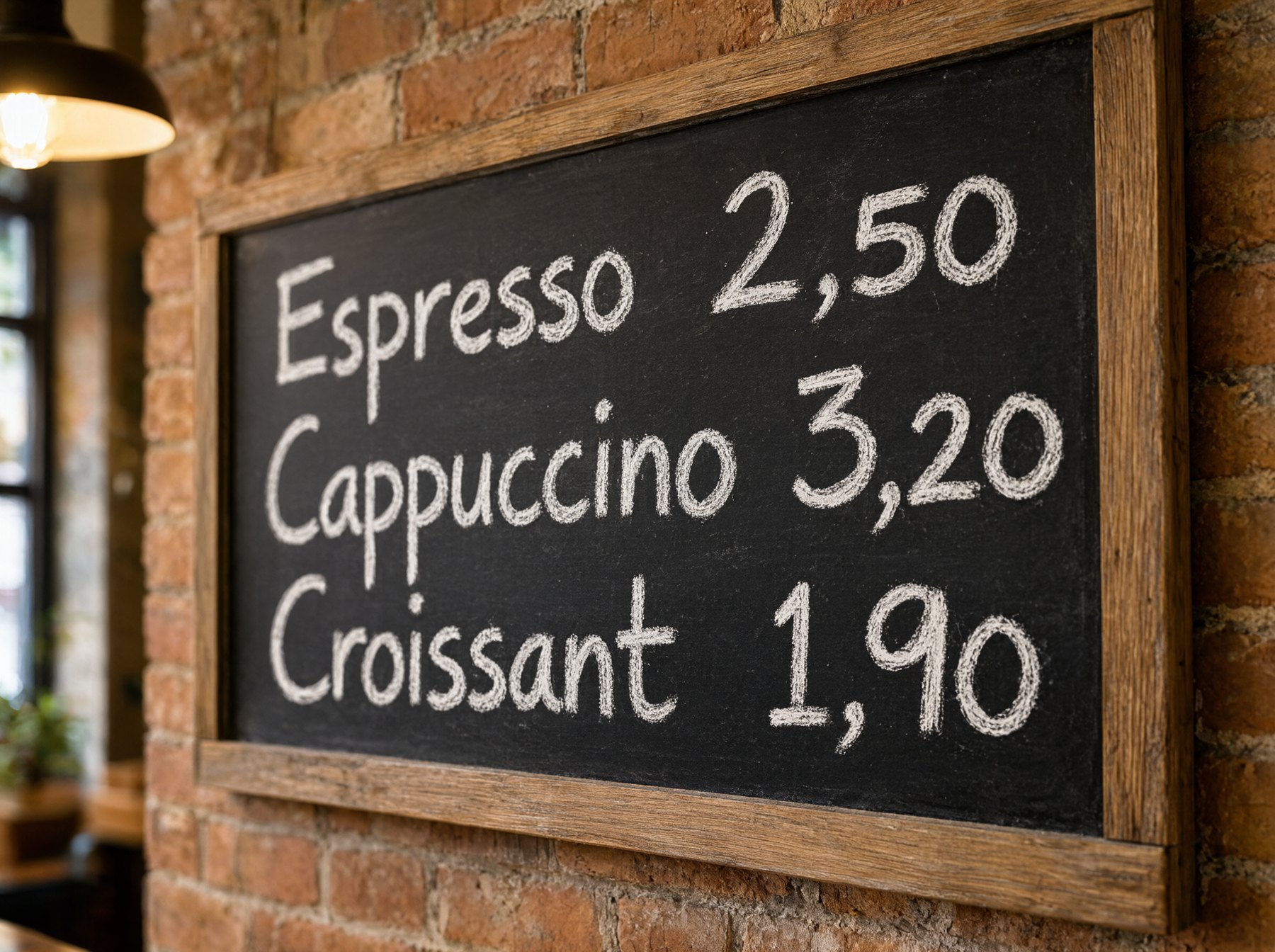
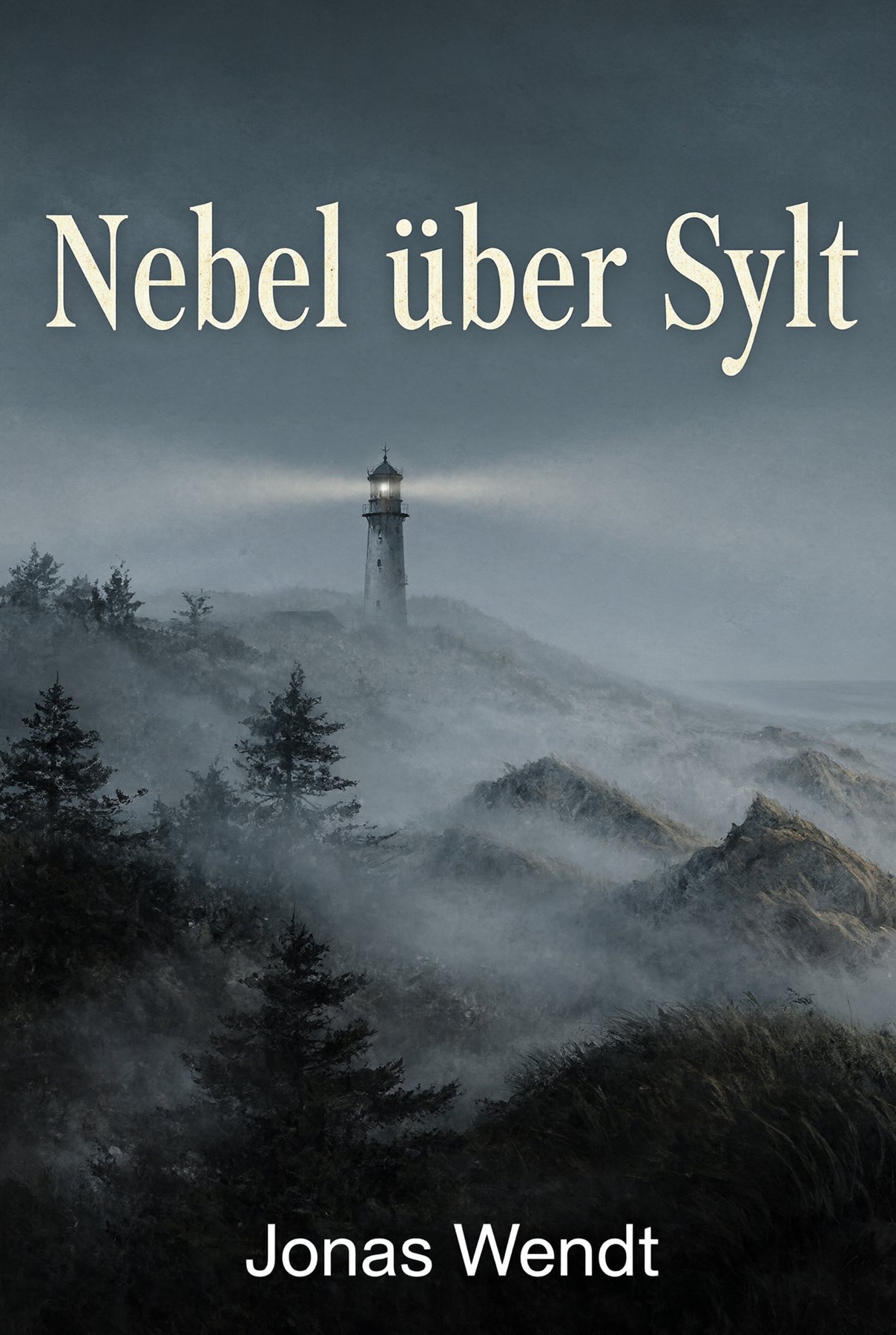
Text rendering from German requests (translated by the rewriter, quoted text kept verbatim)
Multi-reference composition (COMPOSE / EDIT with references, up to 10 condition images)
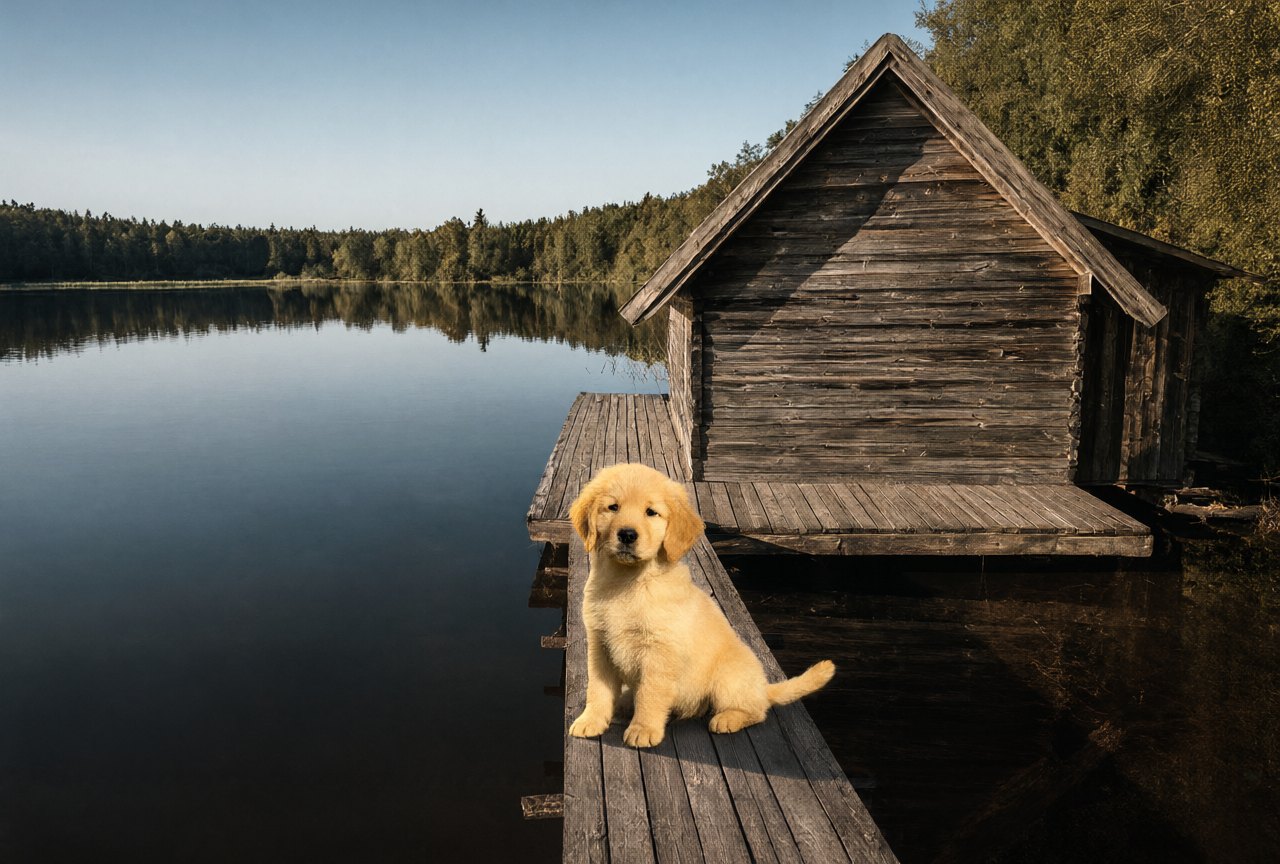
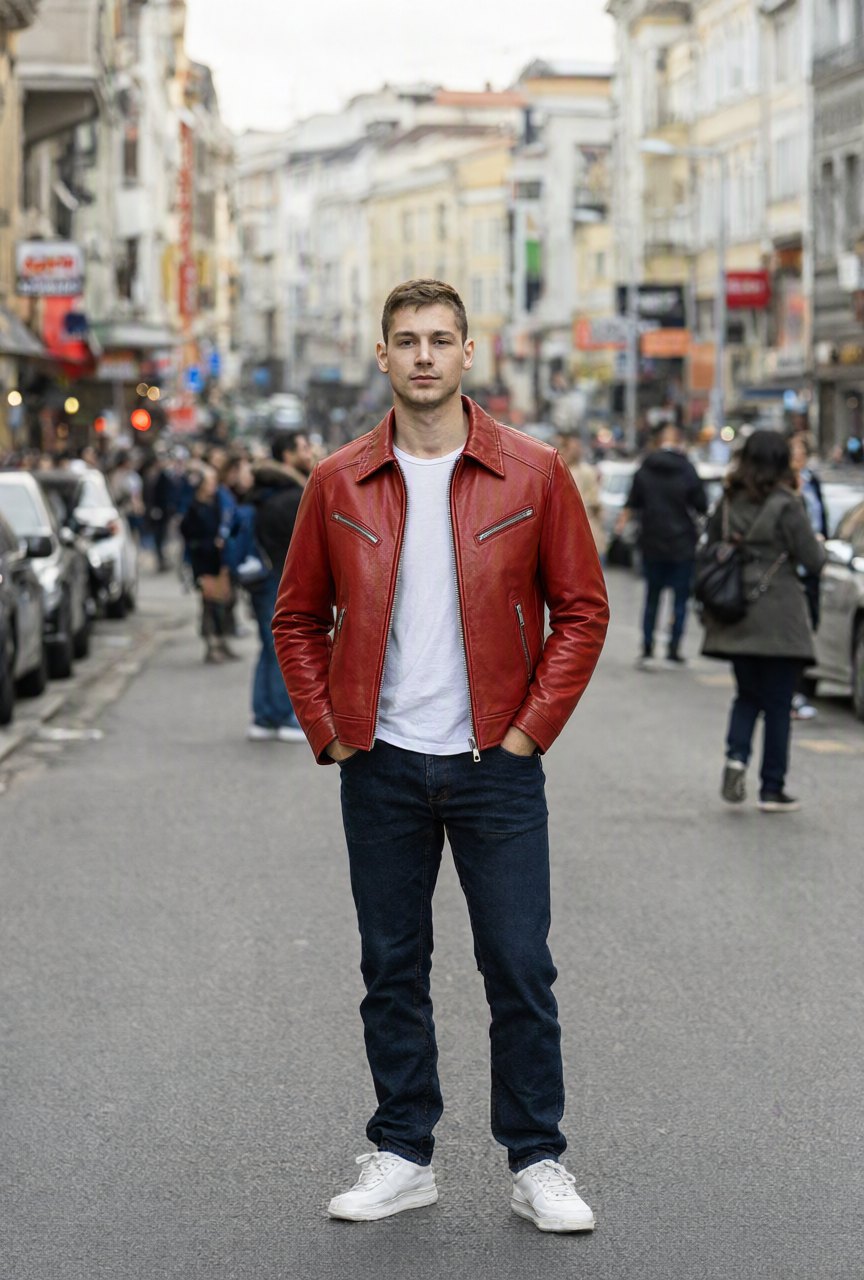
Transparent output (RGBA VAE, Ctrl+A): generated sticker and a cut-out from a photo (shown on grey)
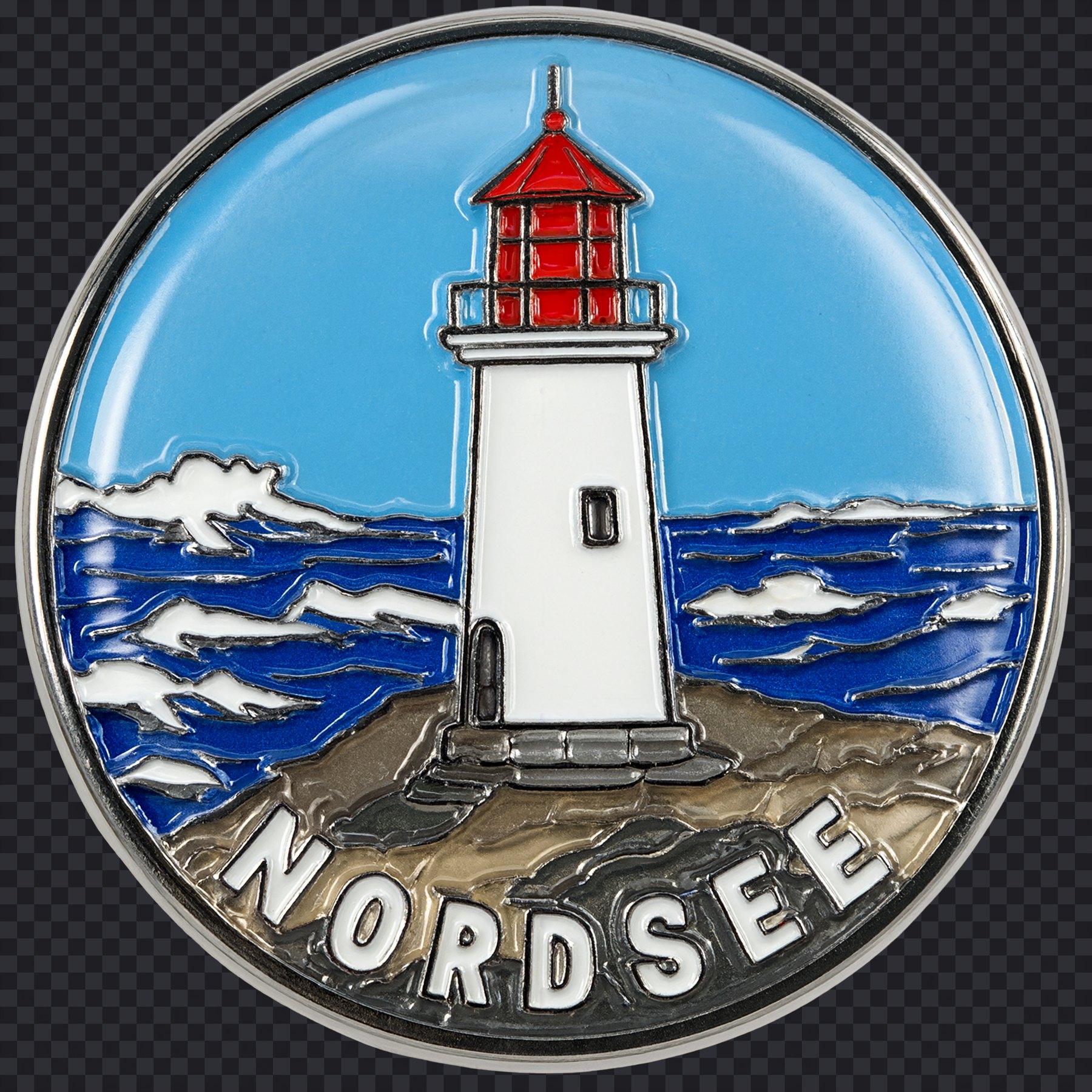
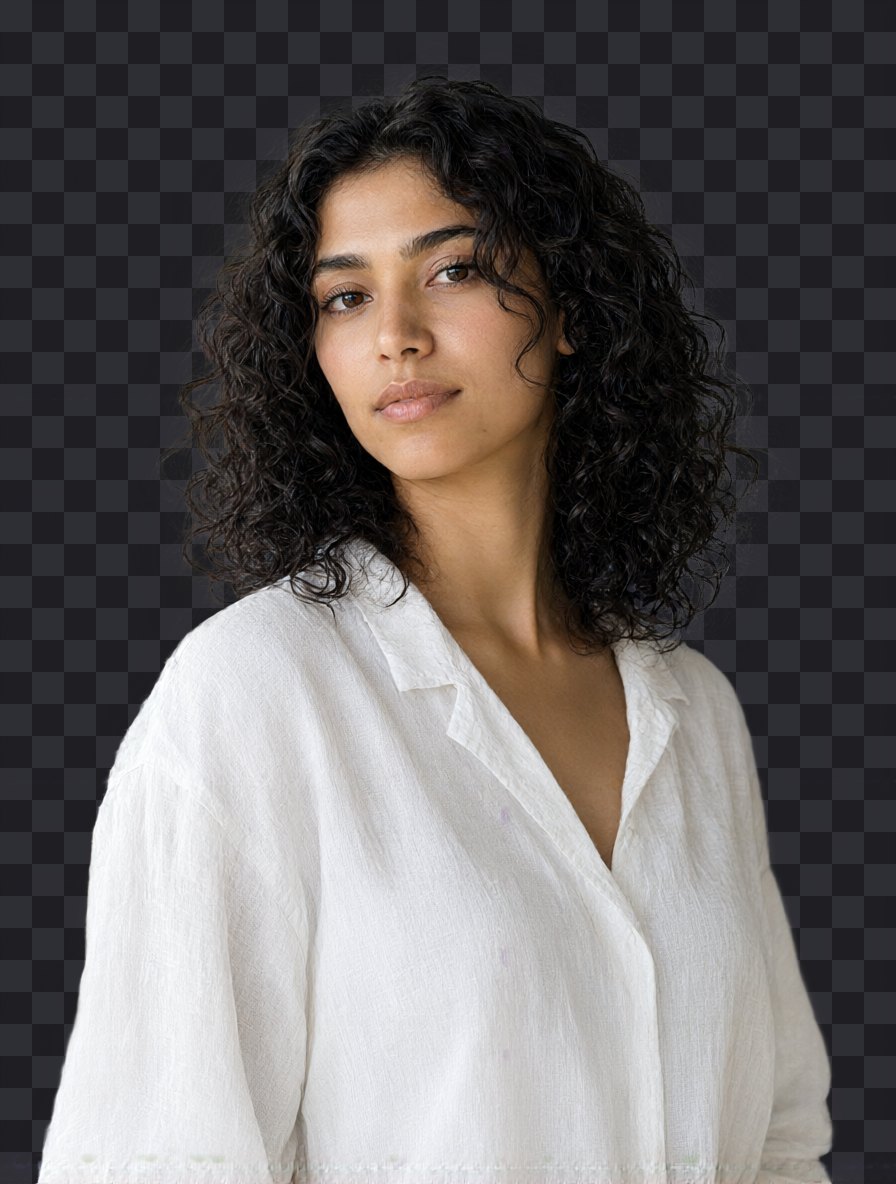
7 · Method & settings
- Servers (own test instances on GPU 1, spawned through BACKEND_SERVER's real spawn path): Qwen-Image-2.1 bf16 DiT + int8 text encoder + RGBA VAE (port 5111), Z-Image-Turbo bf16 (5112), Qwen-Image-2512 Lightning Nunchaku FP4 (5113), Qwen-Image-Edit-2511 GGUF Q4_K_M with the angles/remover/adder adapters (5114).
- Prompts: every request is rewritten once by the vision LLM through PIC STUDIO's production rewriter (the same code path as Ctrl+W); the identical rewritten text is rendered by every model. Predecessors render at their native area with the same aspect ratio. Seed 3407 everywhere, one image per prompt (no cherry-picking).
- Judge: t2i rubrics on the vision LLM
vision-38-27b-obliterated(vLLM, GPU 0, temperature 0, thinking off); images are sent as JPEG copies at ≤1280 px (pixel budget of the backend). Pairwise verdicts use one stitched A|B picture and are asked in both orders. Rubric scores are LLM claims: the author spot-checked every set visually; the checklist verdicts of the format set were confirmed against the field values by eye for both sets. - Defaults changed by this round (all in TUI/CORTEX_CONFIG.txt, read at server load or per run): VAE decode tiles 1024/768 with encode tiles 256/192 and a loud decode fallback; CFG 3.0 with the negative prompt for text-to-image, 1.0 for image-conditioned runs (PIC_STUDIO_QI21_EDIT_CFG; 3.0 halves a 1536² edit); rewriting keeps the schema fields (PIC_STUDIO_REWRITE_KEEP_FIELDS=1); default schema pairs; the negative prompt without text/logo terms; plain results saved as RGB (PIC_STUDIO_QI21_ALPHA_MIN). Verified through the real TUI in a tmux session against the test server (field prompt, rewrite on: sent prompt ends with the field pairs, sidecar marks kept_fields, 2528×1696 at cfg 3.0 in 167 s) and through the tab's edit client (1536² edit at cfg 1.0 in 49 s).
- Colour metric: share of pixels (image reduced to 256 px) within ΔE76 ≤ 12 of one of the eight brand colours of year2066.ai (#050304, #fffaf3, #ff3e3e, #ff6b6b, #8b1118, #f7c86a, #cfc0b4, #8d7a70).
Configuration in force (TUI/CORTEX_CONFIG.txt)
| Key | Value |
|---|---|
PIC_STUDIO_QI21_STEPS | 40 |
PIC_STUDIO_QI21_CFG | 3.0 |
PIC_STUDIO_QI21_SIZE | 2048 |
PIC_STUDIO_QI21_EDIT_SIZE | 1536 |
PIC_STUDIO_QI21_RGBA_EDIT_SIZE | 1024 |
PIC_STUDIO_QI21_ASPECTS | 1:1=2048x2048,4:3=2400x1792,3:4=1792x2400,3:2=2528x1696,2:3=1696x2528,16:9=2752x1536,9:16=1536x2752 |
PIC_STUDIO_QI21_ASPECT | auto |
PIC_STUDIO_REWRITE | 1 |
PIC_STUDIO_REWRITE_MIN_WORDS | 80 |
PIC_STUDIO_REWRITE_MAX_WORDS | 200 |
PIC_STUDIO_QI21_EDIT_CFG | 1.0 |
PIC_STUDIO_NEGATIVE_PROMPT | blurry, low quality, watermark, deformed, ugly |
PIC_STUDIO_REWRITE_KEEP_FIELDS | 1 |
PIC_STUDIO_QI21_VAE_TILE_PX | 1024 |
PIC_STUDIO_QI21_VAE_TILE_STRIDE_PX | 768 |
PIC_STUDIO_QI21_VAE_ENCODE_TILE_PX | 256 |
PIC_STUDIO_QI21_VAE_ENCODE_TILE_STRIDE_PX | 192 |
PIC_STUDIO_QI21_ALPHA_MIN | 128 |
PIC_STUDIO_JUDGE_MAX_SIDE | 1536 |
PIC_STUDIO_GEN_STEPS | 8 |
PIC_STUDIO_GEN_CFG | 1.0 |
PIC_STUDIO_GEN_SIZE | 1328 |
PIC_STUDIO_ZTURBO_STEPS | 9 |
PIC_STUDIO_ZTURBO_CFG | 0.0 |
PIC_STUDIO_ZTURBO_SIZE | 1024 |
PIC_STUDIO_EDIT_STEPS | 8 |
PIC_STUDIO_EDIT_CFG | (not set: PIC_STUDIO_EDIT_CFG fehlt in CORTEX_CONFIG.txt) |
PIC_STUDIO_EDIT_SIZE | 1024 |
PIC_STUDIO_EDITOR | qi21 |
PIC_STUDIO_GENERATOR | qi21 |
PIC_STUDIO_PROMPT_SCHEMA | pairs |
Generation time per backend
| Backend | images | mean | range |
|---|---|---|---|
| gguf-q4km-gpu-te-int8 | 13 | 132.4 s | 103.5–164.1 s |
| nunchaku-fp4 | 37 | 9.6 s | 9.0–15.2 s |
| qwenimage21-bf16-gpu-te-int8 | 91 | 80.5 s | 18.9–165.0 s |
| zimage-bf16 | 47 | 3.2 s | 3.1–3.9 s |
Failed items
| Key | Error |
|---|---|
| none | |